


What’s open and closed today — state offices, courts, banks, the post office — and how to check your own town and school are at the bottom.
Christopher Columbus never set foot in any of the 50 states. He sailed for Spain, explored the Caribbean and the coasts of Central and South America, and believed until he died in 1506 that he had reached Asia. The closest his expeditions came to today’s 50 states was a 1493 landing by members of his crew on St. Croix, now part of the U.S. Virgin Islands, and a visit to Puerto Rico.
Yet nearly three centuries after his first voyage, Americans began naming their country’s symbols after him. Eventually they gave him a federal holiday, which federal law still calls Columbus Day today. Vermont law calls it Indigenous Peoples’ Day.
How a Genoese sailor working for the Spanish crown became an American hero has as much to do with American history as with Columbus himself.
The man himself
Columbus made four Atlantic voyages between 1492 and 1504. They opened lasting sea routes between Europe and the Americas and changed world history. Educated Europeans already knew the Earth was round, so he didn’t prove that. Indigenous people had lived in the Americas for thousands of years, and Norse sailors reached North America around the year 1000.
His conduct drew complaints in his own lifetime:
In his 1493 letter reporting the first voyage, he described claiming inhabited islands for Spain and taking people by force.
Royal orders from 1495 show he shipped Indigenous captives to Spain to be sold as slaves.
In 1500, the Spanish crown sent an investigator who arrested him and sent him home in chains over complaints about how he governed the colony on Hispaniola. The crown later restored him to favor and paid for a fourth voyage, but never gave him back the governorship.
Slavery wasn’t unique to Columbus or to Spain. The United States itself permitted slavery until the 13th Amendment in 1865. But it was disputed even in Columbus’s day: Spain’s Queen Isabella halted the sale of the captives he sent in 1495 until church scholars could weigh in. That history helps explain the eras in which Americans chose to honor Columbus. It doesn’t change what the records show he did.
Why Americans adopted him
Columbus came to stand for different things in different eras:
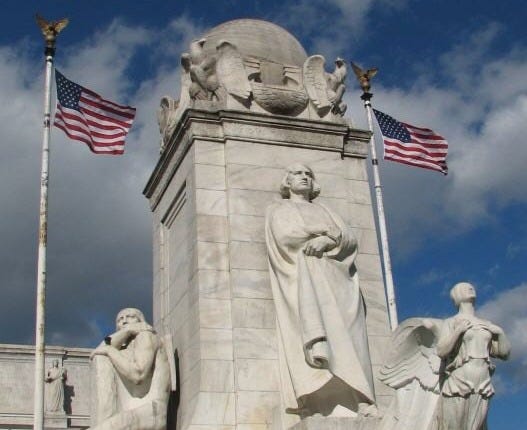
After the Revolution: A young country breaking from Britain wanted heroes who weren’t British. Columbus, who sailed for Spain, fit. The poetic name “Columbia” for America was already in use before independence, and the new nation took it up: King’s College in New York became Columbia College in 1784, and the capital became the District of Columbia. New York’s Society of St. Tammany held the first recorded American Columbus celebration in 1792, on the 300th anniversary of his landing.
The 1800s: Washington Irving’s popular 1828 biography cast Columbus as a lone visionary who overcame doubters. Historians have since shown that Irving embellished parts of the story, but his version shaped how generations of Americans pictured Columbus.
Italian immigrants: As Italian immigration grew, Columbus became a symbol of heritage and belonging for a group that faced harsh prejudice. In 1891, a New Orleans mob lynched 11 Italian immigrants. The next year, for the 400th anniversary of the voyage, President Benjamin Harrison called for a national celebration.
Making it official: Colorado made Columbus Day a state holiday in 1907, with the Knights of Columbus pushing for recognition elsewhere. In 1934, Congress asked the president to proclaim the day every year. Starting in 1971, it moved to the second Monday in October and became a paid day off for federal workers.
The reconsideration
Days honoring Native Americans predate the fight over Columbus. New York held an American Indian Day in 1916, and Illinois followed in 1919. The push to replace the October holiday came later:
1977: Indigenous delegates at a United Nations-sponsored conference in Geneva proposed marking Oct. 12 in solidarity with Indigenous peoples.
1990: South Dakota became the first state to replace Columbus Day, with Native Americans’ Day.
1992: For the 500th anniversary, Berkeley, Calif., became the first city to adopt Indigenous Peoples’ Day.
2016: Gov. Peter Shumlin proclaimed Indigenous Peoples’ Day in Vermont.
2019: Republican Gov. Phil Scott signed Act 18, making the change permanent in state law. The law’s findings note that Vermont was built on land whose original inhabitants were the Abenaki.
Most of the facts about Columbus’s conduct weren’t new discoveries. Encyclopedias in the 1800s already recorded his removal as governor. What changed was how much weight Americans gave those facts when deciding whom to honor.
What today is
Under federal law, today is Columbus Day. President Trump proclaimed it last week, without mention of Indigenous Peoples’ Day.
In Vermont, it’s Indigenous Peoples’ Day, and this year more state workers have it off. The 2019 law named the holiday, but the state’s holiday law leaves office closures and holiday pay to union contracts. Until this year, only corrections officers and state troopers had the day as a paid holiday, and most state offices stayed open. A new contract that took effect July 1 changed that, and the state’s holiday schedule now lists today as a state holiday.
For many Italian Americans, the second Monday in October honors immigrants who fought for their place in the country. For many Indigenous people, the same day marks the start of conquest and the loss of their land. Both groups attach real history to one date. Columbus’s voyages haven’t changed. What Americans want the day to say has.
What’s open and closed today
Who’s closed depends on who sets the schedule. Here’s how to check what’s open where you live.
State offices: Closed, according to the state holiday schedule. Call ahead if you need a specific office.
Vermont courts: Closed. The day is on the Judiciary’s holiday list.
Post office and federal offices: Closed. No regular mail delivery.
Banks: Many are closed; check your branch.
Stock markets: Open.
Town offices: Your town decides. Check your town website or call the clerk.
Schools: Your district sets its own calendar. Check the district website.
Private employers: Vermont law doesn’t require them to give the day off.