


ANALYSIS
On July 1, Google Client Services, Inc. of Mountain View, California gave Gov. Phil Scott $5,180. On August 25, Reynolds American Inc. of Winston-Salem, North Carolina gave him $5,180. Thirteen days before that, an individual in Putney gave Amanda Janoo $5,180.
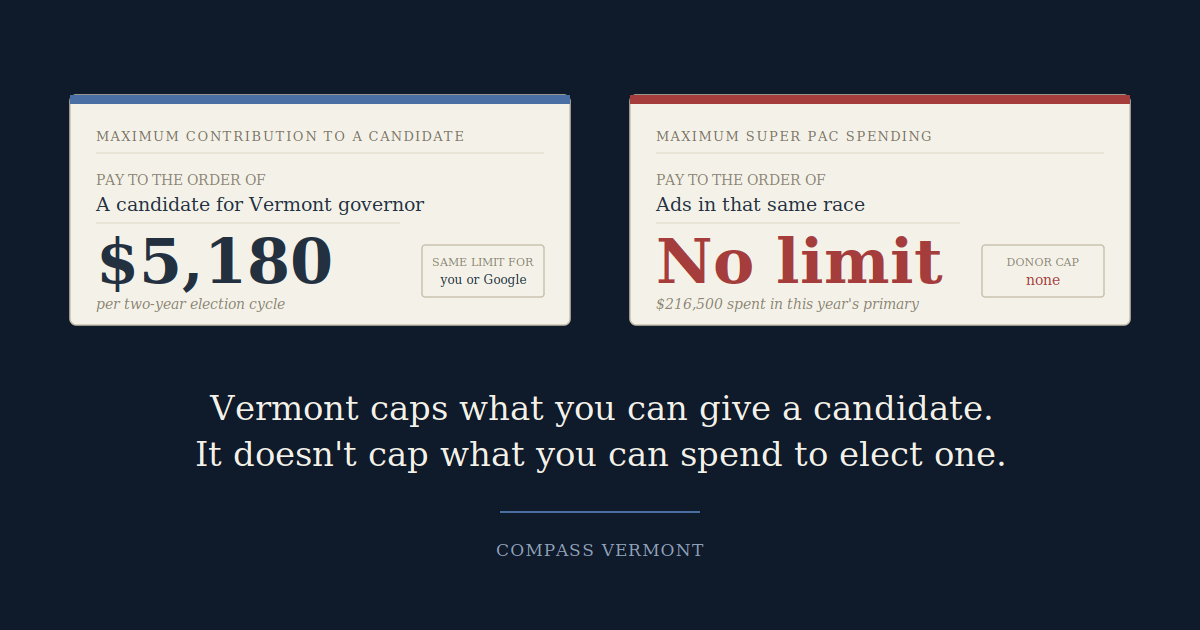
Three checks, one amount. A search company, a tobacco company and a private citizen in Windham County all hit the same wall, because Vermont law does not distinguish among them. The state caps what any single source — a person, a corporation, a union, a business — can give a candidate for governor at $5,180 for an entire two-year election cycle.
That is the money Vermont has spent this campaign arguing about. Janoo has pledged to accept nothing from corporations or businesses. Scott has said he will take money from anyone. Both positions concern a pot that state law already capped at a level low enough that nobody can buy much with it.
A single television or streaming advertising buy in Vermont costs a minimum of about $90,000, University of Vermont political science professor Alex Garlick told Vermont Public last week.
A maximum donor buys about six percent of one ad.
That $90,000 is the floor for broadcast or streaming. Most of the outside money in this year’s primary went to digital advertising and text messages instead, where a dollar reaches further and buys can be placed in far smaller increments. The comparison below uses the broadcast figure because it is the published benchmark for the Vermont market — but the point holds either way, and the numbers that matter most in this piece are the ones compared directly against each other.
What the maximum actually adds up to
Compass reviewed every campaign finance disclosure both candidates have filed this cycle — four reports each — and coded every itemized contribution.
Twenty donors have reached the $5,180 ceiling: thirteen for Janoo, seven for Scott. That is every person and every company in this race who gave everything the law permits. Together they account for roughly $103,700.
Every maximum donor in the race for governor, combined, buys a little more than one advertisement.
The scale holds when you widen it. Janoo has raised $415,030 across the cycle. Scott has raised $191,237, and began this cycle with $218,729 carried over from his last campaign — a figure his filings state directly, and the reason he ended August with $306,935 in the bank against her $59,040.
Vermont has roughly 490,000 registered voters. Everything both candidates for governor have raised, combined, comes to about $1.24 per voter.
Even the most concentrated moments look small. Janoo raised $80,281 in the single week of March 6-12, her strongest week of the campaign, and five donors at the ceiling supplied $25,900 of it — a third of that week’s money, and less than a third of one ad buy.
The cap has seams, and they don’t matter much either
Vermont limits a single source. It does not add up people who control more than one source, and both campaigns’ filings show what that produces.
Five contributions carrying the Casella name — three companies and two family members — total $3,500 to Scott.
Three entities at 217 North Main Street in Rutland gave him $1,000: BAF Inc., Donuts of Rutland and Midway Oil.
Two Brown companies and Charles Brown personally, all at one Castleton address, gave him $1,500.
On Janoo’s side the same structure appears without the companies. Six Penfields gave $18,350, four of them at one address in Sharon. Five Tippers gave $13,934, four of them in South Hero.
Whether commonly owned businesses count as separate sources is a fair question for the Secretary of State. But look at what the stacking buys. The largest family cluster in the entire race, the Penfields at $18,350, comes to about a fifth of one advertisement.
The one difference worth stating plainly: corporate and business money accounts for $37,585, or 19.7 percent, of what Scott has raised this cycle. Janoo’s filings contain none.
The money with no ceiling
Vermont statute recognizes what the Secretary of State calls an independent expenditure-only political committee — a group that operates entirely independent of candidates, gives nothing to any candidate, committee or party, and isn’t closely tied to a political party. A super PAC, in other words.
Contribution limits do not apply to it.
A donor barred from giving Phil Scott or Amanda Janoo more than $5,180 may give an independent-expenditure-only committee any amount at all, and that committee may spend all of it on advertising to elect or defeat the same candidate. It must not coordinate with the campaign, and it must disclose what it spends. That is the whole of the restriction.
One such committee has already spent more on advertising in this race than both candidates for governor combined — by a factor of about a hundred and seventy.
Time for a Change registered with the state as an independent expenditure-only PAC. Its treasurer is John Hollar, a former Montpelier mayor and former lobbyist with the firm Downs Rachlin Martin, who told VtDigger in August that the committee was created by “friends and supporters” of Democratic candidate Aly Richards and had no communication with her campaign. Richards said the group “isn’t something I asked for, had knowledge of, or can control.” Under state law, that separation is what makes the spending legal.
The committee has raised $255,025 this cycle and spent $237,655 — more than Gov. Scott has raised from every donor he has.
Six contributors supplied $255,000 of it. Only one, former National Life Group chief executive Tom MacLeay at $5,000, listed a Vermont address. About two percent of the money came from anyone in Vermont.
$100,000 — Family Security and Prosperity, a Missouri-based organization
$75,000 — Impact Fellows Action Fund, a Kansas nonprofit
$25,000 — Carl Ferenbach, co-founder of the Boston private equity firm Berkshire Partners
$25,000 — Government That Works PAC, a federally registered hybrid PAC
$25,000 — the Global Impact Social Welfare Fund, at a Washington, D.C. address
$5,000 — Tom MacLeay, Montpelier
The five contributors through August 1 appear on the committee’s own disclosure, which VtDigger reported in detail at the time and which identified Ferenbach and MacLeay as figures in the childcare advocacy world Richards came from. The sixth arrived in the filing covering August.
That top figure is worth holding next to the cap. One organization gave $100,000 to influence this race. The most it could have given a candidate is $5,180 — about one-nineteenth as much.
And in at least one case the record simply stops. The Global Impact Social Welfare Fund is a 501(c)(4) — a tax-exempt social welfare organization, a category that is not required to disclose its donors. It describes itself as funding education and advocacy on public policy questions including climate and the environment, justice reform, global health, voter rights, economic development, and racial and gender equality. Whose money it moved into Vermont’s primary for governor on August 6 is not in any public record. It can be traced to a name and a street address and no further.
The spending came in a rush. In the two days before the July 30 filing cutoff, Time for a Change bought $216,500 of mass media — $171,500 through LiftOff Campaigns LLC and $50,000 through Middle Seat, both Washington, D.C. firms — for digital advertisements and text messages in the last two weeks of the primary.
Over the run-up to the same primary, Amanda Janoo’s campaign reported two mass media buys totaling $1,276.40 — $665 with Meta and $611.40 through a California vendor. Phil Scott’s campaign reported none at all.
One committee, accountable to no candidate, outspent both campaigns on advertising by roughly 170 to one.
(Janoo’s filings are not fully consistent on this point. Her campaign filed a 24-hour report for a $665 Meta buy dated July 30, and the expenditure appears on her September 1 disclosure — but the summary line on that same disclosure reports $0 in mass media activity for the period. The figure used here counts the buy.)
Janoo said so herself at the time, calling the super PAC rules a loophole emblematic of “the sad state of politics.” She told VtDigger the system is “designed by rich people” and gives “a huge benefit for those who have connections.”
Vermonters have seen the larger version. In the closing month of the 2022 Democratic primary for Vermont’s U.S. House seat, a super PAC run by the LGBTQ Victory Fund spent close to $1 million supporting Becca Balint over Molly Gray. Nearly all of it came from Nishad Singh, head of engineering at the collapsed crypto exchange FTX, who had given the group $1.1 million. Voters did not learn where the money came from until after they had voted. Compass examined that spending in “Not Grounded in Vermont?” last year.
The most Singh could give her directly was $2,900. The most he could spend to elect her was unlimited. That was a federal race, where the direct-contribution limits differ from Vermont’s — but the mechanism is identical, and Vermont’s own law provides for it.
One caution against reading too much into any of it: the $216,500 did not work. Janoo won the primary. Uncapped money buys volume, not outcomes. But it is the only money in this race with the scale to try.
What happens next, and how to watch it
Beginning September 19 — 45 days before the November 3 election — anyone who spends $650 or more on a single mass media activity must report it to the Secretary of State, and to the candidate named in it, within 24 hours. State law defines a mass media activity as a television or radio commercial, a mass mailing, a mass electronic or digital communication, a literature drop, a newspaper or periodical advertisement, a robocall or a phone bank that includes the name or likeness of a clearly identified candidate.
The same rule applied in the 45 days before the August primary, which is why the summer’s spending is already on the record. The general election filings start over on September 19, and they are the early-warning system for the money nobody capped.
You can watch it arrive yourself. Go to campaignfinance.vermont.gov and click “Search Filed Reports.” You can pull any candidate’s or committee’s disclosures, see every donor who gave more than $100 by name and town, and download the mass media reports as they land. No account is required and nothing sits behind a login.
Two things you won’t find there. Donors who give $100 or less appear only as a lump sum and a headcount — about 21.6 percent of Janoo’s money and 11.2 percent of Scott’s is unnamed by design. And Vermont’s forms ask a donor’s name, town and address, but not employer or occupation, so nothing in the record connects an individual donor to a company he owns.
The argument nobody is having
Vermont’s contribution limit does what it was built to do. Nobody purchases a governor for $5,180, and the twenty people and companies who gave the legal maximum in this race could not, between all of them, pay for two advertisements.
The money with the scale to move a Vermont election doesn’t pass through either campaign’s account. It arrives late, in amounts no law restricts, from a handful of out-of-state sources that in at least one case cannot be traced past a Washington mailing address — and the candidate it benefits is forbidden from touching it or turning it away.
The question worth asking this fall isn’t which campaign took a corporate check. It’s why $5,180 given to a candidate is the thing Vermont regulates, and $100,000 given to influence the same race is the thing it doesn’t.
Compass reviewed the complete 2026 filings of both gubernatorial campaigns — Janoo’s four reports totaling $415,030.09 and Scott’s four totaling $191,237.24 — and coded each itemized contribution by donor, geography and type.
........"The question worth asking this fall is why $5,180 given to a candidate is the thing Vermont regulates, and $100,000 given to influence the same race is the thing it doesn’t."........Dam good question! It's influence and control that is wanted. [bought] Should be Outlawed......