


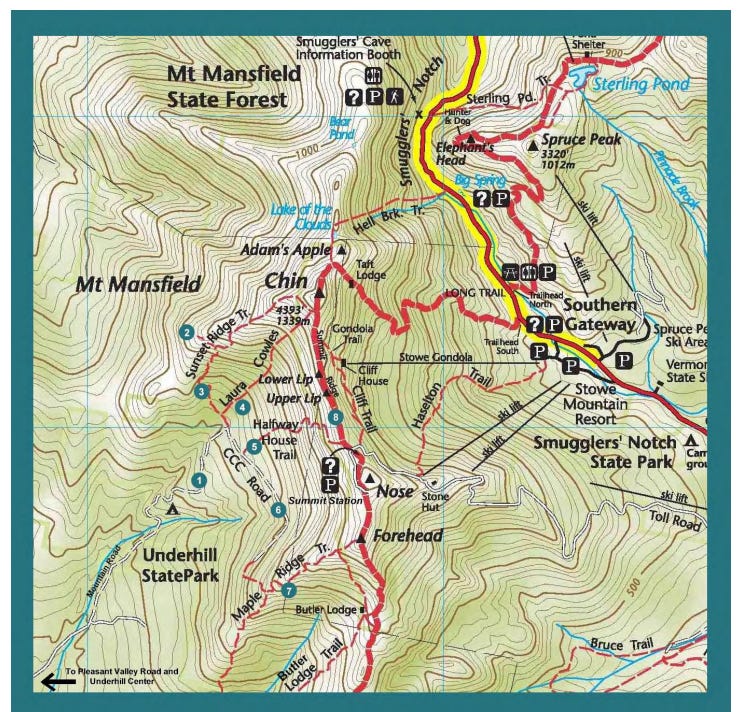
Start with the scale of it.
Between 2016 and 2021, two men cut 327 trees to the ground in Mount Mansfield State Forest. They drilled holes into bedrock to anchor bridges. They sank at least 22 threaded steel rods into rock. And they built two mountain-bike loops totaling roughly 8,000 feet — close to a mile and a half of trail — winding through public land off Nebraska Valley Road in Stowe.
None of it was authorized. All of it took five years. And for those five years, the State of Vermont — which owns the land — did not notice.
This week the Attorney General’s Office announced it had settled the case. Cyril Brunner and Aaron Rice agreed to pay $35,000 in timber-trespass damages and to finish removing what remains of the trail. They neither admitted nor denied liability. A Lamoille County judge signed the order June 29.
That is the story most outlets will tell: an illegal trail, a fine, case closed. Some will ask whether the two men are vandals or folk heroes. That is the easy question, and it is the wrong one.
The harder question is the one in the headline. How does a construction project this large, this permanent, and this loud — chainsaws, drills, five building seasons — happen in the middle of a state forest without the state finding out? The answer is not a secret. It is sitting in the state’s own court filing.
The state explains how it missed it
Buried in the pleadings is a detail the state put in writing: the builders posted “No Strava” signage on the trail.
Strava is the GPS app that riders and runners use to log their workouts. Its global heatmap aggregates all that activity into a public map, where well-traveled routes glow. Ask riders not to record a trail, and it never lights up — which keeps it off the map, and keeps it hidden from anyone looking.
The state was not coy about what that meant. In its filing, it acknowledged that the absence of heatmap trail lines “made it more difficult for FPR to identify the trail.”
Read that sentence again, because it is the whole story. Vermont’s ability to detect unauthorized chainsaw-and-drill work on its own forest depended, in meaningful part, on whether that work happened to surface on a crowdsourced fitness app. The builders understood exactly how the state finds trails — and defeated it with a laminated sign.
This is not the first time
If that sounds like a fluke, it is not.
In 2023, the state settled a strikingly similar case at Hazen’s Notch State Park, where a landowner had cut 839 trees to carve out backcountry ski glades. How did the state find out? A forester received a report of chainsaw noise and passed it to a game warden, who paid the property a visit. The cutting was discovered not through any patrol or monitoring system, but because someone heard a chainsaw and made a call.
Two of the largest public-land tree-cutting cases Vermont has brought in recent years were detected the same way: by accident, after the fact, when the public happened to notice. The state’s enforcement, in practice, runs on tips.
Who is watching 360,000 acres?
There is a reason for that, and it is not a mystery either.
The Department of Forests, Parks and Recreation manages more than 360,000 acres of state forest, park, and wildlife land. Its year-round staff numbers around 35 people, climbing to roughly 450 in summer — most of them seasonal workers running campgrounds and front-country park operations. FPR fields no forest-ranger or enforcement corps of its own. The sworn officers who could investigate a case like this belong to Fish & Wildlife’s game wardens, and ultimately to the Attorney General.
Neighboring states are built differently. Both New Hampshire and Maine staff dedicated forest rangers who work timber cases as part of the job. Vermont does not. When there is no one whose job is to walk the woods looking for this, the woods do not get walked.
The fine measures the wrong thing
There is a second lesson in the settlement, and it is about the tools the state has, not just the eyes.
Vermont’s civil timber-trespass law, 13 V.S.A. § 3606, lets the state recover up to three times the value of the timber that was cut, plus damage to the land. It is a statute built to count and price trees. And 325 of the 327 trees here measured less than six inches across — saplings, essentially, worth very little under the law by design.
So compare the two cases. At Hazen’s Notch, 839 trees brought a $75,000 settlement — about $89 a tree. On Mount Mansfield, 327 trees brought $35,000 — about $107 a tree. The numbers are roughly proportional, because both are, at bottom, arithmetic on a tree count.
But look at what that arithmetic cannot see. The Hazen’s Notch cutter felled more than twice as many trees. Brunner and Rice cut fewer — and drilled permanent holes into bedrock, sank steel into rock, built bridges, ran a trail for five years, and engineered its concealment. By almost any measure of lasting damage or intent, the Mansfield project did more. It cost less. The statute has no line for a trail. It only knows how to count trees.
What the record leaves open
The settlement does two things worth watching. It designates these violations as “prior violations” that will follow the two men into any future state permit proceeding — the state’s real long-term leverage, worth more than the dollars. And it releases them from further criminal liability, provided they comply — which tells us a criminal case was, at least, in the conversation.
The public record does not say how the state finally discovered the trail, or why five years passed between the last cutting and this settlement, or why the case stayed civil. Those are questions for the agencies to answer, and we have asked. When they do, we will report what we learn.
But the core of it is already on the record, in the state’s own words. A mile and a half of trail was built in a Vermont state forest, and the state did not know until someone told it. The fine was calculated on the wood. The trail — the drilled rock, the years, the deliberate hiding — went essentially unpriced.
We bring the data. You form the opinions. The data points less at two men on a mountain than at how little of that mountain anyone was actually watching.