


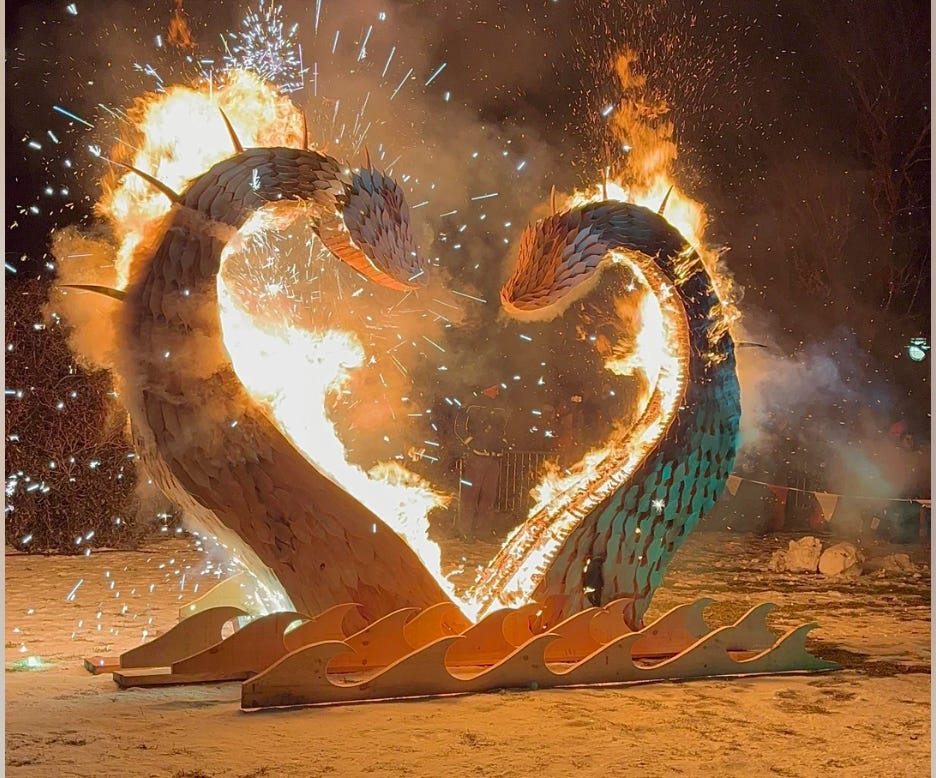
Every New Year’s Eve, thousands of Vermonters brave sub-zero temperatures and Montreal Express winds to gather at Burlington’s Waterfront Park. They’re not there for a traditional ball drop or champagne toast. They’re there to watch a massive wooden monster burn.
The annual Champ Burn has become the centerpiece of Burlington’s New Year’s Eve celebrations, a uniquely Vermont tradition that combines local folklore, artistic ambition, and community ritual. On December 31, 2025, as the city welcomed 2026, the event featured something unprecedented: a two-headed Champ sculpture designed to symbolize national division and the power of unity.
From First Night to Highlight
To understand the Champ Burn, you need to understand what came before it.
For 35 years, Burlington’s New Year’s Eve belonged to First Night, a family-friendly, alcohol-free arts celebration that drew up to 8,000 people annually. The event launched in 1983, part of a national movement that began in Boston in 1976 as an alternative to traditional booze-fueled New Year’s parties.
First Night operated on a “button” system—attendees purchased wearable admission tickets that granted access to dozens of indoor venues throughout downtown Burlington, featuring 10 hours of music, dance, and theater performances.
But by the mid-2010s, the model was failing. Rising production costs, declining attendance, and the loss of key corporate sponsors led the First Night Burlington board to dissolve the organization in 2018, leaving a cultural vacuum in the city.
Burlington City Arts Steps In
Rather than let New Year’s Eve go dark, Burlington City Arts (BCA) launched a new concept: Highlight.
The new festival differed fundamentally from First Night’s top-down curation model. Highlight introduced the “Bright Ideas Project,” an open call inviting Vermont artists and creators to propose one-of-a-kind New Year’s Eve events. BCA provides funding and production support to selected proposals, shifting financial risk from artists to the festival and enabling ambitious projects that wouldn’t be commercially viable.
The name change also carried symbolic weight. “First Night” had become associated with a fading model and trademark disputes within the broader First Night movement. “Highlight” suggested a celebration of Vermont’s creative peaks while avoiding the chronological confusion of calling the last night of the year the “first” night.
Highlight also modernized the festival’s approach. While maintaining family-friendly zones and free admission for children five and under, the new model permits alcohol in designated areas, with sponsors including Foam Brewers and Tito’s Handmade Vodka alongside traditional supporters like the WaterWheel Foundation and Pomerleau Family Foundation.
Enter the Monster
The star of the show—literally the burning centerpiece—is Champ, the Lake Champlain monster.
Champ is Vermont’s answer to the Loch Ness Monster, a cryptid reportedly inhabiting the cold, deep waters of Lake Champlain. Indigenous Abenaki and Iroquois legends spoke of a great horned serpent in the lake. While Samuel de Champlain is often cited as the first European to spot the creature in 1609, historians believe he likely saw a garfish or sturgeon.
The modern legend was cemented by Sandra Mansi’s 1977 photograph, which appeared to show a plesiosaur-like neck and head rising from the water. That iconic image—the arched neck, the small head—has become the template for Champ’s appearance in popular culture.
Over decades, Champ evolved from a figure of mystery into a beloved community mascot. He’s the namesake of Vermont’s Minor League Baseball team (the Vermont Lake Monsters) and a fixture in tourism marketing, representing the quirky distinctiveness Vermonters prize.
The Artist Behind the Burn
Chris Cleary didn’t invent the concept of burning sculptures, but he made it a Vermont tradition.
The Jericho Center-based sculptor’s professional portfolio includes permanent stonework—pet memorials, headstones, and installations like the word garden at Saint Michael’s College. But he’s best known for ephemeral art designed to be destroyed.
Before the Champ Burn became a public spectacle, Cleary hosted burns in his own backyard, creating 20-foot-tall sculptures of Old Man Winter, woolly mammoths, and leprechauns. These private events drew hundreds of neighbors and established the template for the Burlington tradition.
Cleary describes his work as “sculpture meets performing arts.” His portfolio, he notes, is “basically a pile of ashes and screws”—a philosophy that values the creative process and communal experience over preservation or commodification.
Engineering a Monster
Building the Champ effigy is no simple bonfire. The sculpture must be structurally sound enough to withstand waterfront winds, aesthetically detailed for close-up viewing, and engineered to burn dramatically within a 45-minute window.
Cleary constructs a skeleton from wooden discs—which he calls “oversized toilet seats”—creating the serpent’s undulating shape. The exterior is clad in over 1,000 cedar shingles. Cedar is ideal: lightweight, rot-resistant, and burns with high heat and pleasant aroma.
Despite the sculpture’s imminent destruction, Cleary uses premium hardwoods for details. Spikes, fins, and facial features are crafted from walnut, mahogany, and tiger maple. He’s even incorporated wood salvaged from his 1850s farmhouse renovation, literally embedding his home into the public art.
But the real engineering lies in what you can’t see. Cleary builds hidden chambers into the sculpture’s neck and belly, loaded with fireworks and accelerants. The goal is to make the monster appear to breathe fire or explode from within, rather than simply burning from the outside in.
Two Heads, One Message
The 2025 effigy marked a significant departure from tradition. Instead of the single-headed plesiosaur typical of previous years, Cleary constructed a two-headed Champ.
In an interview on the waterfront, Cleary explained his reasoning: “Usually I do the whole body, this time I did the two heads because I felt like we have kind of a divided nation right now and I wanted to make kind of a statement of love, unity, and community.”
The design sparked minor debate among cryptozoology enthusiasts on Reddit, with some noting it “goes against Champ canon.” But the consensus was permissive: fire is cool, and both heads were full of sparklers and other pyrotechnics. The spectacle value overrode mythological accuracy.
Cleary’s two-headed Champ, reminiscent of the Roman god Janus who looked both backward and forward, transformed the burn into a symbolic act. The separate heads looking in different directions yet sharing one body represented polarized perspectives united at the core. As Cleary put it, “coming together and showing love is what makes the world go round.”
The Night Unfolds
The Champ Burn follows a carefully choreographed timeline, dictated by festival logistics and fire physics.
The sculpture is installed at Waterfront Park early in the day, allowing festival-goers to walk up to it, touch the wood, and take photos throughout the afternoon. This interaction builds emotional connection to the object about to be destroyed.
The surrounding Waterfront Fest creates a festive atmosphere with food trucks like Loaded Totz and Woodbelly Pizza, a DJ in the “Fluffy Bus,” s’mores roasting, and performances by bands including Sonido Mal Maiz and Dwight & Nicole.
At 8:00 PM, NorthStar Fireworks launches a display over Lake Champlain, drawing the crowd’s attention skyward. The fireworks serve as a call to order, silencing conversations and focusing collective attention.
As the last aerial shell fades, Cirque de Fuego—a Vermont fire performance troupe co-founded by Kim Cleary, Chris’s wife—enters the circle. Dressed in fire-retardant gear, they spin fire poi and staffs, creating a sensory primer for the main event.
Then, at 8:15 PM, the sculpture is lit.
The cedar shingles catch fire rapidly. Within minutes, flames reach the hidden chambers. Pyrotechnics trigger—fountains of sparks shoot from the necks, colored flames appear. The thermal output is immense, forcing front-row spectators to step back while those behind push forward, creating a dynamic wave in the crowd.
The climax comes when the wooden frame fails and the heads topple, sending a final plume of sparks into the night air. By 9:00 PM, the monster is reduced to glowing embers.
The Barr Brothers take the stage immediately after, shifting the mood from primal fire energy to communal celebration. The crowd then disperses into the city for late-night events like Daytime Disco at Foam Brewers or the Candy Coated Dreams immersive experience at ECHO Center.
Community and Critique
The event isn’t without logistical challenges. Winter conditions at the exposed waterfront can be treacherous. In previous years, icy conditions have caused attendees to fall before reaching the venue, with some watching fireworks from their windows instead.
Yet the harsh conditions are part of the point. The fire isn’t merely symbolic—it’s a functional necessity, a thermal magnet drawing thousands of bodies into a tight mass. The shared physical experience of enduring the cold together reinforces the unity the sculpture symbolizes.
Tickets for the 2025 event were $18 in advance and $20 day-of, with free admission for children five and under. The hybrid model allows the waterfront events to be viewable from public spaces while the button system supports the festival’s operations and funds the Bright Ideas grants.
What Happens Next
The Champ Burn appears firmly established as Burlington’s defining New Year’s Eve ritual. The transition from First Night to Highlight has been successfully navigated, with the burn serving as the anchor event that legitimizes the new festival.
The tradition’s flexibility was demonstrated by the 2025 two-headed design, showing it can absorb contemporary social commentary without losing its folkloric appeal. As long as Burlington City Arts continues funding the Bright Ideas Project and Lake Champlain’s winds don’t blow out the match, the Champ Burn will likely remain the centerpiece of Vermont’s winter celebrations.
For Chris Cleary, the cycle continues. Each year brings a new design challenge, a new monster to build and burn. His backyard tradition in Jericho has evolved into a civic ritual witnessed by thousands, a testament to how one artist’s vision can become a community’s tradition.
The next Champ Burn is scheduled for December 31, 2026. The design remains a secret until installation, but one thing is certain: on New Year’s Eve, Vermonters will once again gather at the frozen waterfront, seeking warmth in the flames and finding unity in the spectacle of watching their beloved monster burn.
Were they listening the Arthur Brown's song too? :)