

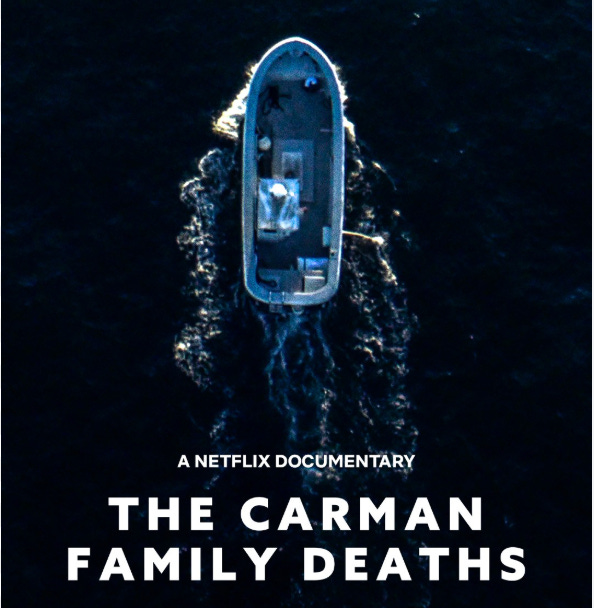
When Netflix released The Carman Family Deaths on November 19, 2025, viewers around the world encountered a story about a Connecticut family fortune, a sinking boat, and a young man accused of killing both his grandfather and his mother for inheritance money. Directed by Yon Motskin and produced by Rachel Grady and Heidi Ewing (the team behind Jesus Camp), the three-part series has drawn millions of viewers into a case that prosecutors described as an elaborate, years-long murder-for-money scheme.
For most viewers, this is a true-crime puzzle set against the backdrop of New England wealth and Atlantic waters. But for Vermonters, particularly those in Windham County and those who follow the state’s federal court system, the story has a different weight.
Nathan Carman lived in Vernon for nearly eight years. The federal indictment was filed in Vermont. The trial was scheduled to take place in Burlington. And when federal agents finally arrested him in May 2022, they did so at a property on Fort Bridgman Road—a quiet dirt road in one of the state’s smallest and most rural towns.
This article examines what the documentary captures accurately, what it glosses over or omits, and why Vermont’s role in this case matters.
What the Documentary Gets Right
The Scale of the Fortune
The documentary accurately establishes the financial stakes at the center of the case. John Chakalos, Nathan’s grandfather, was a self-made real estate developer from Windsor, Connecticut, who built an estate worth approximately $42 million through nursing home and commercial property development. The film uses family interviews and home video to depict Chakalos as a doting patriarch who held his family close—and who provided his grandson Nathan with an apartment, a car, and what relatives estimate was an annual allowance exceeding $100,000.
The Forensic Evidence
The documentary presents the ballistics evidence and boat modifications that formed the core of the prosecution’s case. According to the federal indictment, in November 2013, Nathan purchased a Sig Sauer .308 rifle from a gun shop in Hooksett, New Hampshire. One month later, John Chakalos was found shot three times with .308 ammunition. The rifle was never recovered.
The film also features naval experts who detail the modifications Nathan made to the Chicken Pox, his 31-foot aluminum boat. He had removed the trim tabs from the hull and filled the holes with epoxy putty—a temporary fix that investigators alleged was designed to fail. The documentary conveys the prosecution’s theory: that Nathan deliberately sabotaged the vessel before taking his mother more than 100 miles offshore.
The Autism Defense Debate
One area where the documentary provides substantial coverage is the debate over Nathan’s autism diagnosis. Nathan was diagnosed with Asperger’s syndrome at age four. The defense team, including autism specialist attorney Elizabeth Kelley and advocate John Elder Robison, argued that Nathan’s flat affect, literal speech patterns, and seemingly callous statements—such as telling his mother to “reel in the fishing lines” while the boat was sinking—were characteristic of autism, not evidence of sociopathy.
The film gives voice to both sides: the defense’s contention that neurotypical investigators misread Nathan’s behavior, and the prosecution’s argument that the alleged crimes required a level of planning and executive function that contradicted the “confused innocent” narrative.
The Visual Atmosphere
The documentary uses drone footage and location shooting to capture the isolation that defined Nathan Carman’s life. The shots of the Vermont winter, the empty roads of Vernon, and the cold expanse of the Atlantic effectively convey the solitary and unsettling atmosphere of the case.
What the Documentary Leaves Out or Glosses Over
The Mistress Detail
While the documentary touches on potential motives for John Chakalos’s murder, it does not fully explore one detail that investigators examined: the 87-year-old’s alleged relationship with a 25-year-old woman.
Court records and investigative reports indicate that Nathan had developed strong religious convictions and was reportedly disturbed by this relationship. The documentary describes an incident in which Nathan stood at a church altar for five hours, reportedly praying for forgiveness—possibly related to the “sins” of his family. This “puritanical motive” offers a potentially significant alternative to the purely financial narrative, but the documentary does not explore it in depth.
The State of the Vernon House
The documentary shows the Fort Bridgman Road property using aerial footage, but it does not fully convey what neighbors and investigators described. Media reports indicate the house was “unfinished” and “gutted”. Nathan had reportedly removed walls, dug out the basement by hand, and lived without adequate heating for years.
These details paint a picture of severe mental decline and isolation that preceded the arrest by years. While the documentary references Nathan’s mental health history, the physical state of the house—and what it suggested about his deteriorating condition—receives limited attention.
The Impact on Vernon
The documentary focuses primarily on the Carman and Chakalos families, the federal investigators, and the legal proceedings. What it does not capture is the impact on Vernon itself—a town of fewer than 3,000 residents in the southeastern corner of Vermont.
For nearly eight years, Nathan Carman lived among Vernon residents. Neighbors described him as polite but distant. He drove his truck, bought supplies, and kept to himself. When federal agents, Coast Guard investigators, and local police descended on Fort Bridgman Road in May 2022, the quiet town became the focus of national media attention. The documentary treats Vernon largely as backdrop; for residents, the experience was more immediate.
Why Vermont Matters to This Story
Vermont Was His Refuge
After the 2013 death of John Chakalos—which Connecticut authorities investigated but never charged—Nathan Carman left the state where he had grown up and where suspicion followed him. In 2014, he purchased a property in Vernon for approximately $70,000.
Vernon offered what Nathan apparently sought: isolation and anonymity. The town has no zoning laws—a detail that real estate listings later described as offering “endless possibilities.” In Vernon, Nathan was not the prime suspect in a murder investigation. He was an out-of-stater fixing up a house.
For nearly eight years, Vermont was the place where Nathan Carman avoided scrutiny from his aunts, from Connecticut investigators, and from anyone who might have connected him to the violence prosecutors later alleged.
Vermont Brought the Federal Case
The legal strategy that ultimately led to Nathan’s arrest was crafted by the U.S. Attorney’s Office for the District of Vermont. Because the grandfather’s murder was a state crime in Connecticut—and Connecticut prosecutors had declined to file charges—federal authorities pursued a different approach.
The killing of Linda Carman occurred on the “high seas,” beyond state jurisdiction, making it a federal crime under 18 U.S.C. § 1111. Vermont prosecutors, led by U.S. Attorney Nikolas Kerest, built a case that combined the murder charge with wire fraud and mail fraud counts, alleging that both deaths were part of a scheme to obtain the Chakalos inheritance.
The eight-count indictment was unsealed in May 2022. Federal agents executed the arrest at the Fort Bridgman Road property. It was Vermont’s federal court system that would have tried the case.
Burlington Was to Host the Trial
The trial was scheduled for October 2023 in Burlington. It would have been one of the most high-profile cases in the history of Vermont’s federal courts—a murder trial involving allegations of parricide, a $42 million fortune, disputed boat modifications, competing interpretations of autism, and a defendant who claimed to be the sole survivor of a maritime tragedy.
Burlington would have seen national media, expert witnesses, and a case that raised difficult questions about mental illness, wealth, and the limits of circumstantial evidence. That trial never happened. On June 15, 2023, Nathan Carman died by suicide at the Cheshire County Jail in Keene, New Hampshire.
What This Means for Vermonters
A Case Without Resolution
Nathan Carman’s death triggered the legal principle of abatement ab initio: because he died before conviction, the charges were formally dismissed. In the eyes of the law, he died presumptively innocent. There will be no verdict, no definitive determination of guilt or innocence by a jury.
For Vermonters who followed the case—and for residents of Vernon who lived near the accused—this lack of resolution may be unsettling. The documentary presents a compelling circumstantial case, but it remains the prosecution’s theory, never tested at trial.
Questions About Community and Isolation
The case raises uncomfortable questions about what it means to be a neighbor in rural Vermont. Nathan Carman lived in Vernon for nearly eight years. He was described as polite but distant. Neighbors saw a young man working on his house. They did not see—or could not have known—that investigators in Connecticut and federal agents were building a case alleging he had killed two family members.
Vermont’s rural character, its respect for privacy, and its lack of zoning in many towns can attract people seeking solitude for many reasons. In this case, prosecutors alleged, solitude provided cover.
The Documentary’s Portrayal of Vermont
Viewers of the Netflix series will see Vermont primarily through drone footage of isolated roads and winter landscapes. The state appears as a place of cold and quiet—fitting for the tone of a true-crime documentary, but not necessarily representative of the communities where this story unfolded.
Vernon is a real town with real residents who had to navigate the experience of living near a federal suspect, the media attention that followed, and the knowledge that their community would be forever associated with a case involving alleged murder and fraud.
What Happens Next
The criminal case is closed. With Nathan Carman’s death, there will be no trial and no verdict.
Civil litigation over the Chakalos estate may continue. Linda Carman’s sisters filed suit under the “slayer rule” to prevent Nathan from inheriting. With Nathan deceased, questions about the distribution of the estate—including whether any funds pass to his heirs—may still require court resolution.
The 2013 death of John Chakalos remains officially unsolved. Connecticut authorities never filed charges, and with the primary suspect deceased, the case is unlikely to see further prosecution.
The Fort Bridgman Road property in Vernon has been listed for sale. It remains a physical remnant of the case—a house that was never finished, on a quiet road in a small town that became, briefly, the center of a national story.
The documentary The Carman Family Deaths is now streaming on Netflix. It has brought renewed attention to a case that, for most viewers, is a compelling true-crime narrative. For Vermonters, it is something closer to home: a story about a man who lived here, a case that was prosecuted here, and a trial that never was.
Resources
If you or someone you know is struggling with thoughts of suicide, help is available. Contact the 988 Suicide and Crisis Lifeline by calling or texting 988, available 24/7.