


For 24 years, Brian Canfield was a missing man.
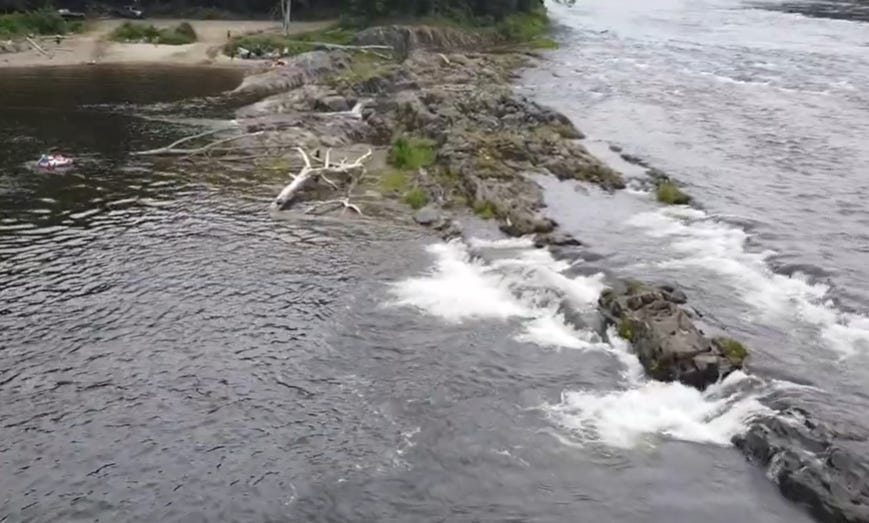
On April 9, 2001, the 38-year-old Weathersfield resident was fishing at Sumner Falls in Hartland when his boat overturned in the Connecticut River. He and his companion, 44-year-old Terry Brinegar of Mount Holly, were both presumed drowned, according to Vermont State Police. Brinegar’s body surfaced about two weeks later at the Bellows Falls Dam. Canfield’s never did.
What surfaced instead, more than five years later, was a human skull. According to the Connecticut Office of the Chief Medical Examiner, which responded to the scene, hunters found it in October 2006 near the Salmon River Boat Launch in East Haddam, Connecticut — more than 150 miles down the Connecticut River from where Canfield disappeared. At the time, investigators had no way to connect it to the Vermont fisherman, and the remains were stored, unidentified, for nearly two decades.
It was a comparatively new forensic method — forensic genetic genealogy — that finally closed the gap this spring. Working from a DNA profile built by a Texas laboratory and a comparison sample from Canfield’s brother, whom investigators located in Delaware, authorities confirmed in May that the skull was his. The case, open since 2001, was closed.
That same technology is now at the center of a bill moving through Congress. The Carla Walker Act, co-sponsored by Sen. Peter Welch, D-Vt., and Sen. John Cornyn, R-Texas, cleared the full Senate this month and is headed to the House. It would create a federal program to put forensic genetic genealogy — the method that named Brian Canfield — within reach of more crime labs and investigative agencies.
Welch has framed the bill as a crime-fighting tool, and for its Texas namesake it was exactly that. But the Vermont case he points to is a different kind of story. Canfield was not a homicide victim; he was presumed drowned in a boating accident the state police describe as not suspicious. His identification was not a prosecution but an answer — a name returned to a family after nearly a quarter-century. The distinction matters, because it points to what the technology does beyond catching offenders: it identifies the dead.
What the technology actually does
The method that identified Canfield goes by a few names — forensic genetic genealogy, or FGG — but its power comes from how much more of the genome it reads than conventional forensic DNA testing.
The system most people picture, the FBI’s CODIS database, works by reading roughly 13 to 20 short tandem repeat markers, or STRs, from a sample and checking them against profiles already on file from known offenders. It’s fast and reliable, but it has a hard limit: if the person isn’t already in the database, there’s no match. The trail ends.
FGG reads a different and far larger slice of DNA — hundreds of thousands of single nucleotide polymorphisms, the SNP markers that consumer genealogy services use to tell you a stranger three states away is your second cousin. By comparing those shared blocks of DNA against the genealogical databases that permit law-enforcement searches — opt-in services such as GEDmatch and FamilyTreeDNA, not the consumer giants Ancestry and 23andMe, which bar police use — investigators can identify not the person directly but their relatives, then build a family tree inward until a name emerges.
That’s the step that broke the Canfield case open. The skull found in East Haddam couldn’t be matched to anyone through conventional means. Othram, the Texas lab, rebuilt a usable DNA profile from the decades-old remains and ran a genealogical search that pointed investigators toward a specific family. From there it was traditional police work — locating Canfield’s brother in Delaware, obtaining a direct comparison sample, and confirming the match this May. The technology generated the lead; a relative’s sample closed it.
What the bill would do
The Carla Walker Act doesn’t create a national DNA database or new surveillance authority. It’s narrower than that. The bill — S.1890 in the Senate — sets up a pair of competitive grant programs that let publicly funded, accredited crime labs apply for federal money to do this work: one stream to purchase the sequencing equipment, another to fund the analysis itself. Under the bill text, each is authorized at up to $5 million a year through fiscal 2029, and the work must follow the Justice Department’s 2019 interim policy governing how forensic genealogy searches are conducted.
The practical pitch is access. The labs that can already afford whole-genome sequencing and in-house genealogy teams tend to be large or well-funded; the cold cases sit everywhere, including in small states with thin forensic budgets. The bill’s logic is that a modest, dedicated funding stream lets a wider range of agencies reach for the same tool that named a Vermont fisherman.
The case behind the name
The bill is named for Carla Walker, and her case became an early test of forensic genealogy in court. Walker was 17 when she was abducted from a Fort Worth bowling alley parking lot in February 1974; her body was found three days later, south of the city. She had been beaten, raped, and strangled. Police collected evidence but had no way, with the science of the era, to identify her killer.
Decades later, Othram rebuilt a genetic profile from the last usable DNA on her clothing and traced it through a genealogical database to a single family — the McCurleys. In 2020, that work identified Glen McCurley Jr., a man who had been questioned and cleared early in the original investigation. By Othram’s account, it was one of the first cases in which FGG evidence was admitted in court after a challenge; a judge allowed it following a pretrial hearing, before McCurley changed his plea to guilty during his 2021 trial. He was sentenced to life and died in prison in 2023. The case also drew Cornyn to Othram’s lab in 2023 for a roundtable on the technology, which the company describes as the start of the process that led to this bill.
The open question
What the bill’s supporters celebrate is real: a tool that can close cases the old science couldn’t touch. But the civic question Vermonters might ask isn’t whether the technology works — Canfield’s name is proof enough — it’s whether a federal program authorized at $5 million a year for each of its two grant streams meaningfully reaches a state like this one.
Vermont doesn’t run the kind of high-volume forensic operation that competitive federal grants tend to favor. And the Canfield identification itself leaned on out-of-state agencies and a private Texas lab — whose work, according to Othram, was paid for not by any government budget but by private donations raised through its DNASolves crowdfunding platform.
Whether the Carla Walker Act becomes a resource Vermont can actually draw on, or mostly a tool for bigger jurisdictions, is the part worth watching as the bill moves to the House.