


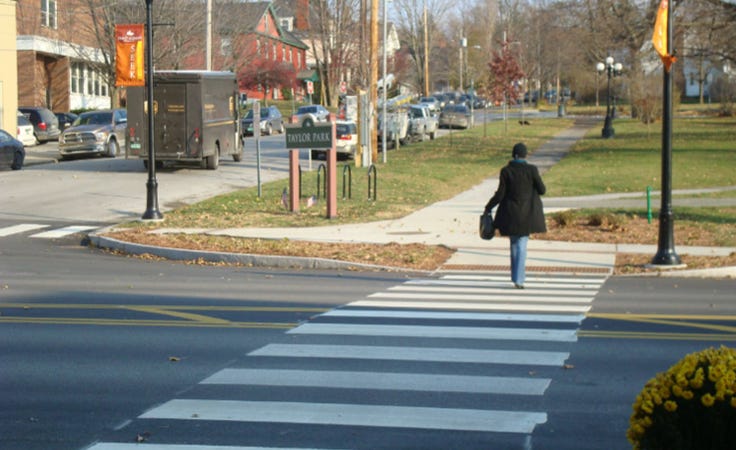
Vermont’s historic village centers—places where storefronts sit just feet from the road and pedestrians share space with logging trucks—may soon have new tools to slow traffic and improve safety. The House Transportation Committee is examining two bills that would expand municipal authority over speed limits in densely populated areas, marking a potential shift in how the state balances the movement of vehicles against the safety of people on foot.
The Current Situation: A 25 MPH Floor
Under existing Vermont law, municipalities can set speed limits on town-owned roads, but they cannot go below 25 miles per hour. This restriction, established under 23 V.S.A. § 1007, reflects mid-20th century engineering standards that treated 25 mph as the minimum reasonable speed for standard roadways.
For many Vermont villages, that floor has become a ceiling on safety. Narrow sidewalks, buildings close to the travel lane, and mixed foot traffic from schools, libraries, and local businesses create environments where 25 mph feels too fast for comfort—and the physics bear this out.
Why Speed Matters: The Numbers Behind Pedestrian Safety
The push for lower limits is grounded in basic physics. A pedestrian struck by a vehicle traveling 20 mph has roughly a 90 percent chance of survival. At 30 mph, that drops to about 50 percent. At 40 mph, fewer than one in ten survive.
This reality has prompted transportation safety organizations nationwide, including the National Transportation Safety Board, to advocate for what’s called a “Safe System” approach—one that acknowledges human error is inevitable and designs roads to minimize fatal consequences when crashes occur.
Two Bills, Two Approaches
The House Transportation Committee heard testimony on February 13, 2026, regarding two pieces of legislation that address these concerns from different angles.
House Bill 605, introduced by Representative Daniel Noyes, takes a targeted approach. The bill would allow municipalities to post speed limits below 25 mph in areas that have achieved “Step Two” or “Step Three” designation under Vermont’s Community Investment Program—a state planning framework that recognizes villages and downtowns meeting certain development and organization criteria.
House Bill 834, a bipartisan effort led by Representative Kate Lalley, casts a wider net. It introduces the concept of a “thickly settled district”—defined as a stretch of highway at least one-fifth of a mile long where structures average 200 feet apart or less. In such areas, a town’s legislative body could establish a 25 mph limit by majority vote. The bill also addresses crosswalk visibility by expanding no-parking zones near intersections and creates a task force to study whether some state highways through village centers should be reclassified as town roads.
The State Highway Complication
Here’s where things get complicated. Many of Vermont’s village centers are built along state highways, which means the state—not the town—controls the speed limits. The Vermont Traffic Committee, composed of the Secretary of Transportation, the Commissioner of Motor Vehicles, and the Commissioner of Public Safety, holds authority over speed changes on state roads.
When a town wants a different speed limit on a state highway, it must request approval from this committee. That request typically requires an engineering study conducted according to VTrans guidelines, which have historically relied on what’s known as the “85th percentile” rule—setting limits near the speed at which 85 percent of drivers travel under free-flowing conditions.
The 85th Percentile Debate
The 85th percentile standard has come under increasing criticism. The logic behind it assumes most drivers are reasonable and that matching limits to actual behavior reduces speed variance and crashes. But critics argue this creates a self-reinforcing cycle: wider, straighter roads encourage faster driving, which leads to higher measured speeds, which leads to higher posted limits, which normalizes even faster driving.
The newly updated Manual on Uniform Traffic Control Devices, the federal guidance document that shapes traffic engineering nationwide, now explicitly allows engineers to consider factors beyond the 85th percentile when setting limits in areas with significant pedestrian activity.
Johnson: A Real-World Example
Representative Noyes pointed to the town of Johnson as a primary example of the problem these bills aim to solve. Johnson’s village center sits on VT Route 15, a significant east-west corridor that transitions from a higher-speed rural highway into a compact downtown with housing, a library, and regular pedestrian traffic.
Under current law, Johnson has limited ability to lower speeds on Route 15 because it’s a state highway. A 2016 corridor study noted the inherent tension between the road’s function as a regional transportation route and the community’s desire for a walkable village center.
If H.605 passes and Johnson achieves the required designation level, the town could theoretically post a 20 mph limit—though on a state highway, this would still require Vermont Traffic Committee approval. If H.834’s task force study eventually leads to reclassifying Route 15 as a town road through the village, Johnson would gain full control but would also assume responsibility for maintenance, including plowing a road that carries heavy regional traffic.
Beyond Signs: The Infrastructure Question
Committee testimony made clear that changing a number on a sign is only part of the equation. The VTrans Traffic Safety Toolbox describes a range of physical measures that actually change driver behavior: raised crosswalks that force vehicles to slow, curb extensions that shorten pedestrian crossing distances, and narrowed lanes that make high speeds feel uncomfortable.
These physical changes are generally more effective than posted limits alone, but they’re also more expensive and can conflict with state maintenance requirements—particularly snow removal. That’s one reason H.834 includes a task force to study the feasibility of towns taking over state highways through village centers.
The Role of Regional Planning Commissions
Most small Vermont towns lack in-house traffic engineers. When they want to study a speed limit change or design traffic calming improvements, they typically work with their Regional Planning Commission. Organizations like the Addison County Regional Planning Commission conduct the data collection—spot speed studies, crash history analysis—required to support requests to the state.
This technical assistance role is expected to become even more important if towns gain expanded authority to set lower limits, as they’ll still need to demonstrate that proposed changes are “reasonable and safe” for their specific contexts.
What These Bills Would and Wouldn’t Do
It’s worth being precise about what’s actually on the table. H.605 and H.834 would expand municipal options within a state framework—they wouldn’t grant towns unlimited authority to set whatever limits they choose. A community couldn’t simply decide on 15 mph because residents want it; the designation requirements in H.605 and the density criteria in H.834 create specific conditions that must be met.
The bills also don’t address the fiscal implications of traffic calming. Physical infrastructure changes cost money. Reclassifying state highways to town highways would shift maintenance costs to municipalities. And lower speed limits on major routes could affect traffic flow patterns in ways that have economic ripple effects.
Implementation Timeline
H.834 specifies that most of its provisions would take effect on July 1, 2026, though the updated federal traffic control standards wouldn’t become fully mandatory until July 1, 2027. That delay would give the Secretary of Transportation time to develop Vermont-specific guidance reconciling federal standards with the physical realities of 18th-century village layouts.
The Class 1 Town Highway Task Force created under H.834 would need to report its findings by January 15, 2027.
What Happens Next
The House Transportation Committee has directed staff to gather additional details on both bills rather than taking immediate action. Questions about how the legislation would interact with state highway authority, what technical requirements towns would need to meet, and how implementation costs would be managed remain under discussion.
The committee’s approach reflects the complexity of the issue: genuine sympathy for communities seeking safer village centers, balanced against the practical challenges of integrating local desires with statewide transportation standards.
The upcoming reports from the Class 1 Town Highway Task Force and the Agency of Transportation’s infrastructure study will be key next steps in determining whether Vermont villages gain meaningful new tools to slow traffic—or whether the authority to change a sign remains largely symbolic without the resources to redesign streets.
Seems to me Vermont can't figure out what it wants to be. On one hand "Tourism" and on the other, more people/growth! Town meeting day is fast approaching. Get out and VOTE.....
Seems like it would be worth figuring out a compromise where the "town road" part allows the town to set a lower speed but since it's still part of the state highway route, VTrans continue to plow through. Silly that one change forces the other.