


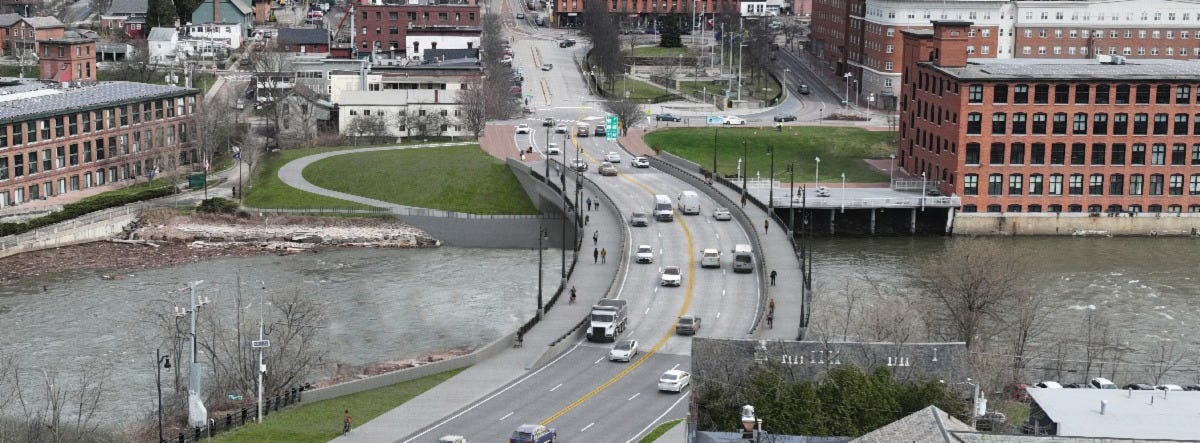
In November 1927, a generational flood on the Winooski River washed away the bridge connecting Burlington and Winooski. Within days, a temporary pontoon bridge was installed to keep the two cities connected. Nine months later, in August 1928, the current bridge was completed and open to traffic — a steel girder structure carrying a trolley line, two lanes for vehicles, and sidewalks.
That bridge is still standing. It is now approaching its 98th birthday. And the project to replace it — first formally studied in 2017, with construction not expected to begin until 2027 and the new bridge not projected to open until 2029 at the earliest — will take at minimum 12 years from study to completion.
The same river. The same crossing. The same two cities. Nine months in 1928. Twelve-plus years today.
In a recent Facebook post, the Vermont Agency of Transportation announced an upcoming open house for the Burlington-Winooski Bridge Replacement Project. The event, scheduled for April 29 at the Winooski School District building, will give residents a chance to weigh in on park aesthetics and landscaping preferences for the Winooski side of the bridge.
The comments section captured something the post itself did not. One commenter said he has been hearing about this project for years and that the state just needs to make up its mind and do it, comparing the timeline unfavorably to a New York bridge that was rebuilt after a fatal collapse. Another asked how many commissions are involved and whether they are consuming the money that should go toward construction. A third called the project overpriced, over budget, and wondered how many more years it would take.
The language was blunt. The frustration was real. And the underlying question — why does it take Vermont so long to build things? — deserves more than a dismissal.
The Timeline
The Burlington-Winooski Bridge carries US Routes 2 and 7 over the Winooski River. It is the only direct downtown crossing between two of Vermont’s most densely populated cities. Roughly 25,000 vehicles and up to 800 pedestrians and cyclists cross it every day.
The bridge has 10.5-foot travel lanes, no shoulders, narrow six-foot sidewalks, no dedicated bicycle facilities, and no physical separation between cars, bikes, and pedestrians. By every modern safety and design standard, it is functionally obsolete.
Here is the timeline to replace it:
2017 — The Chittenden County Regional Planning Commission, along with Burlington, Winooski, and VTrans, initiated a scoping study.
2018 — Both city councils approved the preferred design layout.
2019 — The scoping report was completed, recommending a full bridge replacement with four 11-foot travel lanes, two-foot shoulders, and two 12-foot shared-use paths separated from traffic.
2022 — The project received a $24.8 million federal RAISE grant, which requires the obligation of construction funds by 2026.
2024 — Winooski voters approved a $4.6 million bond for the city’s share. The project team held its first informational open house in December.
2025 — A second federal grant of $22.7 million was announced. VTrans began locating underground utilities.
2026 — The design-build RFP has not yet been released. The April 29 open house will gather feedback on park aesthetics.
2027 — Construction is planned to begin.
2029-2031 — The bridge is expected to open.
Total estimated cost: $60 million to $80 million.
For context: the 1928 bridge that this project will replace was designed, constructed, and opened in nine months — after a catastrophic flood — and has lasted nearly a century.
The Regulatory Stack
What changed between 1928 and now is not engineering complexity. Modern construction technology is vastly superior to what was available a century ago. What changed is the system that lawmakers — federal and state — built around it.
Every major federally funded transportation project must comply with the National Environmental Policy Act, signed into law in 1969. For a project of this scale, that means environmental review, public comment periods, and agency coordination. Federal data on Environmental Impact Statements show a historical average of 4.5 years, though more recent CEQ reporting puts the median closer to 2.8 years for reviews completed between 2019 and 2024. Either way, that is just the federal layer.
On top of that federal framework, Vermont’s legislature has built its own. VTrans’s environmental manual lists the permitting checkpoints that a bridge project over a river must navigate: NEPA review, historical and archaeological resources review, stormwater management, Section 401 Water Quality Certification, Section 404 Clean Water Act compliance, Army Corps of Engineers bridge permit, Coast Guard bridge permit, Vermont shoreland encroachment permit, Vermont stream alteration permit, Vermont wetland permit, Wild and Scenic Rivers Act review, farmland soils review, fish and wildlife review, hazardous materials review, and parks and recreation review.
That is at least 15 separate regulatory gates for one bridge. VTrans did not create them. The legislature did — layer by layer, over decades.
Then there is Act 250, Vermont’s landmark land-use law, enacted in 1970. For public infrastructure projects involving more than ten acres, Act 250 review can be triggered — and a major bridge replacement with intersection reconstruction on both sides of a river may reach that threshold. The review evaluates the project against ten criteria, from water pollution to aesthetics to conformance with regional plans. Each criterion is a potential point of intervention for opponents.
As one policy analysis noted, even when permits are granted — and in 2023, only two of 392 applications were denied — the appeal process can impose enormous costs in time and money. The process is the punishment, regardless of outcome.
How many entities must sign off on a project like this? VTrans. The City of Burlington. The City of Winooski. The Chittenden County Regional Planning Commission. The Federal Highway Administration. The Army Corps of Engineers. The Coast Guard. The Vermont Agency of Natural Resources. The District Environmental Commission if Act 250 applies. Plus advisory committees, public meetings, and council presentations. This is the architecture the legislature has required. VTrans is the agency that must navigate it.
The Burlington-Winooski project required approval from Burlington City Council, Winooski City Council, CCRPC, and VTrans — four separate governmental bodies — before design even began.
And even after years of studies, council votes, and public meetings, advocacy groups continued to push back. Local Motion, the statewide bike and walk advocacy nonprofit, said the bridge was being designed with too many lanes for cars. A Winooski resident who bikes and walks across the bridge voted against the bond because she said public support for protected bike lanes had been ignored at earlier meetings.
The process, in other words, does not end when the process ends.
In 1928, none of these layers existed. Act 250 would not be enacted for another 42 years. NEPA would not exist for another 41. The bridge was designed, approved, and built by the people who needed it, on a timeline dictated by urgency rather than procedure. Today, VTrans is working to replace the bridge using design-build procurement and exploring accelerated bridge construction methods to minimize disruption — but even those tools cannot override a regulatory architecture that requires years of sequential approvals before a shovel hits the ground.
What Other Legislatures Built Instead
Missouri replaced 802 bridges in less time than Vermont has spent planning one. The difference was not better engineers. It was better legislative choices about how to structure procurement, funding, and environmental review.
Under the Safe & Sound Bridge Improvement Program, the Missouri Department of Transportation bundled hundreds of bridges in poor condition into two procurement packages using design-build contracts. The average bridge closure was 42 days — half the time of a normal Missouri bridge project. The program saved an estimated $500 million through economies of scale, and roughly 90 percent of the work was performed by Missouri workers.
Three structural decisions made the difference:
Bridge bundling — grouping similar bridges into single contracts instead of managing each one as a standalone multi-year project. The Federal Highway Administration has documented the approach as a model, noting that bundled bridges grouped by type, size, or location accelerate construction while minimizing inconvenience to drivers and residents.
Design-build contracting — one entity handles both design and construction, collapsing phases that would otherwise run sequentially. Vermont is, in fact, using design-build procurement for the Burlington-Winooski project, with HNTB serving as the owner’s representative. But even under a design-build model, the project must still clear every environmental review, public comment period, and multi-entity approval in Vermont’s regulatory stack before the design-build RFP can go out — which is not expected until late spring 2026, nine years after the scoping study began. Missouri’s design-build contracts, by contrast, moved from procurement to completed bridges in months, because the regulatory pathway had already been cleared at scale.
Streamlined environmental review — Missouri used categorical exclusions for smaller bridges. Under FHWA’s regulations, bridge reconstruction and replacement projects can qualify for categorical exclusion from full NEPA review when criteria are met and no significant impact is demonstrated — allowing projects to bypass the multi-year EIS process entirely.
Georgia committed 100% of its available federal bridge formula funds — the highest rate in the nation — and used design-build contracts with hard deadlines built into the procurement: maximum detour durations per bridge and firm completion timeframes.
These aren't radical ideas. They are standard practice in states that have decided bridge replacement is an operational priority, not a multi-year deliberative exercise. Vermont is eligible for the same federal bridge bundling grants as these states.**
Vermont is eligible for the same federal bridge bundling grants as these states. The Competitive Highway Bridge Program, initially restricted to rural states with population density under 100 people per square mile, included Vermont among its eligible states. But the structural incentives of the system Vermont’s legislature has built — where every project must navigate its own multi-year obstacle course of state permits, public hearings, and multi-entity approvals — work against the kind of streamlined, bundled approach that moves bridges from blueprints to concrete in months, not decades.
The Funding Crisis Lawmakers Haven’t Fixed
Even if the regulatory architecture were streamlined, Vermont faces a more fundamental problem: the legislature has not provided the funding to maintain the system it built.
A funding shortfall in the state Transportation Fund jeopardizes more than $150 million in road and bridge projects. The state is roughly $33 million short of what it needs to maximize its federal drawdown — a deficit that could cost Vermont an estimated $163 million in lost federal revenue.
The consequences are already visible. Facing a gap that lawmakers had not closed, VTrans was forced to implement $7.5 million in budget cuts in September 2025, phasing out 28 positions and pausing upgrades in Springfield and Rutland. Highway mowing, tree trimming, and culvert maintenance were reduced.
In Barre, repaving of Main Street — a state highway — was scheduled for 2027, then pushed to 2030 because the state match was not available. The city spent $187,000 of its own money to do it themselves.
In Royalton, officials were informed through unofficial channels of uncertainty surrounding the Foxstand Bridge replacement. VTrans confirmed a budget shortfall and the need to delay projects statewide.
The root cause is structural: Vermonters drive more fuel-efficient vehicles, which means less gas tax revenue per mile traveled, even as costs rise and roads deteriorate. The state depends on federal funding for more than half its annual transportation budget — but drawing down that federal money requires a state match that the legislature has not funded. The Transportation Fund’s structural deficit has been flagged for years. Lawmakers have not resolved it.
VTrans faces a compounding problem: the regulatory process that lawmakers built adds years to every project, and the funding shortfall that lawmakers have not addressed means there is less money and fewer staff to manage that process. The agency is simultaneously being asked to do more and being given less to do it with.
The Comparison That Went Viral
The Facebook commenter who referenced a New York bridge collapse was recalling a real event, though some of the details were off.
On April 5, 1987, the Schoharie Creek Bridge on the New York State Thruway collapsed after record rainfall scoured the soil beneath a bridge pier. Ten people were killed. The replacement bridge was completed and open to traffic on May 21, 1988 — roughly 13 months later. The total cost was $12 million.
The comparison is imperfect. That was an emergency replacement of a collapsed interstate bridge. No scoping studies. No multi-year design phase. No public engagement process. No landscaping preferences survey. People were dead and a vital interstate was severed.
But the comparison, even imperfect, exposes a real question: have we built a system where it is structurally easier to rebuild after failure than to prevent failure through planned replacement?
Every year that the Burlington-Winooski Bridge goes unreplaced is another year that 25,000 vehicles per day cross a functionally obsolete structure with no shoulders, lanes too narrow for modern traffic, and no separated facilities for the hundreds of pedestrians and cyclists who use it daily.
The regulatory caution designed to protect people may, in practice, be extending the life of infrastructure that does not meet modern safety standards — putting them at greater risk.
The Uncomfortable Question
Burlington’s Champlain Parkway was proposed in the 1960s. Construction began in 2022. Total cost since 1998: $75 million. The Exit 16 diverging diamond interchange in Colchester spent more than a decade in planning and litigation before ground was broken.
These are not outliers. They are the system working as designed.
Vermont’s environmental protections exist for reasons. Act 250 has preserved the state’s rural character for more than 50 years. NEPA ensures that public infrastructure projects account for their impact on communities and ecosystems. Public engagement gives residents a voice.
But when a crossing that was rebuilt in nine months in 1928 now requires more than a decade of process before a single beam is set — when Missouri can replace 802 bridges in less time than Vermont can replace one — when a city has to spend its own money to pave a state highway because the legislature has not funded the Transportation Fund — the system is not just protecting people. It is failing them.
The Facebook commenters may not have had every fact exactly right. But they had the frustration exactly right. And behind that frustration is a structural question that Vermont’s lawmakers have yet to answer:
At what point does the cost of caution exceed the cost of action?
Editor's Note, April 8, 2026: An earlier version of this article included a reference to the Texas Association of Business and legislative action to streamline infrastructure approvals. That source addressed the presidential permitting process for international bridges connecting Texas and Mexico — a federal process unrelated to the domestic bridge replacement timelines discussed in this article. The reference has been removed. Compass Vermont thanks reader Ethan Pepin for identifying the error.
Vermont (and the nation) has needed drastic legislative change for decades but the crux of the problems is voters need an epiphany. Good men have tolerated way too much for way too long.
Both parties need change but historical facts will show, in city after city; state after state; progressive democrats have been, by far, more responsible for creating the problem.
"Texas took legislative steps to streamline its own approval process and eliminate what the Texas Association of Business called unnecessary barriers to infrastructure construction. Where Vermont’s legislature has added regulatory layers, Texas lawmakers have been systematically removing them."
This links to a post about streamlining the PRESIDENTIAL PERMITTING PROCESS for bridges that connect Texas to Mexico. The approval is from the State Dept.... suggests to me either an incredibly sloppy researching or an article generated by AI that whoever runs the site didn't even bother to double check.... my first article here, it will be my last.