


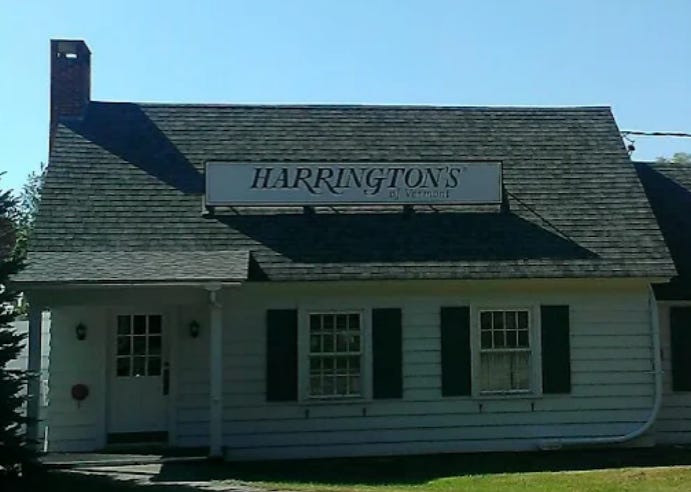
Harrington’s of Vermont, the Richmond smokehouse whose hams have been arriving on Vermont holiday tables for generations, has a new owner in Maryland.
Chesapeake Fine Food Group, LLC of Owings Mills announced the acquisition on Aug. 21. Financial terms were not disclosed, and both companies are privately held, so there is no filing that would reveal what Harrington’s sold for.
The buyer’s stated plan is growth, not change. Chesapeake said it intends to expand Harrington’s distribution across the country while keeping the recipes, the sourcing standards and the small-batch production. Company president Laura McManus said Chesapeake is not buying the brand in order to transform it, and that “Harrington’s will remain unmistakably Harrington’s.” Harrington’s president R.B. Klinkenberg said he was glad the business was going to owners who understood it and had the resources to take it forward.
On paper the fit is a sensible one. Chesapeake is a direct-to-consumer gourmet food company — its other two brands are Mackenzie Limited, a mail-order house founded in 1988 on Scottish smoked salmon, and Chesapeake Bay Crab Cakes and More. Harrington’s sells the same way, by catalog and website, into the same holiday gift market. A larger catalog operation behind a Vermont-made product could mean more hams going out of Richmond, not fewer.
What the announcement doesn’t say
It doesn’t mention Richmond.
There is nothing in it about the smokehouse at 210 East Main Street, and nothing about the people who work there. Chesapeake has published nothing about the future of the Vermont operation, and no public record establishes how many Vermonters the company employs.
None of that is unusual in a private sale between two private companies. It is also the part Vermonters will actually want to know, and the reason this is more than a trade-press item: a 153-year-old brand can keep its name and its recipes while the work behind it moves out of state.
What Harrington’s says today
The company’s website, as of Aug. 26, carries the line “Famous for Smoked Meats and Fine Foods Since 1873” beneath the logo. Its customer service page tells shoppers that the hams, turkeys and bacon are cured and smoked in the company’s Vermont smokehouses, using meat sourced from across North America.
Note what that sentence does and does not say. It is not a blanket claim that the ham is a Vermont ham. It is a narrower statement about one step — where the curing and smoking happen — paired with an acknowledgment that the meat itself comes from elsewhere on the continent.
Vermont has a rule for this
The state’s Vermont Origin Rule, adopted by the Attorney General and in effect since January 2006, sets out when a food product can carry the word Vermont. Its own example of a covered company name is “John’s of Vermont.” A product qualifies only if the company behind it still performs substantial functions in the state — and the rule specifically says mail handling, banking, and sales or distribution staff don’t count on their own — and only if at least 75 percent of the items sold in Vermont are actually made here, measured over as much as a twelve-month stretch.
The rule was written with a specific problem in view. As the law firm Downs Rachlin Martin recounted, one of the situations behind it was a company that had started in Vermont, been sold, lost its Vermont connection, and gone on using the Vermont name on its labels.
Here is the part most people get wrong: the rule does not take the name away. A company whose name says Vermont can go on selling a product made elsewhere. What it has to do is say so — disclose that the company isn’t based here, and state on the front of the package where the product was actually made. The remedy is disclosure, and the burden lands on the packaging.
Whether any particular label meets that standard is a question for the Attorney General’s office, not for a reader or a reporter. What the rule gives a reader is a set of things to look at.
If you order a ham this December
Nothing on a Harrington’s package has to change because of the sale. What a customer can check, on the box or at checkout:
Whether the package still says the product was smoked or made in Vermont.
Whether a different state or region appears on the front panel.
Whether the seller’s address given at checkout is the Richmond one or an out-of-state address.
Vermonters who believe a label is misleading can file a complaint with the Attorney General’s Consumer Assistance Program or call 800-649-2424.
The sale is done, and the sign in Richmond still reads Harrington’s of Vermont. Whether that stays a description as well as a name is something the package will say out loud.