


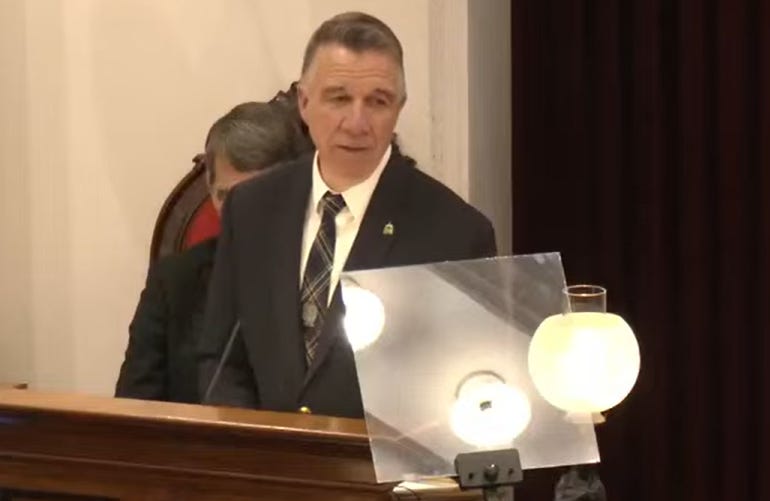
We have two schools in the same county, one with 700 students and one with a hundred. The larger one offers seventeen foreign language courses, the smaller school has just four. And there are kids from different districts who take the same course at their regional tech center but don’t get the same credit towards graduation. This isn’t meaningful local control, it’s significant inconsistency, unequal opportunity, and frankly, it’s just not fair. - Governor Scott
Vermont Governor Phil Scott used his 2026 State of the State address Wednesday, January 7, 2026, to issue an ultimatum to lawmakers: follow through on education reform or face vetoes of key legislation.
In a speech focused almost entirely on transforming Vermont’s public school system, Scott declared that education reform “is not optional, it’s essential” and vowed to reject any budget, education bill, or tax bill that deviates from Act 73, the comprehensive education reform law passed last year.
Education Takes Center Stage
While Scott indicated his administration has prepared proposals on housing, energy, healthcare, and public safety, he devoted his address to what he called Vermont’s “most critical challenge”—education reform and the consolidation of the state’s school governance structure.
The governor framed the issue in stark terms: Vermont is on track to spend $2.5 billion on pre-K through grade 12 this year, up from $1.6 billion when he took office. Despite this increase, student outcomes have declined and inequities between districts have widened.
The Financial Pressure
According to Scott, education spending is projected to require another $200 million this year, leading to another double-digit property tax increase. Beyond property taxes, approximately $800 million from sales tax, lottery revenues, and portions of rooms and meals and purchase and use taxes flow to the Education Fund.
The governor argued this spending crowds out other state priorities. He noted that childcare support, municipal road funding, housing development, public safety, emergency shelters, transportation, flood mitigation, and school construction all must compete for limited remaining general fund dollars.
“This year, there won’t be much – if any – left over,” Scott said, adding that he would propose property tax relief as “another band-aid” while pushing for structural reforms.
What Act 73 Requires
The law passed in 2025 represents what Scott characterized as the first comprehensive approach to Vermont’s education challenges, going beyond previous reform attempts that focused on funding (Act 60), property taxes (Act 68), or limited governance changes (Act 46).
Act 73 is designed to expand pre-kindergarten programs, increase equity in course and program offerings across the state, expand Career and Technical Education access, raise teacher salaries in lower-paying districts, provide targeted student support, establish universal afterschool programs, strengthen literacy instruction, and create new accountability measures.
The law also mandates a shift to a foundation formula funding system that would provide similar funding for students with similar needs regardless of location, joining most other states in using this approach.
Current System’s Structure Problems
Vermont currently operates 52 supervisory unions and 119 school districts serving approximately 74,000 K-12 students, or 80,000 including pre-kindergarten. At the state’s peak enrollment in the late 1990s, Vermont educated about 107,000 K-12 students.
Scott noted that some districts serve as few as 200 students, while high-performing districts elsewhere in the country serve 10,000 or more. Each supervisory union and district maintains its own administration, systems, and fixed costs for salaries, benefits, heating, electricity, and transportation.
The governor provided examples of the inequities: one district offers students 102 courses while another offers 73; one school offers 17 foreign language courses while another in the same county offers four; and students taking the same course at regional technical centers may receive different credit toward graduation depending on their home district.
Consolidation as Solution
The governor called on the Legislature to prioritize drawing new district boundaries as “the first order of business for the committees of jurisdiction.” He argued that consolidating into far fewer districts serving far more students would eliminate duplicated expenses, reduce inequity through more consistent leadership, and give administrators more strategic options beyond cutting already-understaffed positions.
Scott characterized the recent failure to produce consolidation maps as “a political strategy to preserve the old system” and warned that without governance changes, Act 73 cannot deliver its promised improvements.
While Act 73 does not mandate school closures, the governor acknowledged that financial and academic quality benchmarks in the law will likely result in merging some schools and repurposing buildings. He pointed to schools that have already closed due to declining enrollment—Black River High School dropped from 167 students in 2005 to 75 in 2020 before closing; Windham Elementary closed with 15 students; Rochester High School had just two students before closure.
Teacher Impact
The governor directly addressed teachers, acknowledging their challenges and rejecting the notion that reform efforts blame educators. He noted that teachers in some districts are underpaid, overworked, juggling multiple subjects and age groups, and often spending personal funds for classroom supplies.
Currently, average teacher salaries vary by $22,000 per year between the highest and lowest paying supervisory unions. Scott argued that larger, consolidated districts would help close this gap and ensure teachers can choose schools “based on the good they can do, not the salary they need to live.”
“If we want to build the best education system in the nation, we MUST make sure teachers have what they need in every classroom, every district, and every school across the state,” Scott said.
Declining Student Performance
The governor cited recent data showing Vermont’s education outcomes have deteriorated despite increased spending. A Boston Globe report from fall 2025 found that “no state fell as far in early reading as Vermont” over the past decade. Vermont ranked fifth nationally in fourth-grade reading ten years ago but dropped to 37th place in 2024, with similar declines across grades and subjects.
Scott drew comparisons to Mississippi, a rural state with double Vermont’s child poverty rate that spends thousands less per student. Despite educating five times as many students with roughly the same number of districts as Vermont, Mississippi now has a higher high school graduation rate and scores similar or better on national assessments.
“Mississippi was once at the bottom of the charts, and now, because they were honest about their problem and set clear education priorities and then followed through, they’re making REAL progress,” Scott said, calling it the “Mississippi Miracle.”
Historical Context
The governor noted that Vermont faced similar education consolidation debates in 1892, when Governor Levi Fuller signed the “Vicious Act” consolidating over 2,000 local school districts into about 250. He also referenced his hometown of Barre consolidating seven smaller elementary and middle schools into one 800-student facility in the mid-1990s—a controversial decision that proved successful over time.
Scott attended two of those consolidated schools, both of which have been repurposed: Lincoln School is now senior living, and Spaulding Graded School houses the Vermont Historical Society.
Budget Timeline and Political Stakes
Scott announced he will present his budget proposal in 13 days. The budget will reflect the end of one-time pandemic recovery funds and uncertainty around federal support, and will be funded without new taxes, according to the governor.
He framed the upcoming legislative session as a test of political will, contrasting Vermont’s approach with national political dysfunction. “Vermont can be the example,” Scott said. “We can fiercely debate the issues but do it in a way that’s civil and respectful, so we get better policy – not better campaign material.”
What Happens Next
The Legislature reconvenes to begin its 2026 session with education reform as the dominant issue. Committees with jurisdiction over education will face pressure to prioritize drawing new district consolidation maps required under Act 73.
Lawmakers must balance competing pressures: demands for property tax relief, calls to delay or modify Act 73 implementation, and the governor’s veto threat against any legislation that deviates from the reform law.
The budget Scott presents later this month will reveal how he proposes to provide property tax relief while managing the projected $200 million increase in education spending. His proposals on housing, energy, healthcare, and public safety will also be released following the State of the State address.
The debate will test whether Vermont can complete what Scott called “the most critical challenge” facing the state—transforming an education system designed for 107,000 students to effectively serve 80,000 students at a cost taxpayers can sustain, while improving outcomes and equity.