


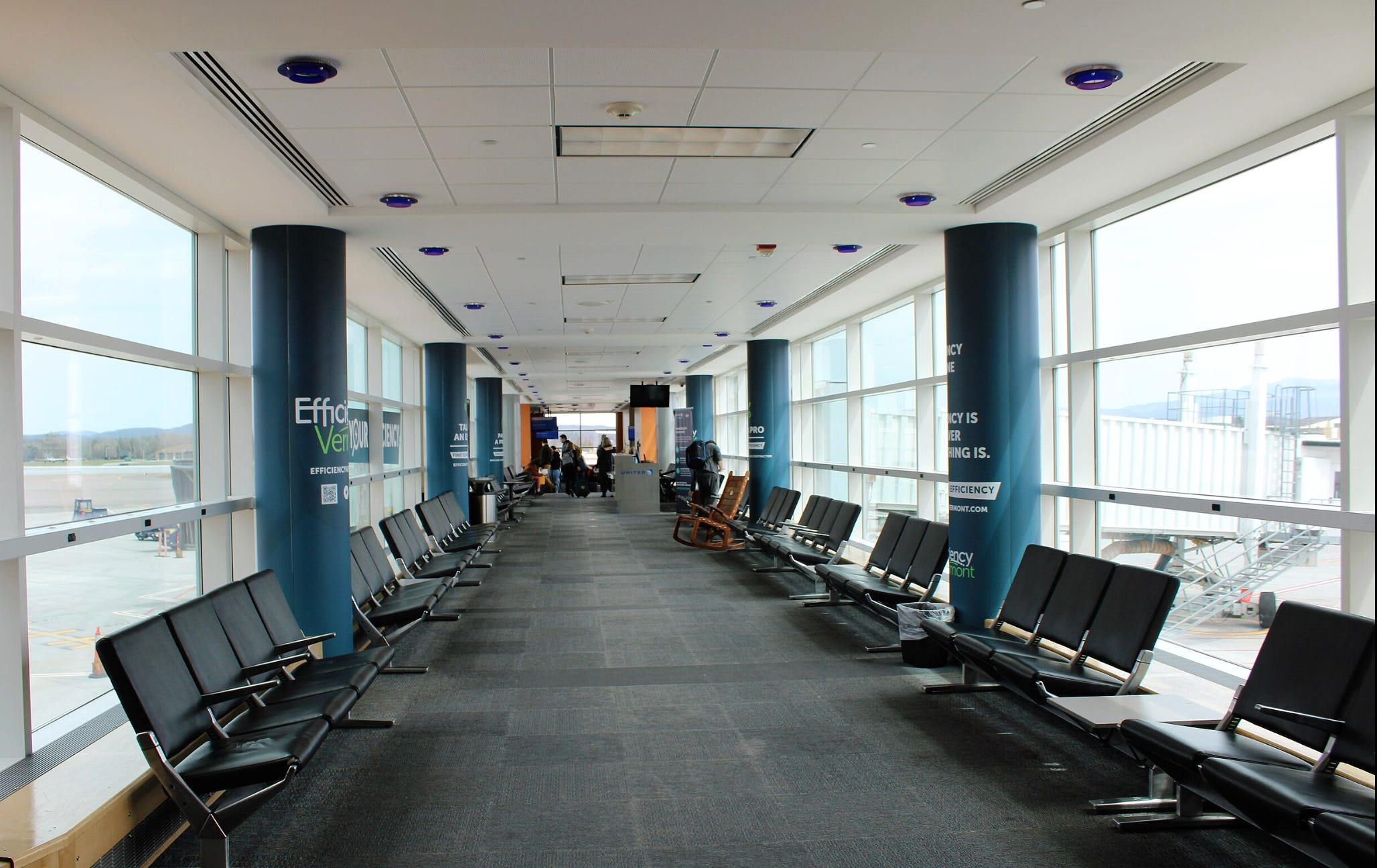
If you’ve received an invitation to participate in a “dress rehearsal” at Patrick Leahy Burlington International Airport, you’re being asked to help test one of Vermont’s most significant infrastructure projects in decades. The airport is preparing to solve what travelers have experienced for years: the notorious “skinny hallway” bottleneck that has made navigating the North Concourse feel like squeezing through a crowded subway car during peak hours.
But this dress rehearsal isn’t just a walk-through. It’s a rigorous operational trial that will put the new terminal’s systems through their paces before the facility opens to the traveling public in Spring/June 2026.
What Exactly Is an Airport Dress Rehearsal?
In aviation terminology, a dress rehearsal is the final exam for a new terminal building. The technical name is Operational Readiness and Airport Transfer, or ORAT, and it’s designed to answer a critical question: Does everything actually work when hundreds of real people are using it at once?
Computer simulations can only do so much. When 500 people simultaneously try to find Gate 2, use the restrooms, connect to Wi-Fi, and follow directional signs, that’s when you discover if your new building truly functions. Similar dress rehearsals at other airports have recruited thousands of volunteers to simulate the chaos of real travel.
Volunteers will be assigned specific roles—perhaps you’re a non-English speaker trying to navigate, a passenger with mobility challenges, or someone running late to catch a flight. These scenarios test whether the airport’s wayfinding signage is intuitive, whether staff can respond to irregular situations, and whether the building’s automated systems can handle peak loads.
The rehearsal will simulate the complete traveler journey: from curbside check-in through TSA screening to finding your gate and boarding. Behind the scenes, airport staff will monitor how the geothermal heating responds when crowds gather, whether the new passenger boarding bridges align properly with different aircraft, and if the “smart infrastructure” sensors accurately track passenger flow.
The Problem: Why Vermont Needed This Project
The Skinny Hallway Bottleneck
The existing North Concourse—serving Gates 1 through 4—was designed over 25 years ago for smaller regional turboprops and passenger loads of about 200 people at a time, according to airport officials. But the aviation industry changed dramatically.
Modern aircraft like the Airbus A320 and Boeing 737 carry far more passengers. Today, the same concourse regularly accommodates 1,000 travelers—a 400% increase over its original design capacity. The result was the “skinny hallway” phenomenon: a cramped corridor where passengers struggled to move, emergency exits were blocked by crowds, and there simply wasn’t room for adequate seating or modern amenities.
Federal Safety Requirements
Beyond passenger comfort, the project addresses a critical safety issue. The old North Concourse sat too close to Taxiway Alpha, the main route aircraft use to move between the terminal and runway. Federal Aviation Administration standards require greater separation distances to accommodate modern commercial jets with wider wingspans. The new facility is being constructed approximately 150 feet farther north, ensuring full compliance with FAA safety standards and allowing aircraft to taxi without restrictions.
What’s Being Built: The New Terminal
Project NexT represents a complete demolition and reconstruction of the airport’s northern terminal wing. The $45 million to $50 million investment, detailed in federal funding documents, will add 25,000 square feet of space, four new gates, and a third-floor community observation deck.
The observation deck restores a historic connection between Vermonters and their airport—a feature largely lost at modern airports due to security restrictions. The space will include outdoor patios and can be rented for private events, generating non-aeronautical revenue while giving aviation enthusiasts a unique vantage point.
Vermont’s Timber Showcase
What distinguishes Burlington’s project nationally is its architectural choice: mass timber construction using Cross-Laminated Timber (CLT) and Glue-Laminated Timber (Glulam). This isn’t just aesthetics—it’s a statement about Vermont’s forest products industry and sustainable building practices.
The Northern Border Regional Commission awarded BTV a $1.78 million “Timber for Transit” grant specifically to demonstrate high-value uses for regional timber products. Unlike steel and concrete, which are carbon-intensive to manufacture, mass timber sequesters carbon dioxide absorbed during the tree’s growth, significantly lowering the building’s environmental footprint.
Net Zero Energy Systems
The terminal is designed to achieve “Net Zero” status, meaning it produces as much energy as it consumes annually. This is accomplished through several integrated systems described on the airport’s project page:
A geothermal well field provides highly efficient heating and cooling by tapping into the earth’s constant subterranean temperature, drastically reducing reliance on fossil fuels. Rooftop solar arrays generate electricity for lighting, air handling, and the new smart sensor networks. The terminal is fully electrified, supporting electric ground support equipment on the apron and furthering decarbonization of airport operations.
The building incorporates “Smart Infrastructure”—AI-driven sensors that monitor passenger flow and energy usage. These systems require calibration, which is precisely what the dress rehearsal will provide. As volunteers move through the terminal, sensors will learn when to ramp up lighting and cooling as crowds gather at specific gates.
The interior design reflects Vermont’s four seasons, with thematic zones celebrating the state’s natural heritage. Burlington City Arts has collaborated on commissioned works that integrate with the mass timber architecture, ensuring the facility functions as a cultural gateway rather than a generic transit hub.
How It’s Being Paid For
The project’s financial structure reveals heavy reliance on federal funding, largely shielding local Burlington taxpayers from capital costs. According to public funding notices, approximately 90% of the estimated $45.5 million cost comes from federal sources:
The FAA’s Airport Improvement Program provides about $34 million—roughly 75% of total costs—through discretionary grants. Another $6.9 million (15%) comes from the Airport Infrastructure Grant program under recent federal infrastructure legislation. Passenger Facility Charges—fees added to airline tickets—contribute approximately $4.2 million (9.2%). The NBRC timber grant adds $1.78 million, with minimal state matching funds.
The $34 million AIP grant represents a significant allocation for a small hub airport, made possible by Senator Patrick Leahy’s position as former Chairman of the Senate Appropriations Committee. The airport’s renaming in his honor in 2023 acknowledges this political reality—without this federal intervention, the debt burden would likely have made the project unfeasible for the municipality.
Burlington’s Aviation Future
BTV projects over 1.4 million passengers in 2025, according to airport officials, and positions itself as New England’s second-busiest airport behind Boston Logan. The new terminal’s linear layout and modern jet bridges are designed to reduce aircraft turnaround times—a key metric for attracting low-cost carriers like Breeze Airways and Frontier, which have recently entered or expanded in the Burlington market.
By sizing hold rooms for 150+ passenger aircraft, the airport is future-proofing against the industry trend of “up-gauging,” where airlines replace smaller regional jets with larger mainline aircraft. This capacity planning ensures Vermont’s primary economic gateway can support projected growth without returning to the bottleneck conditions that necessitated this project.
The smart infrastructure embedded in Project NexT also lays groundwork for emerging technologies. The proximity of Beta Technologies, the electric aviation manufacturer based at the airport, isn’t incidental. The terminal’s heavy electrification and grid-interactive sensors could eventually support integration of electric vertical takeoff and landing aircraft, though that remains a longer-term vision rather than an immediate application.
What Happens Next
The dress rehearsal marks the transition from heavy construction to operational testing. Volunteers participating in the event will serve as the human data set needed to calibrate the building’s automated systems and validate that wayfinding, HVAC performance, and boarding procedures function under real-world conditions.
Following the dress rehearsal, airport staff will analyze the results, identifying any bottlenecks in queue configurations, signage visibility issues, or system performance problems. Adjustments will be made based on these findings before the terminal opens to paying passengers.
The grand opening is targeted for Spring/June 2026, as outlined in airport commission documents. Once operational, the new North Concourse will immediately relieve the congestion that has plagued travelers for years. The old “skinny hallway” will become a memory, replaced by a facility designed for Vermont’s growth trajectory over the next two decades.
For volunteers, the dress rehearsal offers a rare opportunity to preview major public infrastructure before it opens—and to play a small but crucial role in ensuring it works as designed. For the airport, it’s the final test of whether high-minded concepts like “Net Zero” energy and “Vermont Aesthetics” can survive the chaotic reality of modern air travel.
The answer will determine whether Burlington’s $45 million thesis passes its operational exam.