


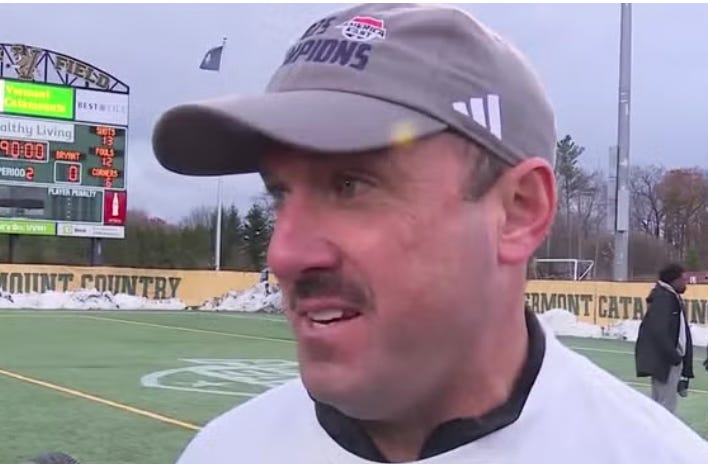
On December 10, Rob Dow officially accepted the head coaching position at Penn State University, leaving the University of Vermont men’s soccer program less than a year after winning the school’s first-ever team national championship. The timing stunned the Vermont soccer community—Dow built the Catamounts into the top-ranked team in the nation before a premature tournament exit ended their 2025 season just weeks ago.
Penn State, a member of the powerful Big Ten Conference, finished the 2025 season with a losing record of 5-8-4 and failed to qualify for postseason play. The contrast with Vermont’s undefeated regular season makes the move appear counterintuitive on the surface, but a deeper examination reveals significant structural factors driving the decision.
What Dow Built in Burlington
Dow’s legacy at UVM is extraordinary by any measure. The 2024 national championship run saw the Catamounts defeat second-seeded Pittsburgh in the quarterfinals, advance past Denver on penalties in the semifinals, and defeat Marshall 2-1 in overtime in the final. The championship game featured late-game heroics, with Marcel Papp equalizing in the 81st minute and Maximillian Kissel scoring the golden goal winner five minutes into overtime.
The team’s motto—“Not underdogs. Just dogs”—captured their refusal to accept a Cinderella narrative. A parade down Burlington’s Church Street drew thousands of fans celebrating the historic achievement.
Building on Success
The 2025 season demonstrated that the championship wasn’t a fluke. Vermont posted a 12-0-5 record in the regular season, earning the No. 1 overall seed in the NCAA tournament and the No. 1 ranking in national polls. Goalkeeper Niklas Herceg was named a semifinalist for the MAC Hermann Trophy, college soccer’s highest individual honor.
The season ended abruptly with a 3-2 overtime loss to Hofstra in the tournament’s second round, but the program had established itself as a national power.
Three Likely Reasons For Dow’s Move
The move becomes clearer when examining three key factors that created an irresistible opportunity for Dow.
1. Salary Differences
According to UVM’s public salary database, Dow’s base salary was $150,000. In the championship season, he earned approximately $68,000 in performance bonuses, bringing his total compensation to just over $200,000. UVM Athletics Director Jeff Schulman indicated that the university was in contract discussions with Dow, but as a tuition-dependent public institution, UVM faces hard budget constraints.
Penn State operates in a different financial universe. The athletic department reported $220.7 million in total revenue for the 2023-24 fiscal year, generating a $5.6 million profit. Football alone produced over $50 million in ticket sales. While Dow’s specific Penn State salary hasn’t been disclosed, Big Ten head soccer coaches at top programs earn between $400,000 and $600,000—potentially tripling Dow’s UVM compensation.
2. The Infrastructure Gap
Penn State’s Board of Trustees approved $9.8 million for the first phase of Jeffrey Field renovations. The project includes a standalone Soccer Operations Center with dedicated locker rooms, a soccer-specific strength and conditioning facility, and an air-supported dome over practice fields for year-round training. Plans call for increasing stadium capacity to 5,000 with chairback seating and covered grandstands.
UVM’s Virtue Field has served the program well, but facilities are shared across multiple sports. The scale of investment at Penn State—creating a self-contained, professional-level soccer complex—provides a significant recruiting advantage.
3. The Career Calculation
At 44, Dow appears positioned for the next phase of his career. Penn State’s previous coach, Jeff Cook, left to take a leadership role with an MLS club, signaling that Penn State serves as a pipeline to professional soccer. The Big Ten’s visibility and competition level—along with the conference’s strong track record of placing players in Major League Soccer—makes it a more direct path to the professional ranks than the America East Conference.
Vermont has produced recent MLS draft picks, including Max Murray and Sydney Wathuta following the championship season. However, Penn State’s consistent pipeline to the professional level, including three players drafted in 2023 alone, demonstrates sustained professional development infrastructure.
The UVM Challenge
Dow’s departure creates immediate concerns for Vermont’s future.
Recruiting Class at Risk
The most pressing issue involves the 2026 recruiting class. Sheridan McNish, a standout defender from the New England Revolution Academy who committed in July 2024, represents the caliber of recruit Vermont began attracting under Dow. McNish, who has been called up to Trinidad & Tobago’s U-15 national team, cited Vermont’s “relentless play style” when committing. With Dow leaving, recruits like McNish may reconsider their commitments, and Dow could potentially bring them to Penn State.
Transfer Portal Concerns
NCAA rules allow players a 30-day transfer window when a head coach departs. Vermont’s roster includes national championship players whose stock has risen significantly. Herceg, the MAC Hermann semifinalist goalkeeper, could attract interest from Power Four programs. International players, who often maintain stronger loyalty to coaches than institutions, face particularly uncertain futures.
The Brad Cole Factor
Associate Head Coach Brad Cole emerges as the likely internal successor. Cole, a UVM alumnus and former team captain, rejoined the staff in 2023 after coaching stints at Cornell and Portland. He’s credited with recruiting coordination for the championship roster and helped assemble Vermont’s first nationally ranked recruiting class. The university confirmed Cole will be considered for the permanent position.
Promoting Cole offers continuity—keeping the same system and relationships that made Vermont successful. For recruits and current players, seeing a familiar face in charge could prevent defections.
What Happens Next
UVM faces a critical two-week period. The athletic department must move quickly on Cole’s candidacy or begin a national search. Every day without clarity increases the risk of losing recruits and current players to the transfer portal.
For committed recruits like McNish, the decision becomes whether to follow Dow to Penn State’s upgraded facilities and Big Ten platform or honor their commitment to Vermont’s proven championship culture under new leadership. Current players must weigh loyalty to the program against opportunities elsewhere—particularly those with professional aspirations who now have championship credentials to market.
Penn State gains a proven winner who can immediately elevate recruiting. The combination of Dow’s championship pedigree and the new facilities investment positions the Nittany Lions to compete for Big Ten titles and return to NCAA tournament contention.
Vermont keeps its 2024 national championship banner, which will hang at Virtue Field permanently. The question is whether Dow built a sustainable program or a dynasty dependent on his presence. The answer will emerge over the next few seasons as the post-Dow era takes shape. The hire of his successor—and whether that person can retain the recruiting class and current roster—will determine if Vermont remains a national contender or returns to regional competitor status.