


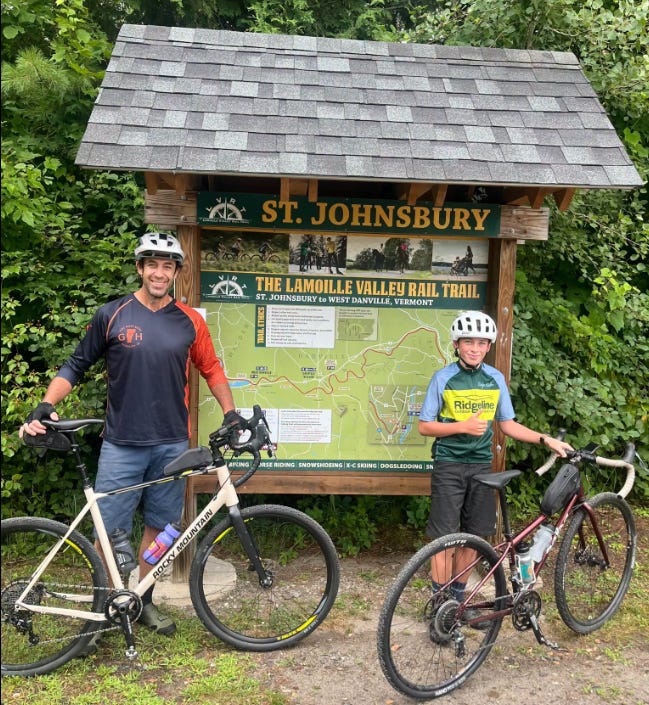
This is the first summer riders have had all of the Lamoille Valley Rail Trail. Not the first summer it exists — the last segment was finished in March 2023. The first summer they’ve had the whole thing. The state’s trail alerts and interactive map currently show no closed segments anywhere along it.
Zac Freeman of Braintree rode it this summer with his 10-year-old son. Freeman owns Apex Trailworks, and in June 2024 he cut, shaped, routered, sanded and painted the trail’s wooden mile-marker posts on an Agency of Transportation contract — about three weeks of work. The two of them started in St. Johnsbury, finished in Swanton, then kept pedaling to Lake Champlain and swam at Cohen Park. Their day came to 102 miles in roughly eight hours, an average just under 13 miles an hour, according to the account the agency posted this week.
Four summers ago the state scheduled that same ride for the governor and set aside 12 hours for it.
The seasons Vermont lost
Gov. Phil Scott’s end-to-end ride was set for Saturday, July 15, 2023. His office announced a 7 a.m. start in Swanton and a finish in St. Johnsbury, with Sen. Bernie Sanders — who secured the original federal grant for the corridor in 2005 — meeting him at the midpoint in Morrisville. Eleven water stops were planned along the way.
The flood came through on July 10. The Caledonian-Record reported that the ride was postponed and every state rail trail closed — washed-out sections, downed trees, impassable bridges — and that the ride would be rescheduled later. The Burlington Free Press put the damage to the trail at an estimated $11 million.
What followed:
June 2024 — a year on, VTDigger reported the trail was almost entirely open but two spots near East Hardwick were still closed, including a three-mile stretch that forced a 1.2-mile detour down a dirt road. “We are working to reroute traffic along local low-volume roads,” said Jackie Cassino, the agency’s rail trails program manager. The trail, the story noted, never had its grand opening party.
July 2024 — another flood damaged parts of it again.
2025 — a 5.5-mile segment at the St. Johnsbury end stayed closed for more than a year.
December 2025 — that segment reopened, and for the first time the trail ran continuously from St. Johnsbury to Swanton — with one signed detour left in West Danville.
Three of the trail’s first four seasons had a hole in them. This one started whole.
What it cost to build, and what one culvert cost to fix
Vermont Business Magazine put the cost of the conversion at about $31.5 million — roughly $339,000 for every mile of trail. The money that finished it came from Scott’s FY21 budget: $2.8 million from the state, matched by $11.3 million federal. Before that, the project ran for two decades on Sanders’s $5.2 million grant from 2005 and a good deal of scraping. Doug Morton of the Northeastern Vermont Development Association described the early years as collecting pennies from a jug at a gas station.
Then came the repair bill, and one line item carries the story. In May, the congressional delegation announced that FEMA had released $6,168,905.58 to the Agency of Transportation to repair a culvert on the trail that floodwater washed away in July 2023.
One culvert cost about a fifth of what the entire trail cost to build.
That money also sat for nearly three years. VTDigger reported that funding for many 2023 recovery projects stalled in part because of an order from then-Homeland Security Secretary Kristi Noem imposing extra scrutiny on FEMA requests above $100,000, a policy her successor rescinded. The delegation called the delay a glaring example of an agency in need of reform. Some of the seasons Vermont lost were lost in Washington.
What a full season is worth
The argument for the trail was always economic. A 2022 analysis of the 38 miles running through St. Johnsbury, Danville, Walden, Hardwick, Greensboro and Cabot found the trail could generate up to $4.7 million a year in sales activity — from less than half the corridor.
The demand showed up even in the broken years. Counters recorded more than 50,000 trail uses in Morrisville and more than 20,000 each in Cambridge, Johnson and Wolcott in the second half of 2024. News & Citizen reported last September that most stops were on pace to far exceed the previous year, with riders coming through from New York to New Hampshire and stopping in towns for provisions, repairs and a drink. Wolcott alone logged 20,253 users in half a year with almost nothing built to catch them.
Those were seasons with miles missing. Nobody yet knows what a whole one looks like.
Who carries it
The trail is the state’s to keep up. VTrans resumed full maintenance and operation of the entire corridor on July 1, 2023, nine days before the flood. The Vermont Association of Snow Travelers, the statewide snowmobile organization that spent two decades building the thing, now grooms it for snow travel from mid-November to mid-April.
The corridor is the exposure. It follows a railbed that carried trains until 1994, built low and tight along water the way railroads were. Thirty-six of its miles run alongside the Lamoille River, and it holds 525 culverts and 53 bridges. One of those culverts just cost $6.2 million and three years.
Nothing is closed today. Final repairs at the St. Johnsbury end remain on the schedule for this construction season, and that section may close briefly while crews finish. That’s the ordinary business of owning 95 miles of trail, and a different thing from losing a summer.
The ride that hasn’t happened
Scott has ridden pieces of it. Last September he rode more than 45 miles of the trail with police officers and state troopers before a Montpelier ceremony honoring fallen officers. The end-to-end ride the state planned for July 2023 — the water stops, the crowd waiting in St. Johnsbury — has never been rescheduled.