


Whatever Happened to the Person Whose Tracks We Followed?
On Saturday, March 22, two skiers at Stowe followed someone else’s tracks into terrain they didn’t know — and ended up “cliffed out” on an icy chute with no way up or down. Stowe Mountain Rescue got them out. Here’s what the tracks never told them.
Two young skiers stood at the top of what looked like a promising line at Stowe Mountain Resort on Saturday, March 22. Someone had been there before them. The tracks said so. That’s all the reassurance they needed.
It wasn’t enough.
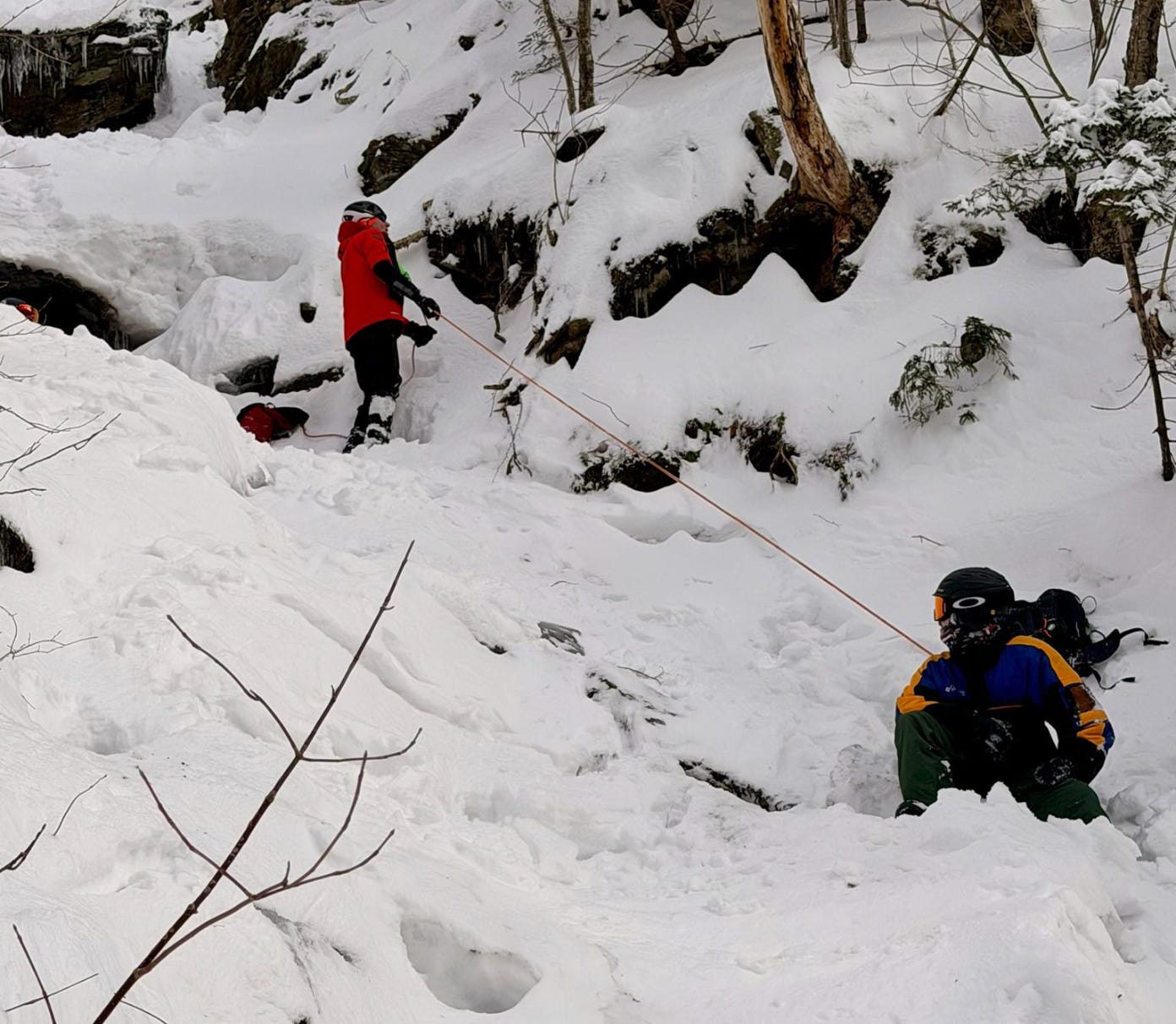
By the time they realized something had gone terribly wrong, they had removed their skis, been funneled into an icy chute, and found themselves frozen — literally and figuratively — on a cliff face with no safe way up or down. They did the right thing and called for help. Stowe Mountain Rescue did the rest.
But the question that every skier who has ever followed a set of tracks should sit with is the one these two young men never thought to ask before they dropped in: Whatever happened to the person who made those tracks?
The Rescue
Stowe Mountain Rescue teams responded Saturday to two skiers stuck, or “cliffed out” in the Notch — a rugged, unpatrolled terrain corridor at the edge of the resort’s boundaries. The men had never intended to leave the resort. But a seductive set of tracks led them off the edge of what they knew, into what they didn’t.
They were drawn into a gully. Believing they could push through to easier terrain, they pulled off their skis. The situation worsened. An icy chute offered no safe path in any direction. To their credit, they stopped, called for help, and agreed to stay put.
Rescue coordinators sized up the problem and deployed two fully equipped teams simultaneously — one ascending from the bottom via the Notch road by ATV and then on foot; a second riding the Sunny Spruce chair lift and traversing half a mile in snowshoes to approach from above. The terrain required eyes-on assessment before any extraction plan could be committed to. The bottom team reached the men first, climbing up to them and belaying them safely out of the chute.
No injuries. Plenty of daylight. Kind weather. Stowe Mountain Rescue will tell you those conditions are a gift they don’t always get.
The two skiers were shaken, grateful, and very clear about what they had done wrong. They had been frightened in a way that reorients a person. They had genuinely wondered whether they might die on that mountain. They savored the prospect of sitting down to eat a meal that night — alive. “No way they’ll blindly follow tracks again,” Stowe Mountain Rescue wrote in their account of the rescue.
What the Tracks Don’t Tell You
In the skiing world, experienced backcountry skiers have a term for this: sucker tracks. Tracks that look like an invitation but are actually a trap — not because whoever made them intended harm, but because the person who made them and the person following them are operating with completely different information, skill sets, and equipment.
There are several reasons the tracks you’re following can lead you somewhere the original skier never got stuck.
They knew the exit.
The most common explanation is the simplest: the skier ahead of you knew exactly where they were going and used a traverse, a specific narrow passage, or a route line you never saw — because you were following their downhill path, not their lateral one. The tracks appear to stop at the edge of a cliff not because the skier vanished, but because they angled out of the terrain in a direction you didn’t follow. Veteran skiers have described watching others follow their tracks straight to the top of a cliff, forced to hike out the long way, because the original skier had already found an exit the followers never saw.
They had skills you don’t.
Experienced skiers note that following tracks only makes sense if you’re confident the person who made them isn’t more capable of handling a difficult feature than you are. A set of tracks leading to a cliff band may mean the original skier dropped cleanly off a feature that would be catastrophic for someone less experienced. The tracks end at the lip — not because there was no cliff, but because the skier flew over it intentionally.
Wind and weather filled the gap.
Mountain weather erases history fast. High winds, changing temperatures, and new snow can obscure cliffs, cornices, and crevices that were perfectly visible when the original tracks were made. A skier who passed through at 9 a.m. on soft snow left tracks that told one story. By early afternoon, wind-deposited snow may have softened those tracks into gentle suggestions — while the underlying terrain grew icier and more committed. The tracks age. The danger doesn’t.
They got cliffed out too — and got lucky.
Every year, skiers are rescued from mountainsides because they went the wrong way and ended up at the top of a cliff with no way out. The person whose tracks you followed may have jumped something marginal, gotten rescued themselves, or hiked out after a terrifying realization. Their tracks are not a safety certification. They’re just marks in the snow.
The terrain funneled both of you.
Gullies and chutes have a physics problem: they narrow as they steepen. A sparsely tracked slope can be a red flag — it may mean those who attempted the line before encountered serious trouble, perhaps a cliff band or a debris field blocking the route. Following tracks into a gully is like reading a sentence that gets progressively harder to finish — until you’re committed and the only question is how you exit.
The Psychology of the Track
There is a deeper reason humans follow ski tracks without questioning where they lead. Psychologists call it social proof — the cognitive shortcut that tells us if someone else did something, it must be safe to do. On a mountain, where the terrain is unfamiliar and the stakes are high, that shortcut becomes a liability.
“They never even intended to leave the resort.” — Stowe Mountain Rescue
In a nearly identical rescue at another mountain, skiers insisted after the fact that they had been “doing it safely” because they had already followed the same route earlier that day without incident — even as they stood there with no rescue gear, no beacon, no probe, no shovel, and no knowledge of the exit routes. The tracks had told them it was fine. The tracks were wrong.
The sensation of following a track is reassuring in the way that most reassuring things are: it offloads responsibility. Someone else made this decision. Someone else went first. That’s not the same as someone else having made it safely — or having made it under the same conditions, with the same equipment, on the same snow.
Stowe Mountain Rescue put it plainly in their account of Saturday’s rescue: the two skiers made “the classic mistake of following others’ ski tracks into unfamiliar terrain, assuming that their mysterious predecessor was ‘in the know.’”
Note that word: mysterious. They never knew who made the tracks. They never knew when. They never knew how the story ended for the person who left them there.
What Comes Next
The two young men rescued in the Notch plan to share their story. Stowe Mountain Rescue hopes they will. “Every experience like this carries the potential to prevent future incidents,” the team wrote. “Hopefully there’ll be a pod of their contemporaries who hear about and heed their lesson.”
That lesson the rescue squad emphasizes in its shortest form: tracks are a record of where someone was. They are not a promise of where you’ll end up.
The next time you see a line threading through the trees, dropping into a gully, or angling toward terrain you don’t recognize — before you follow it, ask the question these two skiers didn’t ask.
Whatever happened to the person who made those tracks?
Make sure you know the answer before you find out the hard way.
Stowe Mountain Rescue is a volunteer organization. To learn more or support their work, visit their Facebook page.