


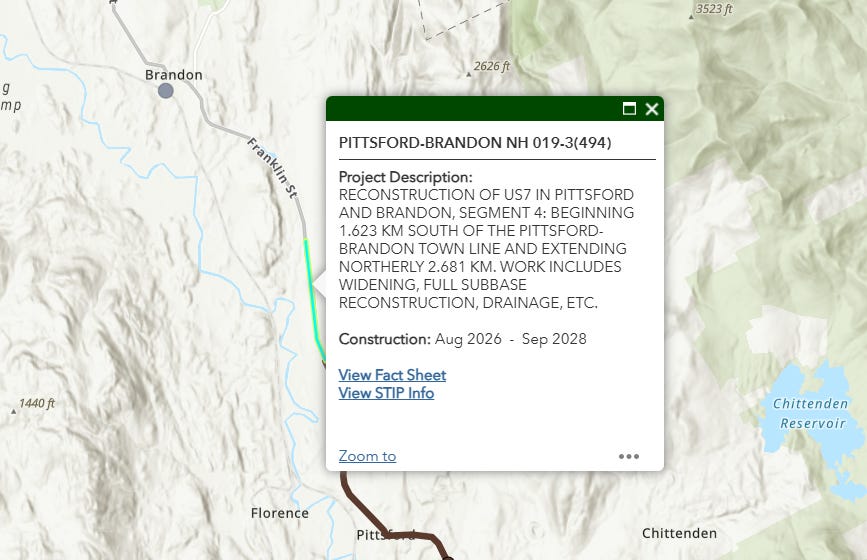
Vermont’s congressional delegation announced Monday that the state has secured $19,719,310 in federal funding to complete the reconstruction of U.S. Route 7 between Pittsford and Brandon. Sens. Bernie Sanders and Peter Welch and Rep. Becca Balint said the money — awarded through the U.S. Department of Transportation’s BUILD grant program and drawn from the 2021 Bipartisan Infrastructure Law — will pay for roadway reconstruction, widening, drainage and culvert replacement, bridge upgrades, safety work, and wildlife-crossing improvements.
What the announcement doesn’t say is how long Vermonters have been waiting for it.
The drive to rebuild this stretch of the Ethan Allen Highway dates to 1996, when the calcium-carbonate producer Omya was weighing an expansion at its Florence plant and wanted assurance that Route 7 could carry its truck traffic. A steering committee formed that year to study improvements between Rutland and Brandon; talk of a Brandon bypass reached back further still, to the 1950s, before concerns about downtown businesses killed it. (As recounted by former Rutland County Sen. Peg Flory, then chair of the Pittsford Select Board, in the Mountain Times.)
In the years since, the Vermont Agency of Transportation carved the corridor into a string of segments and rebuilt them one at a time. Brandon’s downtown stretch — Segment 6, branded “An Even BETTER Brandon” — broke ground in 2017 at $20.8 million and nearly collapsed under right-of-way delays before it was finished. Monday’s award covers what the delegation called the completion of the job.
The rebuilds have been more than cosmetic. When Tropical Storm Irene sent the Neshobe River over its banks and down Route 7 through the heart of Brandon on Aug. 28, 2011 — closing the highway, floating the Brandon House of Pizza off its foundation, in what was then the worst flooding Vermont had seen since 1927 — the stretch rebuilt a year earlier just south of downtown, Segment 5, came through unscathed, its new drainage performing as designed, according to the project’s engineers. Downtown itself, not yet reconstructed, was not so lucky. When VTrans later rebuilt the downtown stretch, it added a large overflow culvert; town officials credit that culvert with sparing Brandon during major floods in July 2017 and again in July 2023. An earlier segment also added a dedicated wildlife passage connecting to the Pomainville Wildlife Management Area — the kind of feature this grant folds in as “wildlife crossing improvements.”
Analysis. The grant lands at a revealing moment for how Vermont pays for its roads. State transportation officials have warned that gas-tax revenue — the traditional source for projects like this — is eroding as vehicles grow more efficient and more Vermonters drive electric. A corridor first driven by industrial truck traffic is being finished largely on one-time federal dollars, at a moment when the state’s own road-funding model is under strain.
The delegation noted that Sanders sits as a senior member of the Senate Environment and Public Works Committee, which oversees the grant program.
Compass Vermont is independent, reader-supported Vermont news.