


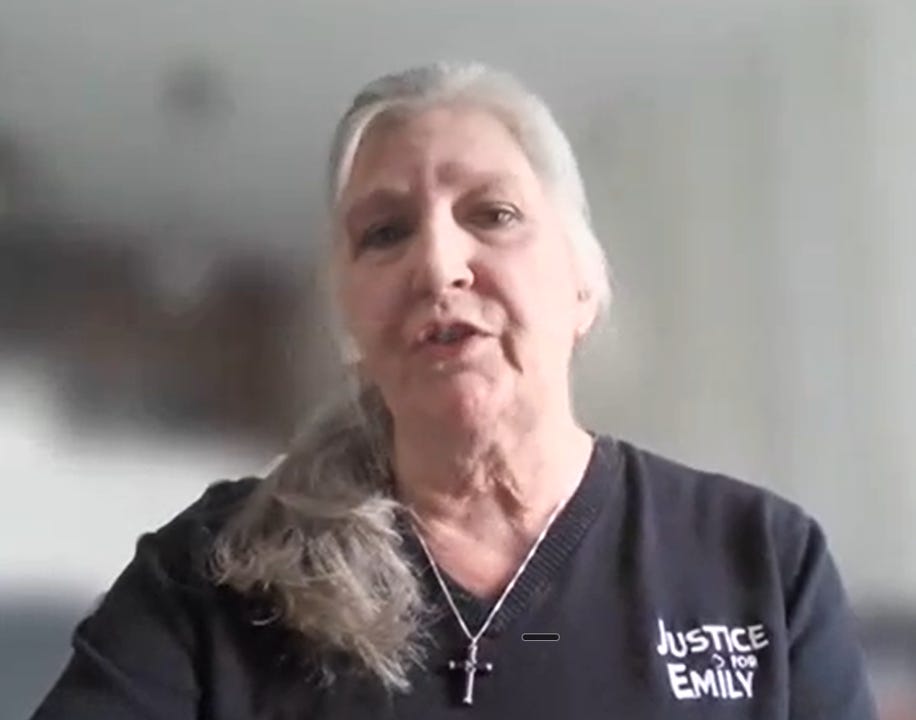
At today's press conference, Governor Scott, law enforcement, and the mother of a murdered Bennington woman laid out a simple case: Vermont has no secure facility for people who commit violent crimes and are found mentally unfit for trial. The legislature has two days to act.
Here is what Governor Phil Scott wants you to understand: if someone in your community commits murder, sexual assault, or kidnapping and is found mentally unfit to stand trial, Vermont has nowhere to put them.
No secure treatment facility. No program to restore their mental fitness so they can face trial. And in many cases, no supervision after they are released back into the community.
At his press conference today, the governor stood alongside prosecutors, law enforcement officials, a state commissioner, and Kelly Carroll — a Bennington mother whose daughter Emily Hamann was murdered in 2021 by a man the system had already identified as dangerous, released, and left without formal supervision. The governor made his case for a bill that would begin to close this gap. The legislature has two days before the session ends.
They know who these people are
Kim McManus, a legislative and policy attorney for the Department of State’s Attorneys and Sheriffs, put the scope of the problem in plain terms.
“All 14 of our state’s attorneys, all 14 of our sheriffs could name individuals in their community who they are worried about,” she said. “Who they know pose a risk, but who are out in our communities because they have been found incompetent. And there is nowhere for them to go.”
The bill currently before the House would apply to a narrow group — people charged with crimes punishable by life sentences who have been found mentally unfit to participate in their own defense. That’s an estimated five or six people at any given time. Most of them are already being held in state custody. But McManus said the broader population of violent offenders with competency issues is much larger, and broadening the bill’s scope “will be the next step.”
When the governor was asked whether any of these individuals are currently living in the community unsupervised, his team said they would need to check — but acknowledged that people in this situation have been placed in the community before. Carroll’s daughter was killed by one of them.
Why the debate keeps stalling — and what most people don’t know
For five years, the legislature has argued about where to put this facility. One side says it should be run by the Department of Mental Health. The other says the Department of Corrections. Each side has blocked the other’s proposal. Nothing has been built.
What most Vermonters probably don’t know — and what today’s press conference made clear — is that the mental health option may not be available at all.
Vermont’s existing psychiatric facilities, including the Vermont Psychiatric Care Hospital in Berlin and the River Valley Therapeutic Residence, are classified under federal rules as Institutions for Mental Disease. If those facilities accept this population, they risk losing their Medicaid funding — the federal dollars that keep them running.
Carroll, who has followed this issue through four legislative sessions, explained it directly: “The legislature’s tried to push this through DMH and DAIL, but because our facilities are what they call IMD institutions, they cannot take these patients because they will lose all Medicaid funding. And we cannot afford to lose Medicaid funding for the Berlin Psych Hospital or River Valley.”
That leaves two realistic options. Build a brand-new standalone facility under a health agency — which testimony has estimated would take five to ten years. Or use clinical space inside an existing correctional facility, which is what the bill proposes and which could be operational almost immediately.
“It’s not perfect,” Carroll said. “But it’s basically where we’ve kicked that can down to. This is our only alternative to get something started.”
What this would actually look like
The facility would not be a prison ward. Clinical services would not be provided by corrections officers. According to the DAIL Commissioner, Dr. Davone, who has worked in forensic psychiatry in New York and Pennsylvania, restoration services would be delivered by providers with specialized forensic training — and overseen by the Agency of Human Services, not DOC.
“What’s most important is what happens inside the facilities, not which facility they are in,” Dr. Davone said.
The DOC Commissioner confirmed that the department is already housing several individuals who would qualify under this bill. “We are doing that with the staff that we currently have,” the Commissioner said. The bill would formalize what is already happening — and add the treatment component that doesn’t currently exist.
What Carroll wants you to hear
Carroll has testified before five committees across four legislative sessions. Today she spoke to the public.
She traced her daughter’s killer through Vermont’s system: violent assaults in 2015 and 2016, an attempted murder of a family in Pownal in 2018, release in 2020 into the custody of a local mental health agency, a violent incident the night before her daughter was killed — and Emily Hamann’s murder the next morning.
“Each time it gets through the Senate, but then it hits a roadblock in the House,” she said. “And the only result is more years of studies and more delays. And with every delay unfortunately comes more victims.”
She addressed lawmakers who have told her that victims don’t belong in this debate. “We have been told that we do not understand or have the experience or the knowledge to understand the complexity of the issues at stake,” she said. “And that is not true. We are not asking for punishment. We are asking for a system — one that provides monitoring, supervision, programming, treatment, and accountability. Because right now Vermont doesn’t have one.”
Two days
The governor said he hopes the House will not “let the perfect be the enemy of the good.” He acknowledged that a DOC-based facility is not the ideal long-term answer. But he said it is the only option that can provide immediate relief while the state works toward something better.
The bill is currently in House Judiciary. It is also being reviewed by House Human Services, House Corrections and Institutions, and House Health Care. None of the four committees has voted. The session adjourns Friday.
Amy Farr, director of Victim Services for the Vermont State Police, noted that the bill would do something no previous law has done: give victims notice and a voice in proceedings that have historically been closed to them. “For the first time, it offers a pathway for resolution and accountability in cases that would probably most likely otherwise be dismissed,” Farr said. “And this is a huge step forward for victims and communities.”
Carroll has been asking for this since January 18, 2021 — the morning her daughter was killed on the Riverwalk in downtown Bennington.
This is the latest in a series of Compass Vermont reports on Vermont’s competency gap. Read the full background, including the legislative history, the families affected, and how other states have addressed this issue.
Compass Vermont is free, independent, and has no ads, no sponsors, and no corporate owner. If you value reporting that gives you the full picture and lets you draw your own conclusions, please consider subscribing or upgrading to a paid subscription.