


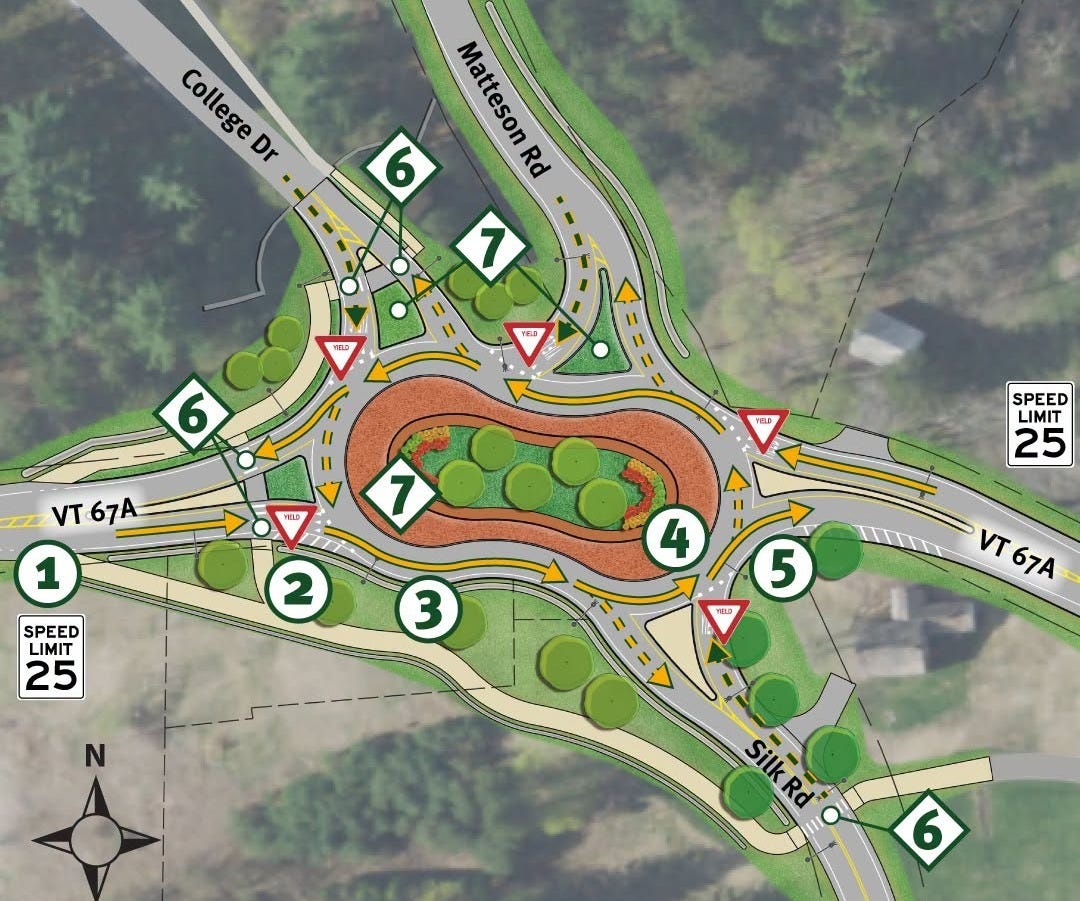
At the bottom: VTrans’s seven rules for driving the Bennington roundabout, including what to do if you miss your exit.
Roundabouts get about the same reception as Brussels sprouts. Tell people one is coming, and they push back. Then they try it.
On Friday, the Vermont Agency of Transportation posted a seven-step guide to driving the roundabout on VT 67A in Bennington, near the entrance to Bennington College. It is a peanut-shaped roundabout: an oval pinched in the middle, built to handle several intersections that sit too close together for a single circle. It replaced the old intersections of VT 67A with College Drive, Matteson Road and Silk Road, and the project was substantially complete Aug. 7.
Brussels sprouts earned their bad reputation honestly. In the 1990s, Dutch researchers tied much of their bitterness to two compounds, sinigrin and progoitrin, and breeders have since developed milder varieties. Sprouts had to change before people came around. Roundabouts don’t change. The drivers do.
The Insurance Institute for Highway Safety surveyed drivers in communities that were getting roundabouts. Before construction, 31% supported them. Shortly after, 63% did. Once the roundabouts had been in place for more than a year, support averaged about 70%. In another study, of two roundabouts near Bellingham, Washington, support went from 34% before construction to 70% a year after.
Vermont Isn’t Alone in Explaining Them
VTrans’s guide went up on the last day of National Roundabouts Week, which the Federal Highway Administration observed Sept. 21-25. Transportation departments across the country have spent real effort teaching drivers how new roundabouts work, including states with hundreds of them:
Washington State held “roundabout rodeos,” where people brought their biggest vehicles and drove a full-size mock roundabout laid out in a parking lot
Missouri sent a roundabout video to driver education programs statewide, and its engineers spoke to driver ed classes
Sioux Falls, South Dakota, set up a mock roundabout with traffic cones so residents could try it before the real one opened
Vermont did something similar this summer for a different kind of intersection. Before Colchester’s new Exit 16 interchange opened Sept. 17, VTrans put a driving simulator at the Champlain Valley Fair. The new design, called a diverging diamond, briefly moves drivers to the left side of the road so they can turn onto I-89 without crossing oncoming traffic.
The Vote Comes Before the Drive
The surveys point to a problem for any town weighing a roundabout: the decision gets made when support is at its lowest.
Bennington is the next test. The state has proposed three more roundabouts at intersections along Northside Drive and Route 7. When the design was presented in November, the Select Board put off its vote so members and residents could study it, the Bennington Banner reported. The consultant working with the state estimated construction was probably about 10 years away. About a month later, the board approved the preferred design 5-1. The member voting no said residents hadn’t had enough time to learn about the plan and weigh in. Unlike the drivers in the IIHS surveys, Bennington’s now have the peanut roundabout to go on.
The case for building them is safety. The Federal Highway Administration finds that replacing a two-way stop with a roundabout cuts crashes that kill or injure people by 82% on average. Replacing a traffic light cuts them by 78%. Drivers enter slowly and all travel in the same direction, which removes most of the chances for high-speed, side-impact and head-on crashes at conventional intersections.
The research also has a caution, and it applies to Bennington. The state’s preferred plan mixes single-lane roundabouts with ones that have two lanes in places. In the Bellingham study of two-lane roundabouts, more than 40% of drivers still said a year later that the signs and pavement markings didn’t make clear how fast to go or who had the right of way. Crashes that killed or injured people declined, but crash rates for fender-benders rose, although that increase was statistically significant at only one of the two roundabouts. Drivers 70 and older became substantially less likely to use that stretch of road, suggesting some were taking another route. Across the IIHS surveys, younger drivers were the most supportive and older drivers the least.
Vermont Got There First
Vermont was an early adopter. Montpelier’s Keck Circle, built in 1995, was the first modern roundabout built on a state highway anywhere in the United States. In 2002, the Legislature directed VTrans to “carefully examine and pursue” roundabouts at intersections that pose safety hazards.
Vermont has built relatively few since then. A July 2026 extraction of the Kittelson national roundabout database, published by RoadSigns.com, lists 21 roundabouts and traffic circles in Vermont, ahead of only South Dakota among the 50 states. For a state this size, that works out to about three for every 100,000 residents, somewhat below the national rate of about four and a half. Massachusetts is at about the same rate as Vermont. The database is maintained by volunteers. It also counts traffic circles, the older, often larger and faster circular intersections that predate modern roundabouts, so it is the best available count rather than an official one.
That may be the biggest problem roundabouts face. Communities usually have to decide whether they want one before the drivers being asked to judge it have had a chance to drive it.
How to Drive the Bennington Roundabout
From VTrans:
Slow down. Reduce your speed to 25 mph approaching and going through.
Yield before entering. Traffic already in the roundabout has the right of way. Wait for a safe gap.
Go counterclockwise. Drive around to the right, following the signs, pavement markings and islands.
Don’t stop once you’re in. If you miss your exit, go around again. Don’t stop for cars waiting to enter, because you have the right of way.
Signal your exit. Use your turn signal as you approach the exit you want.
Watch for people walking and biking. They have the right of way at the crosswalks on College Drive, VT 67A and Silk Road.
Expect big vehicles to use the edges. Trucks, buses and emergency vehicles may drive over the low, paved ring around the center island and some of the raised islands to make wider turns.