


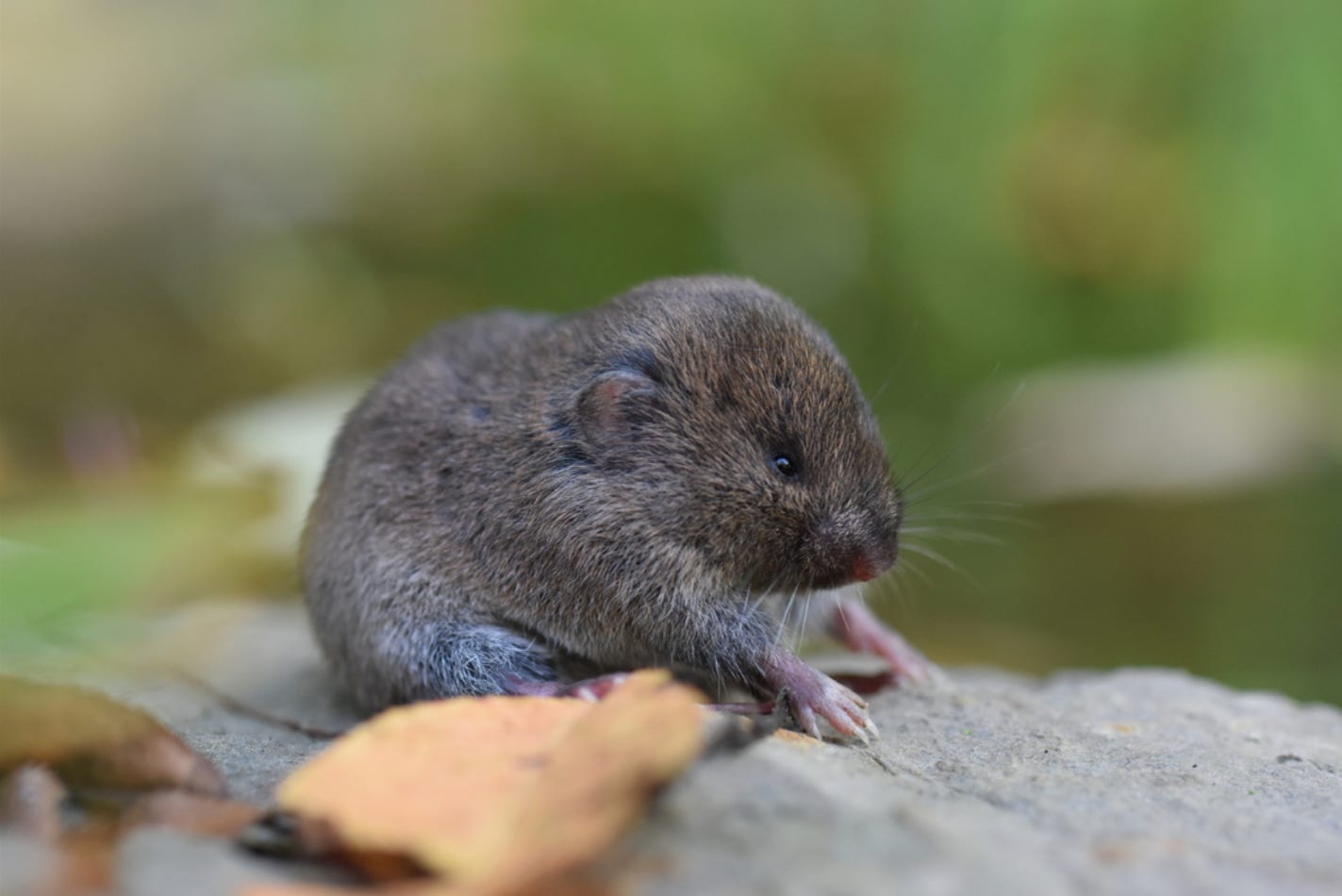
If you mention the word “lemming,” most people immediately picture a fuzzy line of rodents mindlessly marching off a seaside cliff. It’s a cultural trope that has been used to describe everything from political followers to fashion victims.
There’s just one problem: it’s entirely made up.
The myth of the “suicidal lemming” was largely popularized by a 1958 Disney nature documentary called White Wilderness, where filmmakers notoriously herded lemmings off a cliff to create dramatic footage. In reality, lemmings are highly intelligent, solitary, and resourceful survivors. They don’t commit mass suicide; they are simply determined explorers who occasionally find themselves in over their heads—literally—when trying to swim across bodies of water during natural migrations.
In Vermont, we have our very own local celebrity: the Southern bog lemming. And far from being a mindless follower, this “adorable” resident is actually a vital indicator of our state’s environmental health.
Vermont’s Secretive Resident
The Southern bog lemming is a master of the “cute and tiny” category. With its chunky body, short tail, and grizzled brownish fur, it looks like a cross between a hamster and a meadow vole. But unlike the common vole, the bog lemming is a specialist. It lives in the hidden, soggy corners of our state—sphagnum bogs, wet meadows, and cedar swamps.
These little guys are essentially the “ecosystem engineers” of the wetlands. They create intricate tunnel systems through the moss and grass, providing aeration for plants and “highways” for other small insects and mammals. They are also unique for their diet, feeding almost exclusively on bright green grasses and sedges.
However, because they rely on very specific, pristine wetland habitats, they are vulnerable. That is why the Southern bog lemming is taking center stage in a massive new effort to protect Vermont’s wilderness.
Beyond the Lemming: Vermont’s Other “Greatest Needs”
While the lemming is a charming face for conservation, it is only one of many species the Vermont Fish & Wildlife Department (VFWD) is fighting to protect. The new draft of the Wildlife Action Plan highlights several other high-priority residents that face unique challenges:
The Mysterious Lake Sturgeon: This prehistoric “living fossil” can live for over 100 years and grow to over six feet long. Once abundant in Lake Champlain, they were nearly wiped out by overfishing and dam construction. Because they don’t even begin to spawn until they are roughly 15 to 25 years old, their recovery is a slow, multi-generational process that requires careful management of river access.
The “Goldilocks” Orchid: The small whorled pogonia is one of the rarest orchids in North America. It was actually presumed extinct in Vermont for over a century until a small population was rediscovered in 2021. This “fickle” flower requires very specific conditions—just the right amount of light, moisture, and soil fungi—meaning that even minor changes to its forest home can cause it to vanish again.
The Humble Wood Turtle: Known for its beautifully “sculpted” shell and orange-tinged neck, the wood turtle is a traveler. While it winters in streams, it spends its summers foraging up to 1,000 feet away in woods and meadows. This makes them especially vulnerable to habitat fragmentation, as they must often cross dangerous roads to find food or nesting sites.
These species are designated as “Species of Greatest Conservation Need” (SGCN). This classification doesn’t just mean they are “at risk”—it acts as a formal trigger for federal funding and state-level protection strategies.
A 10-Year Roadmap for Vermont’s Wild Places
The VFWD recently unveiled this newly drafted update to the state’s strategy, which is revised every decade. According to Dr. Rosalind Renfrew, who leads the department’s Wildlife Diversity Program, the plan is the result of two years of collaboration between state biologists, faculty from the University of Vermont and Middlebury College, and various non-profit partners.
“Our biologists have teamed up with outside experts... to update Vermont’s SGCN list and identify new conservation strategies,” Renfrew stated. “Now, a new draft of Vermont’s 10-year Wildlife Action Plan is ready for public input.”
Shifting Focus: From Single Species to Whole Landscapes
The logic of the new plan is simple: if you protect the bog where the lemming lives, you also protect the rare orchids, the water quality for the fish downstream, and the carbon-sequestering mosses that help fight climate change.
“The speed and scale of threats like climate change and habitat loss mean that single-species conservation measures alone cannot keep pace,” Renfrew explained. To address this, the plan utilizes Vermont Conservation Design (VCD), a strategic mapping initiative that identifies the most critical “habitat blocks” and wildlife corridors across the state.
How You Can Help
The Vermont Fish & Wildlife Department is now looking for Vermonters to weigh in on the plan. The public comment period is open through February 27, 2026.
How to get involved:
Review the Plan: The draft is available on the Vermont Fish & Wildlife website.
Submit Comments: Use the official online feedback form.
Attend a Meeting: A series of public presentations (all at 6:00 p.m.) will be held across the state:
Jan 22: Edward Kehoe Conservation Camp, Castleton
Feb 5: U32 Middle and High School, Montpelier
Feb 10: Orleans Lake Region Union High School, Orleans
Feb 17: Virtual meeting via Microsoft Teams
By participating, Vermonters can ensure that secretive residents like the Southern bog lemming continue to thrive—far away from the cliffs of myth and safely within the bogs of reality.