


At the bottom: how to have two justices of the peace bring your ballot to you, how to mark it privately at home, when it’s due back, and how to check that it arrived.
Disabled Vermonters voted nearly as often as disabled Americans nationally in 2024, according to Census survey estimates in the 2026 Annual Disability Statistics Compendium from the University of New Hampshire. What sets Vermont apart is how often everyone else votes.
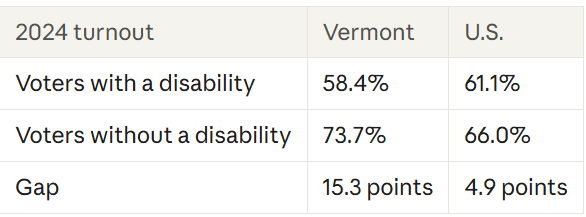
The gap is the difference between those two rates. Vermont’s is 10.4 points wider than the nation’s. About three-quarters of that, 7.7 points, comes from nondisabled Vermonters voting more than nondisabled Americans. The rest, 2.7 points, comes from disabled Vermonters voting less than disabled Americans.
That 2.7-point difference is too small to distinguish confidently from sampling variation. Vermont’s estimates carry margins of error of about 7.5 points for disabled voters and 4.1 points for everyone else.
About one in five eligible Vermont voters has a disability: 94,600 people, or 17.9% of the electorate, by Rutgers University’s 2024 projection.
What the Numbers Show, and What They Don’t
Disability advocates point to the MIT Elections Performance Index, a national scorecard of how states run elections, which ranks Vermont near the bottom on disability access. That ranking uses the same kind of comparison, averaged across three elections. A state where everyone else votes heavily can rank low even if its disabled residents vote near the national rate for people with disabilities.
The gap shows that disabled Vermonters vote less often than their neighbors. By itself, it does not establish why, or whether Vermont makes voting harder for them than other states do.
Nationally, 35.9% of registered people with disabilities who did not vote in 2022 cited illness or disability as their main reason. That response does not establish whether additional voting assistance would have helped. Connecting Vermont’s unusually wide turnout gap to shortcomings in its voting arrangements requires evidence beyond the turnout comparison.
Some evidence of barriers exists. In its 2024 fiscal year, Disability Rights Vermont surveyed polling places in six towns with about 34,000 residents combined. It found accessibility problems under the Americans with Disabilities Act and sent clerks recommendations for temporary and permanent fixes. The report doesn’t name the towns, say which problems remain, or say whether anyone was unable to vote because of them.
Nursing Homes and a Federal Memo
On July 20, the federal Centers for Medicare and Medicaid Services sent nursing homes a memo reminding them to protect residents’ right to vote free of pressure or interference. It cited two cases:
A Texas social worker charged with 134 felony counts for registering residents of a state facility without their consent.
A Wisconsin law enforcement investigation into allegations that eight nursing home residents whose mental capacity had declined cast mail ballots.
The memo bars staff from registering residents or filling out their ballots without permission. It also requires homes to help residents who want to vote. It says it creates no new rules.
Vermont’s long-term care ombudsman, Kaili Kuiper of Vermont Legal Aid, told VTDigger she worried facilities would read the memo as a reason not to help any resident showing signs of memory loss. The CEO of the Vermont Veterans Home in Bennington told the outlet the process there is the same as in past elections.
Vermont law lists four requirements to vote: U.S. citizenship, Vermont residency, taking the voter’s oath, and being 18. It says nothing about mental capacity or guardianship. Vermont’s courts list voting among the rights a person keeps under guardianship.
The Vermont Health Care Association’s September guidance tells homes to ask residents whether they want to vote, help those who ask, and write down the resident’s permission first.
What Vermont Already Does
Vermont provides several voting options and forms of assistance:
Since 2021, the state has mailed a general election ballot to every active voter, with return postage paid.
Every polling place has an accessible voting tablet that prints the same paper ballot everyone else uses.
Two justices of the peace from different parties will bring a ballot to a voter who is ill or disabled, even on Election Day.
Voters who are ill, injured or disabled can mark an accessible ballot online, then print and return it.
The Secretary of State’s office also launched a voting accessibility task force in November 2025 to identify barriers and recommend fixes.
Turnout among disabled Vermonters rose from 45.1% in the 2018 midterm, before every voter got a mailed ballot, to 49.9% in the 2022 midterm. Turnout among other Vermonters rose too, from 56.3% to 64.1%. Survey snapshots can’t isolate what the mail-ballot law did on its own.
Voting With a Disability in November: Your Options
Here is what Vermont law allows, so you can decide what works for you.
Your ballot should already be in the mail. The state had to finish mailing general election ballots to every active voter by Oct. 1, with return postage paid. If yours hasn’t arrived, call your town clerk. You can check whether your ballot was mailed, and whether it came back, on the Vermont Voter Portal.
When it’s due back. Return your ballot one of three ways:
By mail, so it reaches your town clerk before the polls close at 7 p.m. Tuesday, Nov. 3. It has to arrive by then, so mailing at least a week ahead is the safe choice.
To your town clerk’s office or a secure drop box by the close of business Monday, Nov. 2.
To your polling place by 7 p.m. Tuesday, Nov. 3.
You can have your ballot brought to you. If illness, injury or disability keeps you from the polls, tell your town clerk when you ask for a ballot. Two justices of the peace from different parties will bring it to you and carry it back, even on Election Day. Requests are due by 5 p.m. or the clerk’s closing time the day before the election, or earlier if your clerk’s office is closed that day. Clerks can accept emergency requests after that. Ask early.
You can mark your ballot privately at home. If you’re ill, injured or have a disability, you can request an accessible online ballot through the Vermont Voter Portal and mark it with your keyboard or assistive technology. You still have to print the ballot and its certificate, sign the certificate, and return the paper by mail or in person.
At the polls, you can:
Use the accessible voting tablet, which prints the same paper ballot everyone else uses.
Bring anyone you choose to help you, except your employer, someone acting for your employer, or an officer or agent of your union.
Ask two election officials to help you.
Ask for your ballot to be brought out to your car.
Bring a magnifier or a written list of your choices into the booth.
Returning ballots for someone else. Anyone can return up to 25 ballots to a town clerk or drop box. Justices of the peace delivering ballots are exempt. Candidates and their paid campaign staff can return only their own ballot, the ballot of an immediate family member or someone they care for who asked for their help, or ballots they deliver as a justice of the peace on official duty.
If you live in a nursing home or have a guardian. Having a guardian does not take away your right to vote. You choose who helps you, and the home must get your permission before staff assist.
Who to call:
Secretary of State, Elections Division: 1-800-439-8683
Disability Rights Vermont: 1-800-834-7890
Vermont Center for Independent Living: 1-800-639-1522
We put the facts in context so you can put the news in perspective. If you value that work, please consider a paid subscription to Compass Vermont.