


The 42-day partial shutdown of the Department of Homeland Security is heading toward a resolution. In a unanimous voice vote shortly after 2 a.m. Friday, the Senate approved legislation funding most of DHS — including the Transportation Security Administration, the Coast Guard, FEMA, and the Cybersecurity and Infrastructure Security Agency — through the end of the fiscal year.
The bill excludes funding for Immigration and Customs Enforcement and Border Patrol, the agencies at the center of the political fight. The House is expected to vote on the measure as early as Friday afternoon.
Hours earlier, President Trump announced he would sign an executive order directing newly confirmed DHS Secretary Markwayne Mullin to pay TSA agents immediately, calling the situation an “emergency.”
For the roughly 50,000 TSA officers who have been working without pay since February 14 — and for the travelers who have endured the longest security wait times in the agency’s history — the news means back pay is coming. But for airports like Patrick Leahy Burlington International, the question is no longer whether the shutdown ends. It’s what the shutdown leaves behind.
What 42 days cost
The damage is already quantified. As of acting TSA Administrator Ha Nguyen McNeill’s testimony before the House Homeland Security Committee on March 25: nearly 500 officers resigned nationally, call-out rates climbed from a pre-shutdown baseline of around 4% to over 11% nationwide, and individual airports like Houston Hobby (55%) and Atlanta (41%) saw staffing levels that produced wait times exceeding four and a half hours. The agency accumulated nearly $1 billion in unpaid payroll for FY2026 — a figure that includes 87 days of unpaid work across both the current shutdown and the 43-day shutdown in October-November 2025.
McNeill told Congress that officers were sleeping in their cars at airports, selling blood plasma, and taking second and third jobs to cover basic expenses. She also reported a more than 500% increase in assaults on TSA officers since the shutdown began.
The officers who quit aren’t coming back with the funding. It takes four to six months to recruit, clear, and certify a new Transportation Security Officer. Union leaders told Axios that repeated shutdowns — this was the third in less than a year — have made recruiting even harder. “They love this job. They’re quitting because they have no choice,” said Hydrick Thomas, TSA Council 100 President at JFK. “It’s going to be hard to recruit people to work for TSA.”
That staffing gap will carry into the summer travel surge and the 2026 FIFA World Cup, when Houston alone is scheduled to host seven matches and airports across the country will face millions of additional international visitors.
What happened at BTV
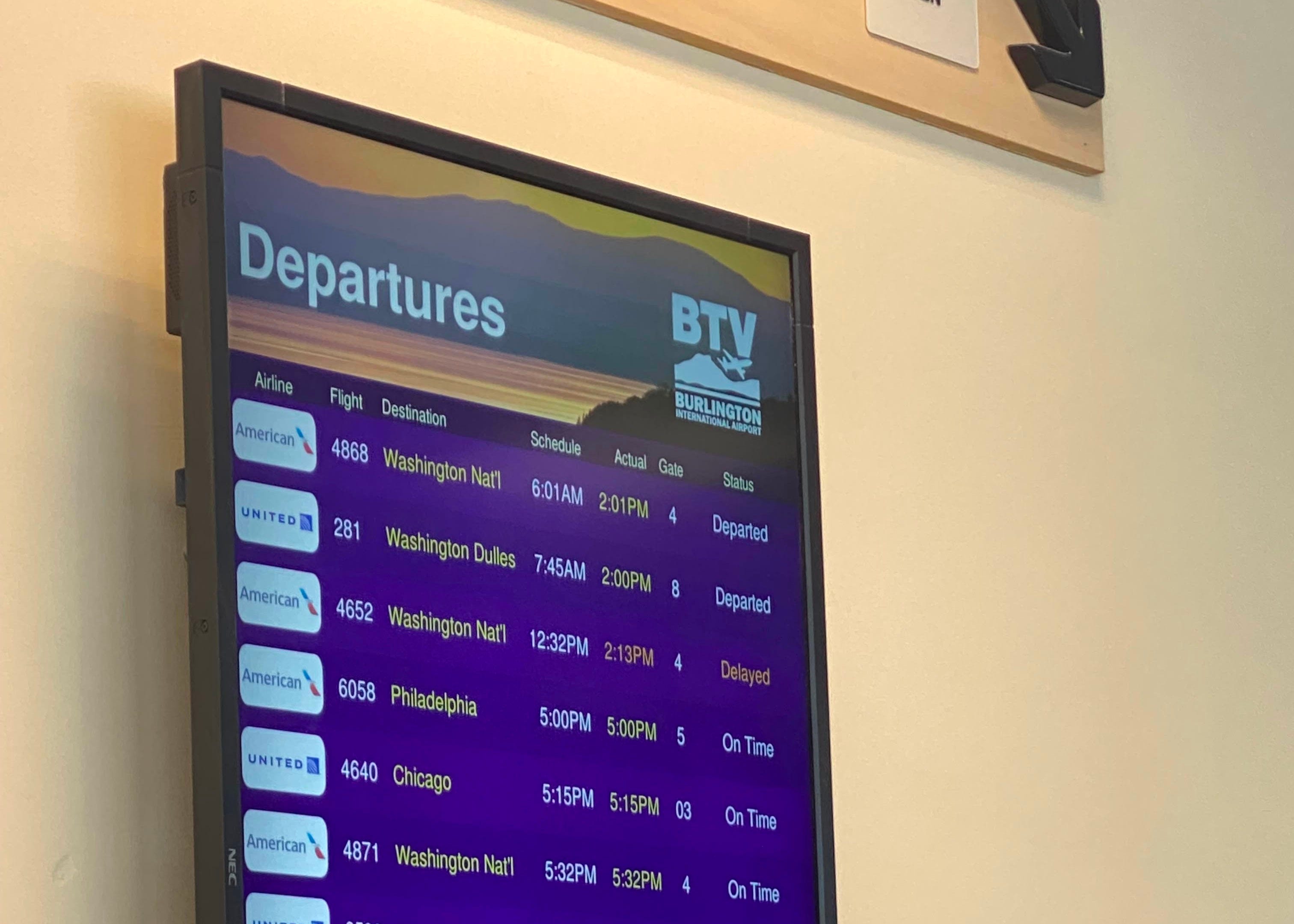
Burlington’s airport kept its checkpoint running throughout the shutdown without major disruption. Security lines held at 15 to 45 minutes, no flights were canceled for staffing reasons, and no ICE agents were deployed to BTV — unlike the 14 major airports where agents were sent to assist.
But keeping the airport open required community intervention. BTV launched a food drive and began providing weekly meals to its TSA staff. “At least once a week, we’re providing them a meal for the entire staff that’s on,” BTV Director of Innovation & Marketing Jeff Bartley told ABC22/FOX44. “And we’re doing it with to-go boxes so they can eat there, and if there’s some leftover, they can take it home and feed their family and feed themselves.”
The airport also collected donations of non-perishable food, household essentials, and gift cards in small denominations. As of WCAX’s March 25 report, BTV had “largely avoided major issues with TSA during the 40-day DHS shutdown.”
Bartley acknowledged the fragility earlier this month. “There has not been an operational impact, definitely a morale impact,” he told WCAX on March 13. “As this lingers, there may be impacts down the road, and we’ll have to communicate with passengers accordingly.”
Why BTV’s vulnerability doesn’t end with the shutdown
The structural risk that nearly forced small airports to close hasn’t changed. BTV operates with a lean TSA crew — small enough that the airport’s weekly meals served “the entire staff that’s on.” At that scale, the loss of even a handful of officers threatens checkpoint operations. Federal law is unambiguous: no commercial flight may depart without passengers being screened by certified TSOs.
McNeill and acting Deputy Administrator Adam Stahl both warned during the shutdown that the TSA had exhausted its reserve workforce — the National Deployment Office teams used to plug staffing gaps in emergencies — and that smaller airports faced potential closure. BTV was specifically named on lists of at-risk small-hub facilities.
The funding bill means paychecks will resume, but it doesn’t address the underlying pattern. TSA officers have now worked 87 unpaid days in a single fiscal year across two shutdowns. The workforce that was already stretched thin before February 14 is now smaller and more demoralized. And Senate Republicans have signaled that the ICE funding fight — the unresolved piece — will return through the budget reconciliation process, meaning the political conditions that produced this shutdown haven’t been resolved, only deferred.
The political context
The shutdown began after federal immigration agents shot and killed two U.S. citizens in Minneapolis in January — Renée Good on January 7 and Alex Pretti on January 24. Democrats refused to fund DHS without reforms to ICE. The White House insisted on including the SAVE America Act, a voter registration and ID bill. TSA became collateral.
Vermont Senator Peter Welch was among the most vocal advocates for separating TSA funding from the ICE fight. “Let’s debate that, but let’s pay TSA. Let’s get relief funds out for FEMA folks. Let’s pay the Coast Guard,” Welch told Roll Call. The overnight bill essentially does what Welch proposed — funding everything except ICE and Border Patrol — though without the enforcement reforms Democrats had demanded.
What Vermonters should know
If you’re flying from BTV: Security lines have been manageable throughout the shutdown, but the bigger risk has been at connecting hubs. As Compass reported in November, 14 of BTV’s 18 nonstop destinations feed into airports that experienced significant disruption. Even as staffing recovers, the effects of the workforce loss will take months to fully work through the system.
The economic stakes: BTV contributes $1.07 billion in annual economic activity to Vermont, supports 5,646 jobs statewide, and generates $62 million in state and local tax revenue. Vermont’s only airport with mainline commercial service came within weeks of a scenario that would have forced passengers to drive to Boston or Manchester, New Hampshire.
What happens next: Back pay will arrive — after the 2025 shutdown, it took 14 to 30 days for workers to receive payment. The nearly 500 officers who resigned nationally cannot be replaced before the summer travel season. And the ICE funding fight that triggered the shutdown is moving to reconciliation, not going away. The third government shutdown in less than a year may be ending, but the conditions that produced it remain.
This story replaces an earlier version published on March 27.
Sources include TSA testimony (March 25, 2026); WCAX, ABC22/FOX44, Axios, AP/GBH, CBS News, NPR, CNBC, Roll Call, Wall Street Journal, and the BTV economic impact assessment.