


Pressure came out in late May, still plays in a couple of small Vermont theaters, and is now available to buy digitally — and it arrives with a strange, very local distinction: it might be the most Vermont movie ever made about World War II.
Stay with that for a second.
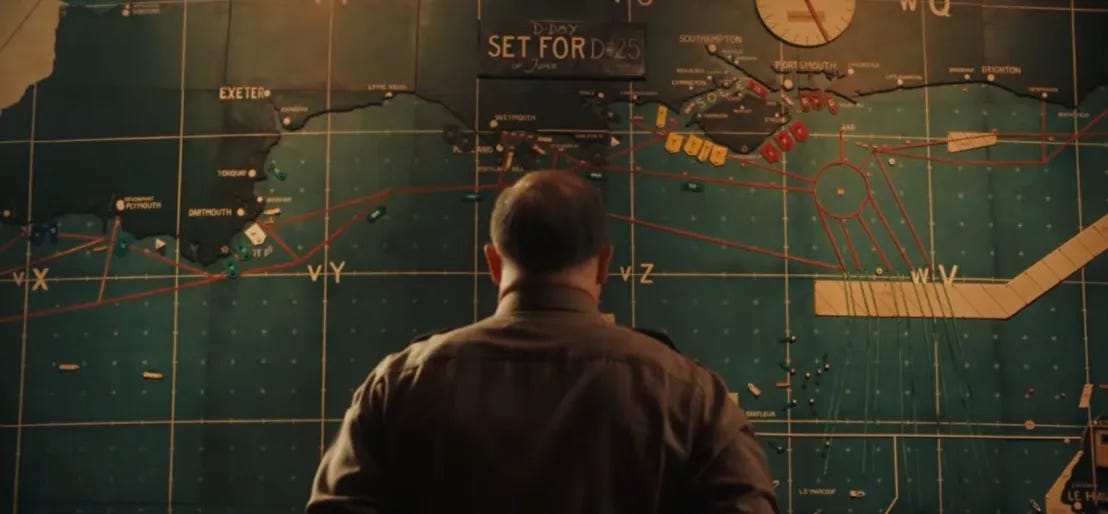
If you go in expecting another beach-storming epic in the Saving Private Ryan tradition, you’ll be surprised. Pressure is about D-Day, but it’s barely about the battle. There’s almost no Normandy in it. Instead, the film locks itself inside a cramped command house on the south coast of England in the 72 hours before the invasion, and it asks a question that decided the fate of the largest seaborne assault in history: what’s the weather going to do?
That’s the whole movie. And it’s riveting.
A movie about an argument over a forecast
The drama hangs on two men who could not read the sky more differently. Andrew Scott plays Group Captain James Stagg, the dour, careful Scottish meteorologist tasked with handing Eisenhower (Brendan Fraser) a forecast he can bet a war on. Stagg’s method leans on the physics of the atmosphere — fronts, pressure systems, the actual mechanics of an approaching storm. Across the table, at least as the film frames him, is the confident American forecaster Irving Krick (Chris Messina), who built his prediction on “analog” forecasting: pull the historical records, find years where the conditions looked similar, and bet that the past will rhyme with the future.
One of them sees a storm barreling toward the Channel. The other is sure it’ll be calm and clear. The skies overhead, inconveniently, are blue and sunny — which makes the cautious man look like the crank. And there’s an entire invasion, and tens of thousands of lives, riding on whose chart Eisenhower decides to believe.
No spoilers here on how it resolves — you know how D-Day itself turned out, but the how of the forecast is the real story, and it’s worth watching cold. What’s worth saying is this: the filmmakers somehow made a two-hour standoff over a weather forecast feel like a thriller. There’s no villain. Just smart, exhausted people staring at the same data and reaching opposite conclusions, with the clock running out. It’s a movie about uncertainty, about reading a sky that won’t tell you the truth, and about the nerve it takes to say “wait” when everyone in the room wants to hear “go.”
And somewhere around the second act, the realization lands. We know these people. We are these people. Not the uniforms or the stakes — the temperament. The instinct to study the sky, distrust the easy read, and argue the data right up to the deadline.
The most weather-obsessed state in America
There is no group on Earth better equipped to appreciate a high-stakes argument over a forecast than Vermonters. We don’t watch the weather. We practice it.
Consider the evidence. Since 1981, the Fairbanks Museum in St. Johnsbury has produced “Eye on the Sky,” the forecast that runs multiple times a day on Vermont Public radio. It is not a weather report so much as a statewide ritual. Mark Breen and his colleagues have become such fixtures that a Vermonter started selling shirts, mugs, and bumper stickers built around the line “Don’t talk to me until I’ve had my morning Eye on the Sky” — and printed an entire Breen forecast across the back. He’s sold hundreds. Try to name another state where the local forecast has merch.
Down in central Vermont, Roger Hill has been forecasting for Radio Vermont listeners for decades — he’s now past 50 years in the field — running his “Weathering Heights” service and posting through every cold snap and washout with the energy of a man who genuinely cannot help himself. Over in South Burlington, the more than a dozen meteorologists at the National Weather Service office have effectively become public figures; VTDigger, profiling the office, called them Vermont’s “spokespeople for the skies,” their names showing up in the news before, during, and after every storm. WCAX runs a “First Alert” team. There’s a beloved one-man blog, Matt’s Weather Rapport, that bills itself plainly as a “Vermont weather geek’s hodgepodge.” And the Vermont State University campus in Lyndon — known for generations as Lyndon State College — runs the only atmospheric sciences program of its kind in the state, respected enough that it has quietly fed forecasters into newsrooms, the Weather Channel, and federal weather offices for years.
Then there’s the rest of us — the amateurs. Vermonters are the kind of people who will pull up the National Weather Service’s Area Forecast Discussion, the dense technical note meteorologists write for each other, just to argue about whether a storm is being over-hyped. Compass devoted a whole piece last fall to the “scare-cast” cycle, where a single high-end snowfall number gets amplified into panic — and how reading the actual discussion talks you off the ledge. We trade in the old folk-weather lines — “if you don’t like the weather, wait five minutes,” “nine months of winter and three months of poor sledding” — and we say them like we invented them. We’ve turned mud season into the state’s unofficial fifth season. We’ve lived through Irene and the floods of 2023 and 2024, and we’ve watched a drought creep in this past year, and every one of those events became a shared, statewide conversation about pressure systems and rainfall totals and what the models were saying.
How much do we talk about weather? Constantly. It’s our small talk, our identity, our running argument, and — for a stoic, taciturn people not famous for chitchat — one of the few subjects that reliably gets a Vermonter going. We don’t make small talk about the weather instead of having a real conversation. For us, the weather is the real conversation.
Why this one lands here
So a film where one of the most consequential military decisions of the 20th century comes down to two forecasters disagreeing about a low-pressure system? That’s not a war movie to a Vermonter. That’s Tuesday. That’s the comment section on any local weather post. That’s the debate at the Northfield general store when somebody insists the storm’s going to miss us and somebody else has already pulled up the radar.
Pressure found drama in the thing we’ve always taken seriously — that the sky is worth studying, that the forecast matters, that the careful read can save you when everyone else in the room wants certainty. Eisenhower supposedly told JFK, years later, that the Allies won in part because they had the better meteorologists. Historians can’t quite confirm he said it. But you know who would believe it without a moment’s hesitation?
A Vermonter.
If you watch it, the next time you catch yourself checking what the barometric pressure is doing today — not because a storm’s coming, just because you want to know — take comfort. After two hours with James Stagg, you’ll understand something the rest of the country doesn’t.
You’re not alone.