


At the bottom: a chart to check your household’s monthly pay against today’s Vermont limit and the federal limit USDA wants, a free tool to see whether you qualify today, and how to comment before Dec. 10.
A Vermont parent raising one child and working full time at minimum wage could earn too much for food assistance under a rule the U.S. Department of Agriculture proposed this month.
At today’s minimum wage of $14.42 an hour, a 40-hour week works out to about $2,480 a month before taxes. For a family of two, Vermont lets households earn up to $3,337 a month before taxes and still apply. The standard federal limit is $2,345. That puts this parent $135 over the federal limit now. When the minimum wage rises to $14.91 on Jan. 1, the gap grows to about $220.
The program is 3SquaresVT, Vermont’s name for the federal Supplemental Nutrition Assistance Program, or SNAP, once called food stamps. Under today’s rules, that parent passes Vermont’s first income test. Under USDA’s proposed rule, published Nov. 10, the family could be turned down before rent or child care is even considered.
Sen. Peter Welch joined every Democrat on the Senate Agriculture Committee in a letter, made public Nov. 17, asking USDA Secretary Brooke Rollins to withdraw the rule entirely. USDA says the change closes a loophole that has put people on SNAP who don’t meet the limits set in law.
The rule is only a proposal. It has not changed anyone’s benefits. Public comments are due Dec. 10.
What the Rule Would Change
Vermont uses a state option, called broad-based categorical eligibility, that loosens two federal rules for 3SquaresVT:
Income: Vermont lets households earn more, up to 185% of the federal poverty level instead of the standard 130%. For a family of two, that is $3,337 a month instead of $2,345.
Savings: Vermont doesn’t count savings for most households.
The option works through a link to the federal welfare program, Temporary Assistance for Needy Families, or TANF. The proposal would cut that link back so it covers only families that get TANF cash assistance, which in Vermont is the Reach Up program.
Some households would still qualify automatically, as they do today. They include households where everyone gets Supplemental Security Income, the federal monthly payment for low-income people who are older, blind or disabled, or state General Assistance, according to the proposal.
Everyone else would face the standard federal tests:
Income: no more than 130% of the poverty level, before taxes.
Savings: no more than $3,000, or $4,750 for a household with someone 60 or older or disabled.
Households with someone 60 or older or disabled don’t face the before-taxes income test under federal rules. For them, the change would come mainly through the savings limit.
What the Paycheck Means at the Grocery Store
Compass estimated what one family gets today, using USDA’s published figures for this year. The family is a parent and one child, neither elderly nor disabled, living only on the parent’s wages. The parent works 40 hours a week at the January rate of $14.91, pays $1,700 a month in rent and pays $100 a month out of pocket for child care needed to work.
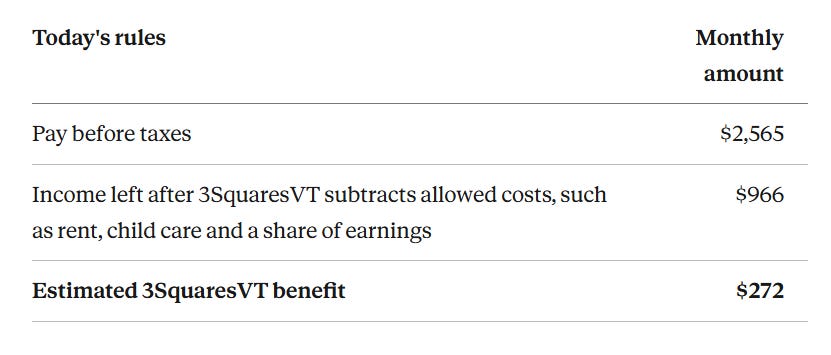
That is about $9 a day for groceries, or roughly $3,260 a year. Under the proposal, the same family would get nothing. Its pay would be over the federal limit, so those costs would never be counted.
DCF calculates each household’s actual benefit from its own income and costs.
The Tax-Credit Route Would Close Too
Working parents in Vermont have a second way in today. DCF lists families with children who get the Vermont Earned Income Tax Credit as eligible for 3SquaresVT. A full-time minimum-wage parent with one child would typically get that tax credit.
That route would not survive the rule as written. The proposal ties automatic eligibility to the federal definition of TANF “assistance,” and that definition leaves out refundable earned income tax credits. Under the proposal as written, getting the Vermont tax credit alone would no longer qualify a family for 3SquaresVT.
How Many Vermonters
There is no exact count of how many Vermonters would lose 3SquaresVT, but the estimates land around 10,000. Welch’s office puts it at more than 10,000, and the Center on Budget and Policy Priorities, a Washington research group that opposes the rule, counted about 10,000 Vermonters who qualified in 2023 because of Vermont’s higher income limit, most of them in families with children.
That would be about 1 in 6 of the 58,465 Vermonters on 3SquaresVT in July, according to USDA’s initial count. Nationally, USDA projects 6.3 million people, or 17.6% of everyone on SNAP, would lose benefits once the rule takes full effect.
Why USDA Wants the Change
USDA says the option has let states stretch SNAP past the limits in federal law and give benefits to households “with income and assets far above federal limits,” according to a department statement. The proposal cites a Minnesota man who had little income on paper but $1 million in property and retirement accounts. USDA projects the change would cut federal SNAP spending by about $44.6 billion over five years.
Why Welch Wants It Withdrawn
Welch and the other senators argue that a raise shouldn’t cost a working family its food aid. Without Vermont’s option, they wrote, a family “could lose SNAP benefits entirely after a modest raise,” even when the extra pay doesn’t make up for the food aid it loses. Vermont’s rules instead let benefits shrink gradually as pay goes up, and let low-income families and seniors keep modest savings.
What It Would Mean for State Budgets
USDA projects states nationwide would spend about $928.5 million more over five years to run SNAP under the rule, though about $5.243 billion less overall. Vermont is already paying more. Since Oct. 1, the state has covered 75% of the cost of running 3SquaresVT, up from 50%, a change in the 2025 federal budget law that DCF estimated would cost Vermont about $8.4 million a year.
What Happens Next
USDA is taking comments through Dec. 10. It would have to issue a final rule before anything changes. The Trump administration proposed a similar rule in 2019; the Biden administration withdrew it in 2021.
Check Where Your Household Stands
Nothing has changed, and if you get 3SquaresVT now, you don’t need to do anything. To see which side of the line your household falls on, find your household size and compare your monthly pay before taxes to both columns. If it falls between them, the proposal could affect you, unless you qualify another way, such as through Reach Up, Supplemental Security Income or General Assistance.
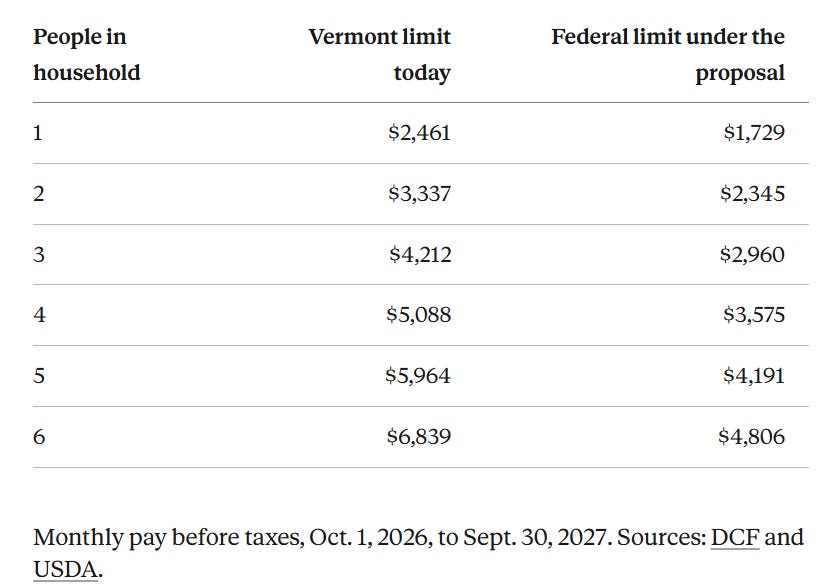
Households with someone 60 or older or disabled don’t face the pay limit but would face a $4,750 savings limit; most other households would face a $3,000 limit.
To check whether you qualify today, use Hunger Free Vermont’s free online screener or call the Vermont Foodbank’s 3SquaresVT help line at 855-855-6181. To weigh in before USDA decides, comment at regulations.gov by 11:59 p.m. Dec. 10, using docket number FNA-2026-0661.