


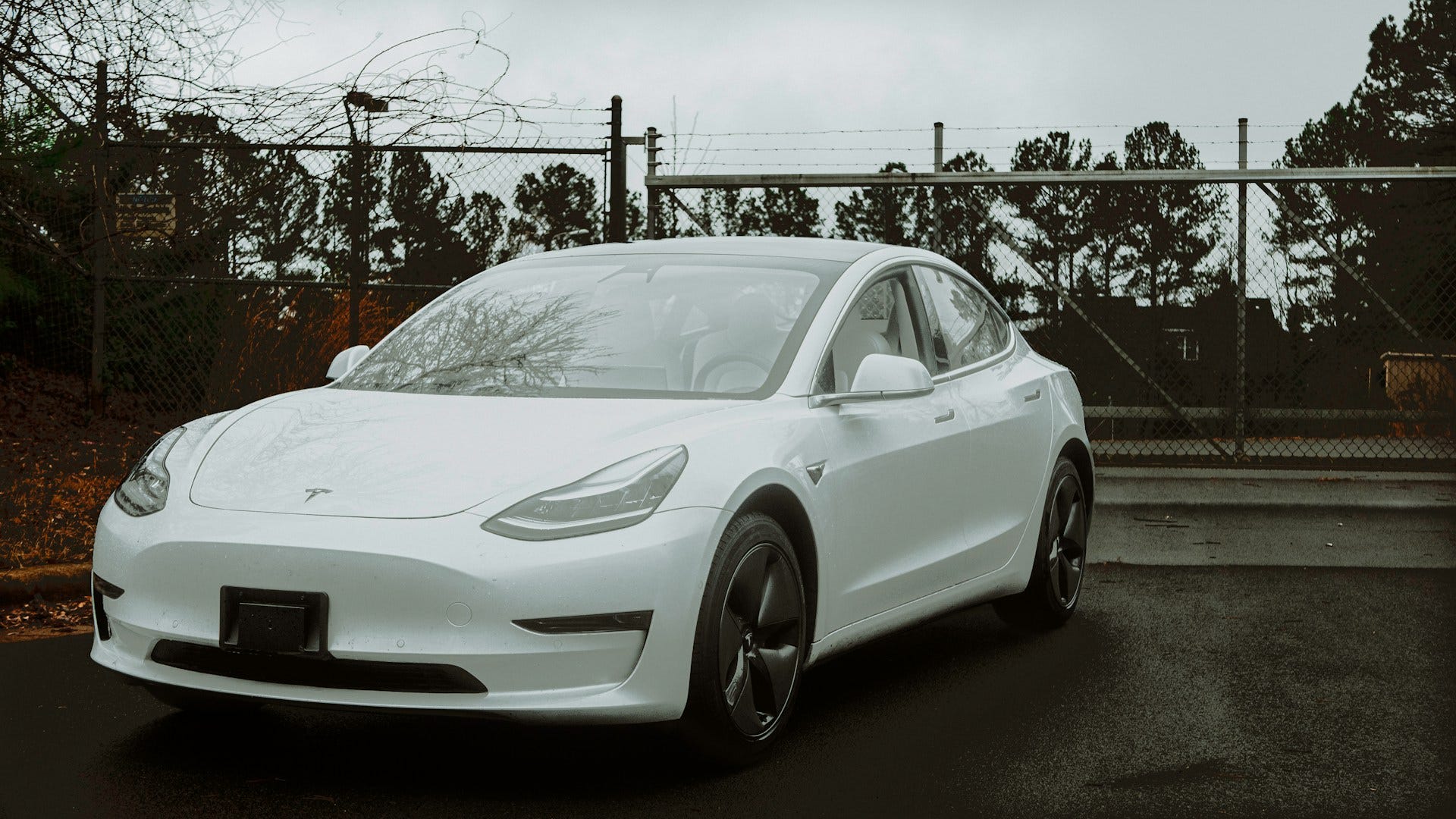
A Wall Street Journal column in mid-May made a national argument that has been building for a couple of years: with gas prices elevated and three-year leases flooding the resale market, a used electric vehicle is now, for many households, the cheapest car you can buy. Close to 300,000 used EVs are expected to come off lease and back onto dealer lots in 2026 alone.
The math the column lays out — lower fuel cost, lower maintenance, a deep used inventory — travels fine across the Connecticut River. What does not travel is the incentive picture. In Vermont, the money that used to take the sting out of an EV purchase has shifted underneath buyers in the last twelve months, and where you land now depends less on the car than on the utility printed at the top of your power bill.
Here is what changed, and what is left.
The federal credit is gone
The federal incentives that anchored the last EV buying wave have ended. Under the 2025 tax law, the credits for new clean vehicles and for previously owned clean vehicles do not apply to vehicles acquired after September 30, 2025. A buyer who signed and paid before that date may still claim the credit on a 2025 return. A buyer shopping a Vermont lot today cannot. The roughly $4,000 used-EV credit that shaped the market is, for new purchases, no longer on the table.
The state’s used-EV program is paused
Vermont’s own used-EV incentive — MileageSmart, administered by Capstone Community Action — covered 25 percent of the purchase price up to $2,500, and up to $5,000 for SNAP-eligible buyers. As of this writing the program is not operating: its funding is gone, restarting it would require new legislative authorization, and its program website is no longer live. So the headline state program a Vermont buyer would have reached for first is, for now, dark.
What’s left runs through your utility
With the federal credit ended and the state program paused, the durable money in 2026 sits at the utility level — and Vermont’s fractured utility map means the offer changes from town to town. There is no single statewide number. A used-EV rebate that is worth $1,300 on one side of a town line can be worth a few hundred dollars on the other.
The figures below reflect each utility’s own published terms as of early June 2026. Utility programs change without much notice, so confirm the current amount on the utility’s own page before acting.
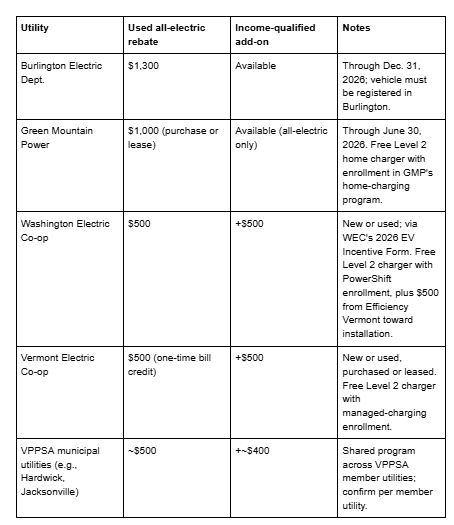
A footnote worth heading off: Green Mountain Power’s terms also list a $1,500 figure, but that is the rebate for a new all-electric purchase — the used number is $1,000. It is an easy line to misread.
The practical takeaway is not which number is biggest. It is that the same used Leaf or Bolt carries a different out-the-door price depending on the meter it will be charged from. A Burlington Electric customer and a Washington Electric Co-op member buying the identical car start $800 apart before either one turns the key — and the buyer, not the dealer, is usually the one who has to know that.
The other half of the savings: when you charge
The WSJ column’s reminder to check your off-peak rate lands squarely in Vermont, where utilities have built time-of-use pricing specifically to move EV charging into off hours. Burlington Electric, for one, discounts EV charging to about 9 cents per kilowatt-hour for customers who charge between 10 p.m. and noon, and offers a flexible-load option that trades a remote-control hookup for the same discounted rate. Several other utilities offer their own time-of-use plans and free or subsidized Level 2 home chargers tied to enrollment in a managed-charging program.
For a buyer running the total-cost math the column recommends, the charging rate and the rebate are two halves of the same equation — and both are set by the utility, not the dealer.
One cost the rebate doesn’t erase
Every EV registered in Vermont also carries a flat annual infrastructure fee — $89 for a battery-electric vehicle, $44.50 for a plug-in hybrid — that took effect January 1, 2025, on top of the standard registration. That fee is on its way out: in the legislative session that ended in late May, lawmakers adopted H.944, the FY2027 transportation bill, which replaces the flat fee on battery-electric vehicles with a per-mile road charge — about 1.4 cents per mile — beginning January 1, 2027. The charge is read off the odometer at annual inspection, with the first bills following after that. The Joint Fiscal Office estimated it would cost a typical Vermont EV driver roughly $150 a year. That is a separate story; for a buyer today, the flat $89 is still the number that applies.
Before you sign
The same used EV can cost a Vermonter several hundred dollars more or less depending on three things the sticker doesn’t show: which utility serves the address, whether the buyer is income-qualified, and how the car will be charged. The federal credit is gone and the state program is paused, but the utility money — and the off-peak rate — is real and checkable.
We’ve laid out where it stands. The decision is yours.
Sources for verification before publish: Burlington Electric Department EV rebate page; Green Mountain Power EV rebate terms & conditions; Washington Electric Co-op 2026 EV Incentive Form; Vermont Electric Co-op Energy Transformation Program; VPPSA member utility listings; Capstone Community Action / MileageSmartVT.org; IRS clean-vehicle guidance; Vermont Legislature H.944 bill status; Vermont DMV / Act of 2024 EV infrastructure fee.
Not ready for a Electric car, not even close....