


Gov. Phil Scott wondered aloud how a Vermonter in Newport should feel about it. Compass built the record. Over two years, nearly every discretionary move the state has made on homelessness and street disorder has landed in one county — the one with the highest incomes and a homelessness rate below the state average.
Burlington’s city council passed a resolution Monday night asking Gov. Phil Scott for help with homelessness, mental illness, substance use and crime downtown. Mayor Emma Mulvaney-Stanak backed it. The resolution lists ten requests and closes by asking the mayor to carry them to the Governor in person.
At the end of a press conference Tuesday, Scott was asked about it. He said he had not read the resolution completely, only scanned it, and that the scan disappointed him. “We’ve done a lot for Burlington,” he said, adding that if he were sitting in Newport he might wonder “what more can we do for one of the most affluent areas of the state when they’re suffering in other areas as well.” He said he would take it up at a future press conference.
He raised a fair question, and it is answerable. Compass read the filed resolution line by line and ran it against the enacted state budget, the Department for Children and Families’ county-level shelter and motel data, and Coordinated Entry counts of who is unhoused and where.
What comes back goes well beyond any single program. Pilots, deployments, targeted plans, new facilities — the discretionary responses, the ones the state chose to create rather than had to fund, have nearly all been built in the same place.
What the state has already sent
Since 2024:
An overdose prevention center, written into law by name. Act 178 of 2024, the harm-reduction bill introduced as H.72, authorizes a pilot in Burlington — not in Vermont generally, in Burlington. The Legislature passed it over Scott’s veto. The city accepted a $2.2 million state grant in September 2025, and lawmakers approved roughly $1.1 million more in May 2026. The money comes from Vermont’s share of the national opioid settlement — paid out of a crisis that reached every county. As of this spring the center had no site, and about $300,000 had gone to consultants and community outreach.
A court of its own — and the most intensive version of it. Scott announced the Chittenden County Community Accountability Court in response to concerns about disorder in Burlington, appointing a special prosecutor while the Judiciary assigned a dedicated judge. It ran from October 2025 to February 2026, five days a week, and resolved 702 of the 972 cases on its docket. Two other counties have since gotten a version — Rutland, with about $350,000 in a budget adjustment, and Windham, where a 90-day Rapid Accountability Docket began in July. Neither got Burlington's version. The Judiciary proposed running Rutland's one day a week over three months; Scott objected publicly, saying the daily schedule was what made Burlington work and that a weekly court might fail.*
A state plan written for one city. Scott’s administration rolled out a multi-point Burlington public safety plan in October 2025 — the accountability court was its first initiative.
Two State Police deployments. Troopers patrolled downtown Burlington in late 2025 and again from July 27 to August 16 this year, under directives from the Governor’s office.
Two state-started shelters. The state stood up the Williston Family Shelter and handed operations to CVOEO in May 2025. A young adult shelter was set to open in Chittenden County that June, in a building renovated by Champlain Housing Trust.
Forty-four percent of Vermont’s new shelter capacity, detailed below.
Two points belong here before anyone draws the wrong conclusion.
Chittenden County has the largest absolute number of unhoused Vermonters — 1,036, more than any other county. Concentration is not by itself unfair. The biggest raw caseload will draw resources.
And no single official built this. Scott vetoed the overdose prevention center and lost. The accountability docket came from the Judiciary and the state’s attorney. The trooper deployments came from the Governor’s office. Different actors, different years, opposite politics — and the same destination nearly every time.
Vermont does not appear to have decided to favor Chittenden County. It appears to default there.
Where the new shelter beds went
Vermont’s emergency shelter system held 616 household slots in May 2025. As of DCF’s July 2026 report, it holds 679 — 63 additional slots statewide in fourteen months.
Here is where they landed:
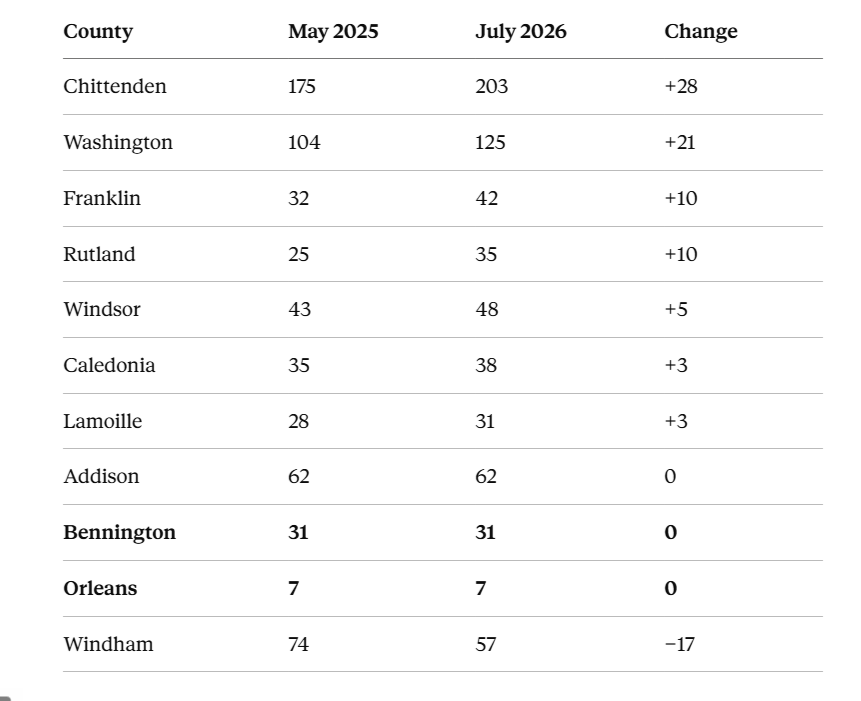
Chittenden and Washington together account for more than three-quarters of the net statewide gain. Bennington, which has the highest homelessness rate in Vermont, gained nothing. Orleans — Newport’s county — gained nothing. Windham lost seventeen slots.
What that looks like per person
Coordinated Entry counted 4,588 unhoused Vermonters in June 2025, by district. Set those against 2025 Census estimates and the picture inverts what most people assume:.
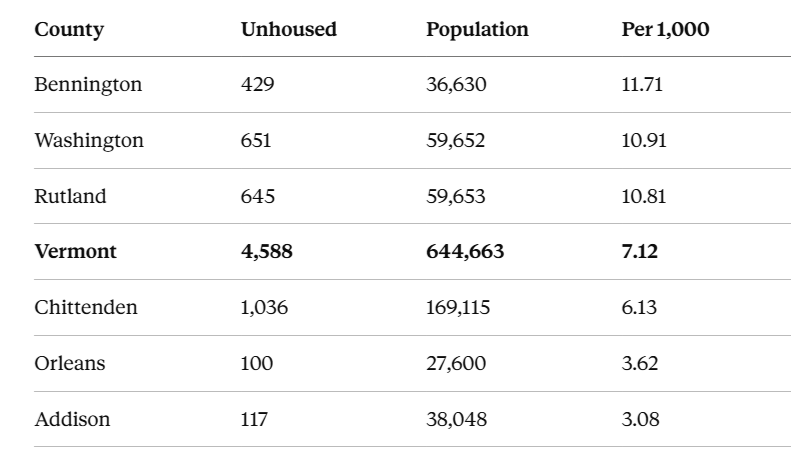
Chittenden’s homelessness rate is below the statewide rate. Bennington’s is nearly double Chittenden’s. Orleans has the lowest on the board.
Now put shelter next to it. Chittenden has about 20 slots for every 100 unhoused people. Washington has 19.
Rutland has 5. Bennington has 7. Orleans has 7.
Rutland County carries nearly twice Chittenden’s homelessness rate with roughly a quarter of its shelter coverage — and the gap widened this year rather than closing. Chittenden’s share of statewide capacity rose from 28 to 30 percent, against a 23 percent share of the state’s unhoused population.
One caveat in the open: shelter capacity follows where providers are, not only where need is. Several organizations have construction underway and expect to open this fiscal year, including in Rutland and Windham. That is context. It is not a reason a county with the state’s highest homelessness rate went a year without a single added bed.
Vermont built one system statewide and left the other to chance
There is a second pattern here, and it explains something the tables do not.
Vermont delivers harm reduction nearly everywhere. Vermont CARES operates syringe services out of St. Johnsbury, Barre, Rutland and Burlington, with mobile delivery reaching Orleans, Essex, Caledonia, Orange, Washington, Lamoille, Addison, Rutland, Chittenden, Franklin and Grand Isle. The AIDS Project of Southern Vermont runs a walk-in program in Brattleboro. Naloxone, fentanyl test strips and wound care travel with them, and the Health Department maintains the network and publishes a locator.
Emergency shelter works nothing like that. It exists where a provider exists. There is no statewide map, no mobile version, no requirement that any county have a minimum number of beds.
Put the two side by side in Rutland. A Vermonter using drugs there can reach clean supplies and overdose reversal about as readily as one in Burlington. A Vermonter there who needs a bed is in a different state entirely — 35 slots for 645 people.
That is not an argument against harm reduction, and the evidence does not support treating these services as a draw; the counties with Vermont’s highest homelessness rates have them too. It is an observation about how two responses to the same crisis were built. One was designed to reach every county. The other was left to follow whoever showed up to build it.
Ten requests, nothing offered
Here is what Burlington’s resolution asks the state to do, in its own order:
Direct the Agency of Human Services to help the Champlain Valley Office of Economic Opportunity find and secure a site for a 100-bed low-barrier shelter, help staff it, expedite it before winter, and support transportation to it.
Direct AHS to support CVOEO’s Community Resource Center and expand daytime low-barrier space.
Expedite municipal access to FY27 money for problems tied to people sheltering on public land.
Extend motel stays past the 70-day cap for vulnerable households, as Act 143 permits.
Reinstate four inpatient psychiatric beds and three recovery services positions at the state’s Central Vermont site, work with the University of Vermont Medical Center on acute care, and restore a cut coordinator position there.
Direct the Health Department to partner more closely with the city, including support for syringe service programs and temporary state staffing.
Allocate more resources to the Chittenden County court system, keep funding a Howard Center caseworker, and expand treatment and mental health court capacity.
Convene youth service providers, schools and AHS staff on juvenile violence and gun possession.
Increase and coordinate resources against the illicit drug market statewide.
Coordinate state law enforcement support for Burlington on drug trafficking, traffic enforcement and retail theft.
Every operative verb points at Montpelier: direct, expedite, extend, reinstate, allocate, convene.
What makes that worth noticing is not that a city asked for help. Cities ask. It is that Burlington is not a town without means. It employs its own police department, controls its own zoning, and owns real estate. Several of the ten requests describe problems the city has authority over. The resolution commits none of it — no city dollars, no city-owned site, no zoning change, no BPD commitment, and no matching contribution of any kind.
The first request shows the shape of it. The council asks the state to identify and secure a location for the 100-bed shelter, and notes that state help matters especially if a suitable site is found outside Burlington. Siting a shelter is a municipal function. Burlington is asking the state to perform it, and allowing in advance that the answer might be another town’s problem.
For scale: Vermont’s entire emergency shelter system holds 679 household slots. A single 100-bed facility would be among the largest additions the state has ever made, and the resolution asks for it before winter.
The money is $500,000, and it is already moving
The third request asks the state to speed up municipal access to FY27 money for people sheltering on public land, and to tell qualifying towns how to apply.
Compass found it in the enacted budget. Act 144 appropriates $500,000 for grants to municipalities under 33 V.S.A. § 2209(a), inside a $21.2 million General Fund package — alongside $14.1 million for motel rooms, $3 million for shelter development, $2.1 million for staffing and contracts, and $1.5 million for cold-weather shelters.
Half a million dollars is the entire statewide pot. Every Vermont town with an encampment draws from it.
The schedule is published too. DCF’s July report sets out the timeline: outreach through July and August, the funding opportunity posted to municipalities in August, awards finalized by October 15, communities ready to mobilize by November 15. Burlington’s request to expedite the process and improve outreach arrives against a calendar the department laid out weeks earlier — one that already lands before winter.
The motel program shrank by a third
The fourth request asks the state to extend motel stays past the 70-day cap for vulnerable households.
The General Assistance emergency housing program held 1,001 households in May 2025. As of July 2026 it holds 630 — down more than a third. Hotel authorizations ran at least $30.8 million in state fiscal 2025 — the state’s figure covered eleven months — against $26.7 million in 2026, about $6 million under budget. Meanwhile the number of Vermonters seeking help barely moved: 4,588 in Coordinated Entry in June 2025, 4,666 in July 2026.
So the request targets a real and shrinking resource, and it is aimed at the right official. The 70-day limit is statute — the Legislature passed it and Scott signed it in June — but the law leaves extensions to the commissioner’s discretion. That is a decision the administration can make on its own.
What that means for the Governor’s question
Scott asked how someone in Newport should feel. Orleans County has the least homelessness in Vermont. On the numbers, its claim is the weakest in the state.
Rutland and Bennington are the counties with the case. They carry nearly twice Chittenden’s per-capita homelessness with a fraction of the shelter. Over the past fourteen months Bennington received none of Vermont’s new capacity while Chittenden received 44 percent of it. Rutland got a version of the accountability court months after Burlington's, at a fraction of its intensity. Neither county has a state plan of its own, a trooper deployment, an overdose prevention center, or a governor answering questions about it at a press conference.*
Burlington’s individual requests are not unreasonable. Four psychiatric beds and three positions were cut by the state and can be restored by the state. Motel extensions sit within the commissioner’s discretion. Those are real asks aimed at the right officials, and a city facing what Burlington faces downtown has every right to make them.
But they arrive as ten requests with nothing offered back, from the county that has already received nearly every discretionary move Vermont has made on this crisis — and whose homelessness rate is lower than the state’s.
The question is not whether Burlington deserves help. It is why, for two years running, Burlington is where the help goes.
Scott said he would take the resolution up at a future press conference.
What to watch
Before Labor Day, when Mulvaney-Stanak has said she hopes to meet with Scott. The resolution asks her to bring these requests to him and report back.
September 1, when Act 143’s new motel rules take effect and the commissioner’s extension standard determines how much of the fourth request is deliverable.
October 15, when DCF finalizes municipal awards from the $500,000 — and which towns get them.
Compass attended Gov. Scott’s August 25 press conference. Shelter, motel and spending figures are from DCF’s monthly housing reports; county homelessness counts are from Coordinated Entry, June 2025.
*Correction: Aug. 26, 2026: An earlier version of this story said no county other than Chittenden received an accountability court. Rutland County received a version of the model beginning in early 2026, funded with roughly $350,000 in a budget adjustment, and Windham County launched a 90-day Rapid Accountability Docket in July. The Chittenden court sat five days a week; the others have not. The story has been updated.
This appears to be a self inflicted wound the rest of the state once again will end up footing the bill for.
As the ol saying goes, You made your bed,so you lie in it.......