


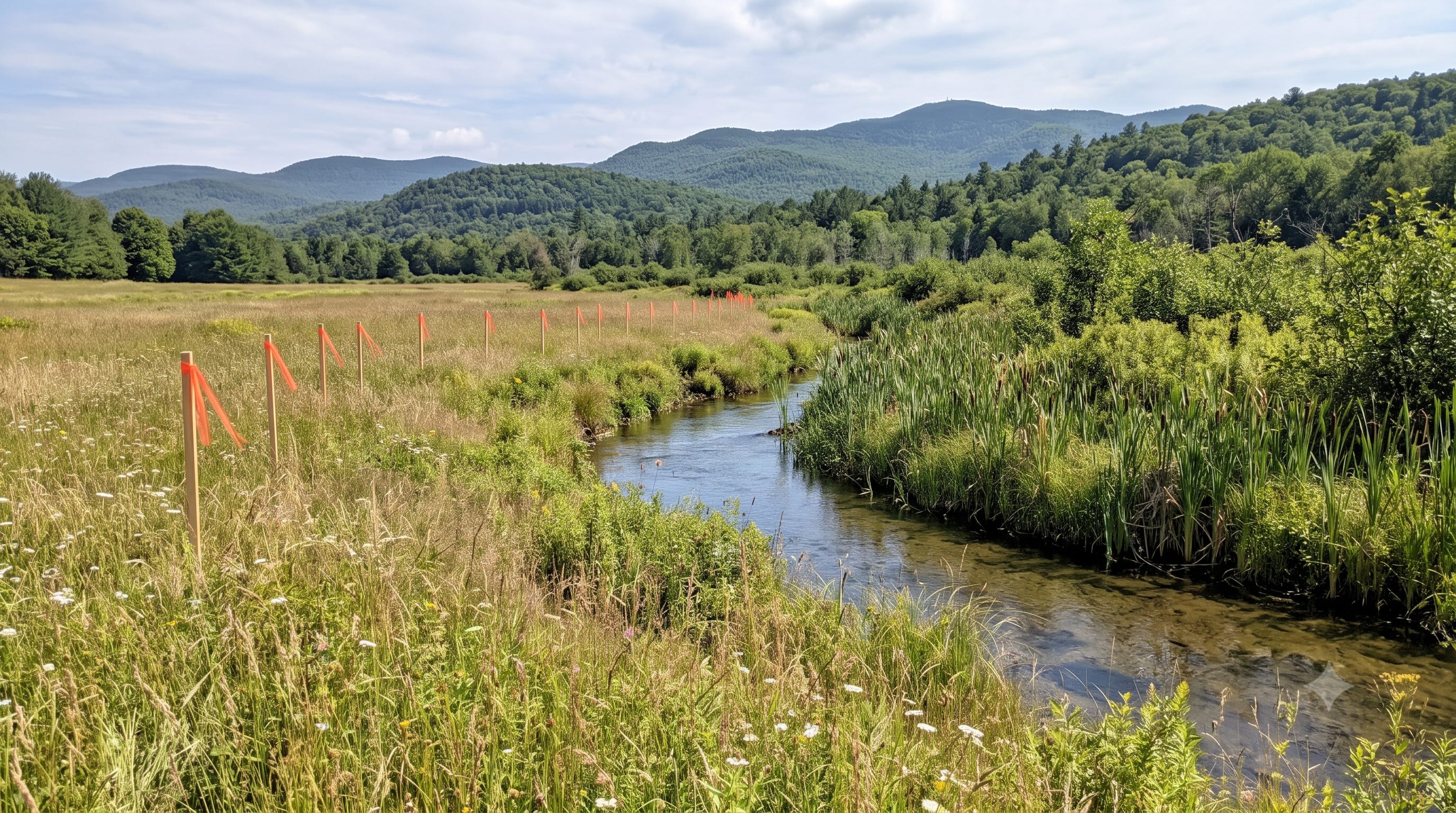
The Legislative Committee on Administrative Rules voted 5-3 Thursday against the Scott administration’s revised wetlands rule, declining the Agency of Natural Resources’ request to withdraw the objection the committee lodged in May. It is the second time this year the committee has come down against the wetlands and housing provisions of Executive Order 06-25.
The committee’s posted agenda listed rule 25-P040 for that day; minutes and a roll call had not been published as of Friday.
Governor Phil Scott’s office announced the vote the same day, saying the administration had narrowed its original proposal after months of negotiation and that the narrower version earned “the support of both environmental and housing advocacy organizations.” The statement did not name them.
The agency’s own filing names them, and describes the arrangement in different terms.
In a July 14 letter to committee chair Rep. Trevor Squirrell, DEC Commissioner Misty Sinsigalli wrote that the deadline extension allowed the agency to negotiate changes to Section 6.26 with Let’s Build Homes and the Vermont Natural Resources Council, which in turn worked with partners in the Water Caucus. On the changes that resulted, the letter says Let’s Build Homes and ANR support them and that VNRC “does not oppose” them.
It adds that the agency does not speak for either organization and that the agreement should not be treated as precedential. The Conservation Law Foundation, the Lake Champlain Committee and the Connecticut River Conservancy, which joined VNRC in welcoming the May objection, are not described as parties to it.
The letter is also candid about why the agency negotiated at all: without an agreement, it says, litigation was virtually certain, and would delay the housing work either way.
What the administration gave up is substantial. The revised rule eliminates the allowed use for housing in unmapped Class II wetlands — the provision conservation groups objected to most loudly, and the one the committee called arbitrary because it leaned on state inventory maps. Projects in the outer 25 feet of a buffer would now need a wetland delineation approved by the Secretary within the past ten years.
The geographic reach narrows to within a half mile of designated areas served by public sewer or water, or with soils adequate for wastewater disposal. And builders would have to notify the wetlands program 30 days before construction rather than after.
Two allowed uses survive: housing and associated infrastructure within 25 to 50 feet of the buffers of mapped and delineated Class II wetlands, and linear utilities inside Class II wetlands under a set of best management practices carrying compensation for permanent impacts above 5,000 square feet. The 2030 sunset is unchanged, with registered projects permitted to finish construction into 2031.
The committee had objected on May 21, also 5-3, on three grounds — chief among them that the agency cannot weigh housing benefits against wetland protection through rulemaking when the Legislature has already written that balance into statute. LCAR’s eight members are five Democrats and three Republicans, and both votes fell along that line. None of the five is leaving the Legislature. Candidate filing closed May 28, and all five are on the November ballot; two of them, Sen. Seth Bongartz and Sen. Robert Plunkett, face a contested Democratic primary on August 11, with three candidates running for Bennington’s two Senate seats.
For a Vermonter with a housing project near a Class II wetland in a designated growth area, none of this is in force. Vermont statute sets the Class II buffer at 50 feet unless the Secretary determines otherwise for a particular wetland, and activity inside a significant wetland or its buffer generally has to qualify as an allowed use or be authorized by permit or conditional-use determination. DEC’s site states that the 2023 rules remain in effect and that the housing amendments have not been adopted.
Two votes. Two different rule texts. The same 5-3 alignment.
The thing to notice is what the negotiation could and could not change. It changed the substance considerably — enough that the state’s largest conservation group stepped back from opposition. It did not change the committee’s stated objection, which was never about how much wetland the rule would affect. LCAR’s May memo argued that the agency cannot set aside the Legislature’s wetland-protection policy in order to weigh it against the economic benefits of housing, and that adjusting a Class II buffer calls for an individualized determination rather than a blanket reduction for a class of projects. That is an argument about who holds the authority. A private agreement among an agency, a builders’ coalition and an environmental group cannot confer it.
Which is a fair answer to the Governor’s framing, and an uncomfortable one for the committee too. If the objection is purely about authority, then the narrowing was beside the point and the second vote was decided before the negotiation began. If it was about substance, the narrowing should have moved somebody. Nobody moved.
That distinction also describes a narrower power than a veto. Under the Administrative Procedure Act an agency that receives an objection may respond and adopt the rule anyway; what a certified objection changes is who carries the burden afterward, requiring the agency to show in any later challenge that the provisions are authorized, consistent with legislative intent and not arbitrary. LCAR cannot stop a rule. It can make adopting one expensive.
Twice now, the committee has declined to make it cheaper.
There is an obvious objection to reading this as lawmakers choosing land over housing: Act 181. The 2024 law reworked Vermont’s land-use framework in an explicitly pro-housing direction, and the designated areas at issue here exist because of it — ANR’s filing cites Act 181 alongside 24 V.S.A. chapter 76A and 10 V.S.A. §§ 6033–6034 as the basis for the roughly three percent of the state where the rule would apply. Bongartz, the committee’s vice chair and one of Act 181’s architects, told VTDigger and Vermont Public in May that framing housing and wetlands as an inherent conflict is “preposterous.”
But Act 181 answered where. It did not repeal the statutory Class II buffer, and it did not authorize a categorical reduction of that buffer for housing inside the areas it designated. That gap — land marked for concentrated growth, still governed by the wetlands statute — is what Executive Order 06-25 set out to close by rule.
It is still open. The Legislature could close it by statute. The administration could adopt the rule and defend it in court. Ten months after Executive Order 06-25, the buffer is where it was in September.
This post mixes policy, law, and politics and as a result is hard to follow — imo.
It all boils down to a dispute over WHO gets to decide the policy and whether the Executive branch gets to change (loosen) protections by Executive Order. The answer to this question is NO — the Governor does not get to do this by EO.
My five main takeaways from this article are as follows:
• The Governor revised Vermont’s wetlands rule to make housing easier to build near certain wetlands, after months of negotiations with builders and environmental groups.
• A legislative oversight committee voted 5-3 to object anyway, for the second time this year.
• The compromise among builders and environmentalists narrowed the rule, but it did not resolve the committee’s core concern: whether the administration had the legal authority to make this change by rule.
• The vote means the rule is not in force, and the state would have to defend it in any later legal challenge if it adopted it anyway.
• Even if the compromise is better (debatable), the administration does not have the legal authority to make that kind of change without the Legislature.
Very confusing. What are the rules for use of land in the outer 25 feet of buffer at this point?