


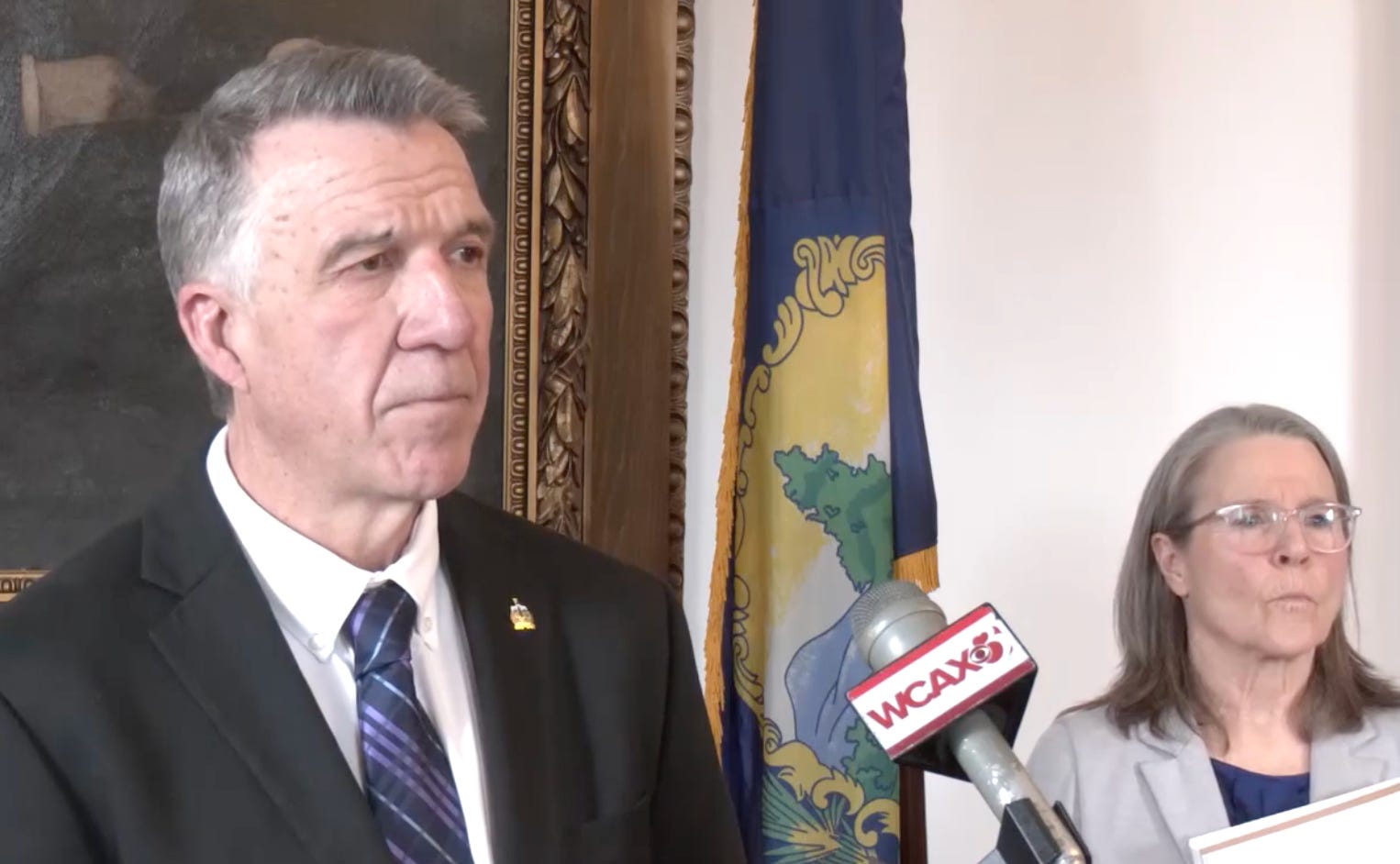
In a written statement, Governor Scott’s office called the Vermont Labor Relations Board “broken” and its decision “biased. “It’s all weighted towards labor,” he said. “I made some appointments, but there’s some parameters, guardrails, that don’t give us many choices.”
Those words deserve a closer look. Because the guardrails Scott is describing were designed to produce exactly the kind of balanced board he now questions — and every sitting member still got there with his signature.
Of the five sitting members of the Vermont Labor Relations Board, Scott appointed four directly — Roger Donegan, David Boulanger, Michelle Phelps, and Gwenna Peters — and reappointed a fifth, Robert Greemore, who originally joined the board under Governor Peter Shumlin. The sixth statutory seat appears vacant. Not one sitting member reached the board without Scott’s approval.
That’s the context missing from most coverage of this story.
What the board actually is — and how it’s built
The VLRB isn’t a body assembled at a governor’s discretion. Vermont statute requires that members be selected from a nominee slate prepared by a five-member Labor Board Review Panel — a panel that includes the Vermont Bar Association’s executive director, the Commissioner of Labor, the State Court Administrator, and one representative each from labor and from employers. The law specifically requires the panel to ensure “a continuing balance on the Board of labor, management, and neutral backgrounds” before forwarding names to the governor.
Scott is right that the Review Panel limits his choices. That’s the point. The process was designed to produce a balanced board — and then he made the final calls. The board he now questions is the board he built.
What the board actually ruled
The dispute began in the fall of 2025 when Scott’s administration formally notified the Vermont State Employees’ Association in September that beginning December 1, roughly 3,000 state employees — many of whom had worked remotely since the COVID-19 pandemic — would be required to return to their designated offices at least three days per week. The union filed a complaint with the VLRB on November 10.
In a 60-page decision issued April 1, the board found the state had “refused to bargain in good faith,” ruling that telework is a mandatory subject of bargaining under the State Employees Labor Relations Act and that unilateral imposition while under a duty to bargain is a per se violation.
The board ordered the state to rescind the mandate, offer employees the option to return to their prior remote or hybrid arrangements, rehire any employees who left their jobs as a result of the policy, and reimburse workers for “any monetary losses” caused by the return-to-office requirement.
The cost question — and who created it
Scott has warned that taxpayers could face significant costs if the ruling stands — commuting reimbursements, child care expenses, and other losses incurred since December. That warning is not wrong, but according to the board’s ruling, the liability exists because his administration implemented a major change to working conditions without following the collective bargaining process Vermont law requires. The cost isn’t a product of the ruling. It’s a product of how the mandate was rolled out.
The state had already committed to a five-year, $2.3 million lease for 22,000 square feet of office space at the Pilgrim Park complex in Waterbury to accommodate the returning workforce — space that may now sit empty. The lease was signed with Malone Superior LLC, a company whose owner Wayne Lamberton is a close personal friend of Scott’s, according to reporting by VTDigger.
The state has filed a notice of appeal with the Vermont Supreme Court and requested a stay of the board’s order while the appeal proceeds.
What comes next
Scott said he expects the stay to be granted, which would keep the three-day in-office requirement in place while the Supreme Court weighs in. The unresolved questions are significant: how monetary losses will be calculated, what happens to the Waterbury lease taxpayers are now committed to, and whether the Supreme Court will uphold a ruling made by a board the governor himself assembled.
Scott also suggested Wednesday that the ruling fits a pattern, pointing to a Scott-nominated neutral member whose Senate confirmation was blocked seven years ago following union opposition — an episode he called “tremendously controversial.” It is the strongest argument his administration has made that the process is tilted. Vermont’s Supreme Court will now decide whether it’s strong enough.
When a process produces a result a governor dislikes, questioning the process is a familiar move. In this case, the record shows the governor built the process, staffed it, and lost. Those are different things.
Compass Vermont is an independent, reader-supported news outlet. If this kind of accountability reporting matters to you, please consider subscribing or making a contribution.
Once again Scott complains because he forgot how negotiate. Process is everything.