


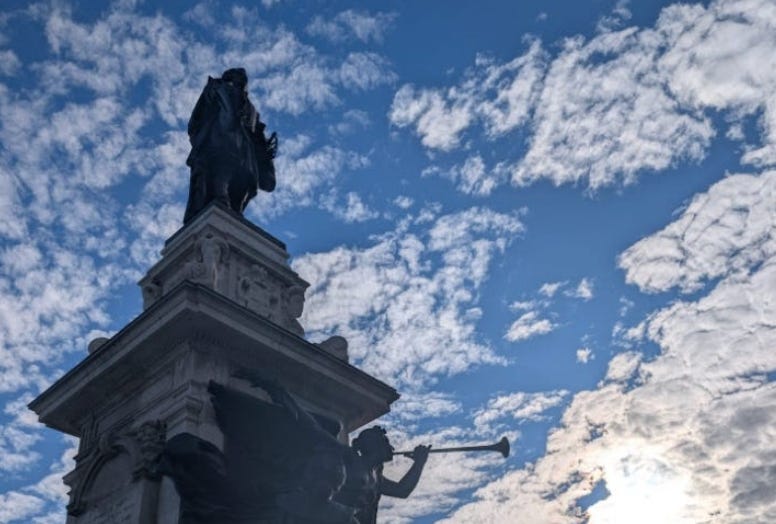
For generations, Vermonters have looked north to Quebec and seen a vacation destination, a trade partner, and a friendly neighbor. But when a delegation of Norwich University cadets crossed the border this past November, they found themselves walking a geopolitical fault line that is hotter now than it has been in two centuries.
The timing of the university’s “Canadian Peace and War Field Study” could not have been more charged. With Washington and Ottawa locked in a bruising trade war and President Trump openly musing about Canada as the “51st State,” the “unguarded border” feels anything but.
“I felt a lot of animosity... towards the Americans,” noted Cadet Megan Sweeney in her field report. It was a sentiment that echoed back 250 years, to the very event the students had traveled to study: the 1775 American invasion of Canada.
While most Americans learn the Revolution as a fight for independence, for our northern neighbors—and specifically for the Vermonters who fought there—1775 was a war of conquest. The Norwich trip has shed fresh light on a forgotten chapter of Vermont history, revealing that 2025 isn’t the first time the United States has misjudged the resolve of the people to our north.
The “14th Colony” That Never Was
The backdrop of the students’ visit was the stark diplomatic freeze of late 2025. Following the election of Prime Minister Mark Carney, Canada has pivoted away from the U.S., joining European defense pacts and signaling it will no longer rely solely on American security.
It is a defiance that mirrors 1775. That year, the Continental Congress launched a two-pronged invasion of Quebec, convinced that the French-Canadian population would rise up and join the Thirteen Colonies as the “14th Colony.”
“The American invasion assumed French Canadians would respond positively to Patriot promises of liberty,” noted Dr. Zachary Bennett, a Norwich professor who led the delegation.
They assumed wrong. And at the heart of that failure—and the bloodshed that followed—were the Green Mountain Boys.
The Vermont Connection: Warner vs. Allen
For many Vermonters, the story of the Green Mountain Boys begins and ends with Ethan Allen capturing Fort Ticonderoga. But the invasion of Canada reveals a different, perhaps more crucial, Vermont hero: Seth Warner.
History books often gloss over a contentious town meeting in Dorset in July 1775. When the Green Mountain Boys were formally mustered into the Continental Army, they voted against Ethan Allen, electing the steadier Seth Warner as their commander.
The invasion proved them right. While Allen, acting on his own thirst for glory, was captured in a reckless attempt to take Montreal in September 1775 (spending the rest of the war in a British prison), Warner and his Vermonters were doing the heavy lifting.
At the Battle of Longueuil on October 30, 1775, it was Warner’s regiment that stood on the banks of the St. Lawrence. Using expert marksmanship, they repelled a British relief force trying to save Fort St. Jean. That victory forced the British surrender and opened the gates to Montreal.
But the Vermonters’ greatest service came in defeat. After the disastrous American assault on Quebec City on New Year’s Eve 1775—where General Richard Montgomery was killed and Benedict Arnold wounded—the army collapsed. As the Americans fled back toward Lake Champlain in the spring of 1776, rotting with smallpox and pursued by the British, it was Seth Warner and the Green Mountain Boys who stayed behind. They fought a desperate rear-guard action, standing between the retreating hospital wagons and the British bayonets, effectively saving the Northern Army from annihilation.
“American Babylon”
Why did the invasion fail? Why didn’t Canada join the U.S.?
The Norwich students grappled with this question, discovering that the cultural divide in 1775 was just as wide as the political one in 2025.
For decades prior to the Revolution, New England ministers had preached that Catholic Quebec was the “American Babylon,” a den of heretics. When American troops arrived promising “liberty,” the French inhabitants remembered the years of anti-Catholic rhetoric.
“In the American mind, Quebec City was the ‘American Babylon’ from which all the evil that plagued them emanated,” Dr. Bennett explained to the cadets. It is a historical irony that resonates today: you cannot spend years antagonizing a neighbor and then expect to be welcomed as a liberator.
A History of Hostility
The students’ reflection that “most people don’t think about the US invasion” is a common blind spot. The border between Vermont and Quebec has seen more than its share of violence.
The War of 1812: American troops burned the Parliament buildings in York (modern Toronto), an act of arson that led directly to the British burning of the White House in 1814.
The Fenian Raids (1866): In a bizarre historical twist, Civil War veterans (Irish-Americans) launched invasions of Canada from U.S. soil, hoping to hold the territory hostage for Irish independence. The U.S. government, angry at Britain, turned a blind eye, effectively allowing state-sponsored terrorism from Vermont and New York into Canada.
The View from 2025
Today, the tension takes the form of tariffs rather than muskets. The Norwich cadets noted with surprise the fierce pride of the Canadian officer cadets at the Royal Military College Saint-Jean. They observed a military that, while smaller, is fiercely specialized—particularly the Canadian Rangers who patrol the Arctic, described by students not just as soldiers, but as masters of their environment.
“The 1775 invasion shows that outcomes are never inevitable,” Bennett told the students.
As Vermonters watch the news of trade wars and diplomatic insults flying between Washington and Ottawa, the lesson from our own backyard is clear. The border isn’t just a line on a map; it’s a scar from a conflict where Vermonters fought, bled, and ultimately learned that Canada was determined to remain Canada.
For Seth Warner’s descendants, and for the students returning to Northfield, the message is the same: Good neighbors are built on respect, not conquest.