


What happened
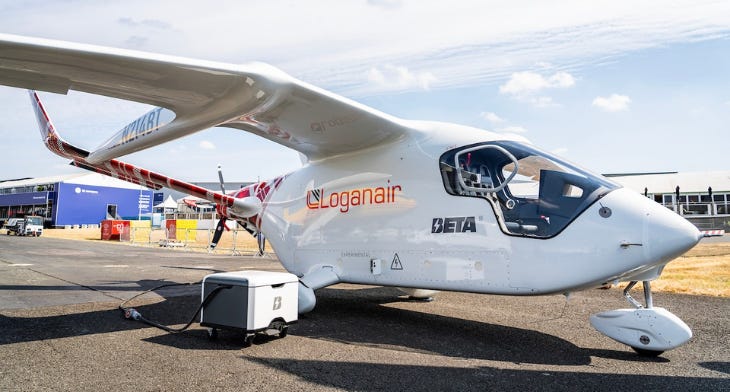
On July 20, at the Farnborough International Airshow, BETA Technologies and Loganair announced a signed term sheet under which the UK’s largest regional airline would purchase five all-electric ALIA CTOL aircraft — the CX300 — with options for five more.
The aircraft are built in South Burlington. If the deal converts and the timeline holds, Loganair would become the first commercial airline in Europe flying an electric fleet.
Expected entry into service: 2029.
The flying that got them here
In March, BETA and Loganair completed what both companies describe as the UK’s first electric flight demonstration programme: 23 flights over 10 days, covering more than 1,000 nautical miles across Loganair’s actual network — Glasgow, Dundee, Aberdeen, Inverness, Wick and Kirkwall.
Wick and Kirkwall are thin, weather-exposed, short-sector connections that exist because there is no road or rail alternative. Scotland’s island and remote communities treat regional air service as infrastructure, not convenience.
That matters for the technical fit. Most of Loganair’s sectors run under 100 miles, which sits inside the CX300’s mission profile rather than at the edge of it. The aircraft uses existing runways — no new vertiport, no new airport category — and recharges in 20 to 40 minutes on BETA’s charging hardware.
The demonstration also tested the parts that rarely make a press release: ground handling, charging, and integration into existing airport and airspace procedures. Those are the details that determine whether a new aircraft type works on a real schedule, and they are what a demonstration programme is for.
What a term sheet is
A term sheet is a signed statement of agreed commercial terms that ordinarily comes before a definitive purchase agreement. It establishes what both sides intend to do and on what basis. It generally precedes the delivery slots, firm pricing and deposit schedules that turn an intention into a booked order.
Neither company disclosed price, deposit structure, or how the five options are triggered.
This is the second BETA announcement in five days — the July 16 charging consortium with Archer and Macquarie came first — and together they mark two commercial agreements in under a week. The specific terms of each, however, are not yet fully fixed, or at least not yet public.
Loganair anticipates significant operating cost reductions
Loganair’s leadership is openly optimistic about the economics. The airline’s chief executive said the demonstration programme showed the potential to cut operating costs by up to 80 percent while maintaining the regional connectivity its communities depend on.
Electric propulsion does carry a structurally lower energy and maintenance cost profile than a turboprop. But a number like 80 percent is a projection, not yet a measurement. It will take hundreds of flight hours across a full range of seasons, sectors and weather before anyone can say where the real figure lands.
What comes next
If this follows the normal path of an aircraft transaction, several things still have to happen before 2029.
A definitive purchase agreement. The term sheet sets the terms; the definitive agreement makes them binding, with delivery positions, pricing and deposits attached. That step typically shows up in a company’s backlog reporting.
Type certification. The CX300 is working toward FAA certification. Entry into service follows the certificate, so that timeline governs everything downstream of it.
Regulatory validation in the UK. An American type certificate is normally validated by the UK Civil Aviation Authority before an aircraft enters commercial service there. For a new propulsion category, that process is being built alongside the aircraft.
Infrastructure at the airfields. Charging hardware has to be installed and commissioned at the airports on Loganair’s network — work the March demonstration was partly designed to scope.
The options. Five firm plus five options is a standard structure that lets a launch operator fly the aircraft in service before committing to a full fleet. Whether the second five convert is the milestone worth marking.
A new economic chapter for Vermont
Vermont does not export many complex manufactured goods. It exports very few that a foreign airline would build a fleet strategy around.
A production line in South Burlington supplying Scotland’s regional carrier is a genuinely different kind of economic story than the one this state usually gets to tell — high-skill manufacturing jobs, an aerospace supply chain, and a Vermont-built product on the tarmac at Glasgow and Kirkwall.
There is a great deal of paperwork ahead before any of that becomes a delivery. But the flying has already happened, the customer is a serious operator with six decades on exactly these routes, and Vermont will be watching closely to see what follows once the agreements are finalized.
Compass Vermont is independent and reader-supported.