


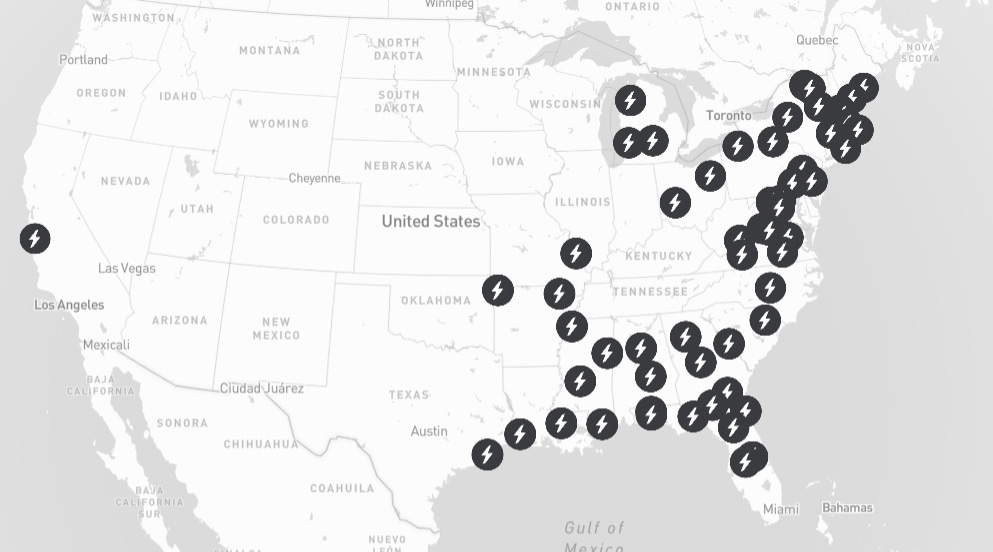
On Thursday, BETA Technologies — the South Burlington manufacturer that has become one of Vermont’s most closely watched employers — joined Archer Aviation and Macquarie Capital to announce America’s Consortium for Electric Skyways, or ACES: a plan to build charging for up to 250 electric air-taxi sites across the country by 2030.
For Vermont, the interest here isn’t that the chargers are coming to the state — the plan is aimed at metro markets elsewhere. It’s that a Vermont company is making a significant strategic move, and whether it succeeds matters to the state’s economy. Below is what the announcement and our reporting make clear, and what remains genuinely open.
What was announced
ACES pairs three players. BETA supplies the charging hardware, built on the Combined Charging Standard (CCS) — an open standard endorsed by the General Aviation Manufacturers Association and used across most of the industry, so that different manufacturers’ aircraft can share the same chargers. Archer, a California eVTOL developer, plans to anchor demand with passenger air-taxi service in the target cities. Macquarie Capital, an investment bank, will advise the consortium and help arrange the capital to acquire sites and build the facilities.
The stated goal is up to 250 sites by 2030, focused on airports and vertiports in California, Texas, Florida and New York. The effort is tied to the companies’ selection for the Federal Aviation Administration’s eVTOL Integration Pilot Program (eIPP), the federal on-ramp for early commercial electric flight.
What we know
The buildout is aimed at major metro markets, not Vermont. The announcement names California, Texas, Florida and New York — in practice, large metropolitan areas within them — as the consortium’s focus. As of this week, BETA’s own charging map shows a modest footprint close to home: two active sites in Vermont and one just across Lake Champlain in New York. Those belong to BETA’s existing network rather than the forward-looking ACES target, and the New York the consortium is targeting is the New York City region, not the Champlain Valley. The release doesn’t itemize the 250 sites or say whether any existing chargers count toward the total.
“Up to 250” is roughly a doubling of BETA’s current network. On its May 12 earnings call, BETA said it had reached 123 charging sites; its year-end filing described more than 100 sites in the U.S. and abroad. Measured against that base, the 2030 target represents about a doubling over four years, concentrated in four large states.
It builds on work already underway. BETA and Archer announced an interoperable-charging collaboration in 2023, and Archer has purchased BETA chargers since. There’s also a public-sector precedent: BETA has described Florida’s Department of Transportation procuring shared charging at state and municipal airports, with BETA supplying the equipment. ACES extends that pattern across four states, with privately arranged capital through Macquarie as the funding source rather than a state agency.
How BETA’s charging business is structured. On the same earnings call, CEO Kyle Clark described a model in which customers often pay a priority-access fee roughly equal to BETA’s cost to deploy a charger, while BETA retains ownership and sells the remaining capacity. Where BETA sells chargers outright, it requires that they stay part of its network. The result is that BETA generally remains the operator of the network its hardware sits in, regardless of who pays for it — including, under a shared standard, chargers used by other aircraft makers.
BETA’s financial context. BETA guides to $39–43 million in revenue for 2026, against a much larger $3.9 billion aircraft backlog, and it is spending heavily to get its aircraft certified and its operations built out: a $122.3 million net loss in the first quarter alone, and full-year adjusted losses it guides to between $355 million and $445 million — a range it widened specifically to absorb the cost of preparing for the federal pilot program. Charging hardware is a small part of near-term revenue.
BETA’s own read on charging revenue timing. Notably, BETA did not raise its 2026 revenue guidance when it discussed the charging pipeline. Chief Financial Officer Herman Cueto told analysts that permitting, contracting, and coordination with airports and the FAA make the timing of charging revenue hard to pin down. The company’s own signal, in other words, is that this is a long build rather than a near-term revenue event.
What we don’t know yet
The financing. Macquarie’s role is to advise and help arrange capital. The announcement names no dollar figure and no committed source of funding for site acquisition or construction. How much capital, from whom, and on what terms are all open questions.
What’s been formally committed. As of July 17, neither BETA nor Archer has filed a Form 8-K disclosing ACES to the Securities and Exchange Commission; on both companies’ filing records, the launch appears as a press release. That isn’t unusual and doesn’t imply anything is amiss — companies file 8-Ks when an agreement is material and binding — but it does mean any binding terms aren’t yet public. An SEC filing would be where those details surface.
The specifics. The release doesn’t lay out which airports come first, the sequence or pace of construction, how ACES relates to BETA’s existing network, or how the site rollout lines up with the eIPP timeline.
What to watch
BETA’s next earnings call, expected in August, is the near-term checkpoint. Management will likely face analyst questions about ACES, and any funded commitments or clearer revenue timing would surface there or in an accompanying filing. SEC filings from either company are the other place binding terms would appear, if and when they’re finalized.
What it means for Vermont
For Vermont, the story isn’t a charging network in Texas and Florida. It’s that a South Burlington employer with roughly 1,400 workers — and a stated plan to add a thousand more over the next 18 months — is making a long, capital-intensive bet on becoming central to the infrastructure of an industry that doesn’t yet commercially exist, while absorbing heavy losses along the way.
Whether that bet pays off matters to Vermont’s economy in a way a map of far-flung charging sites does not. BETA’s trajectory is the Vermont story here — and this announcement is one more marker of the direction the company is betting on.
Compass Vermont is independent and reader-supported.