


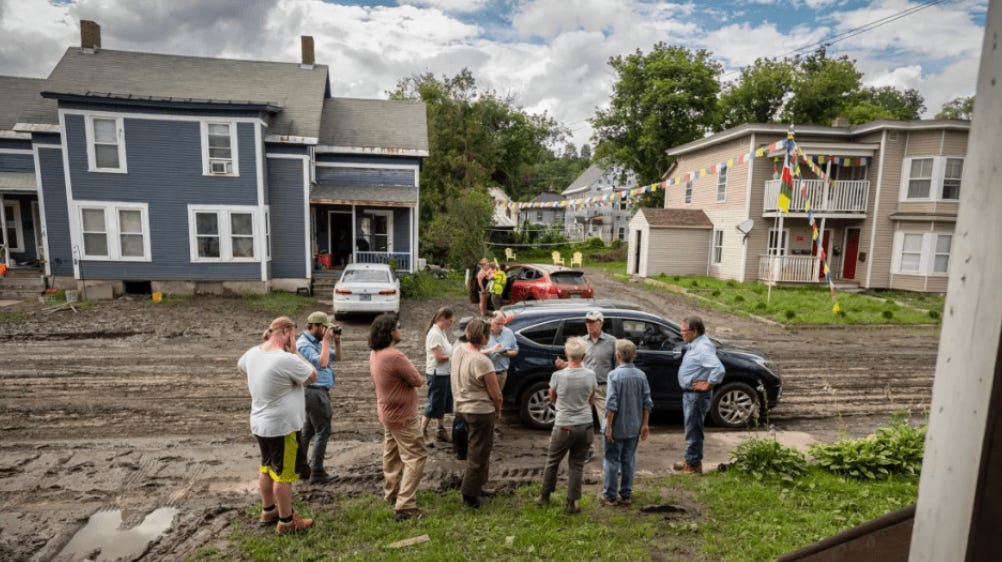
The State of Vermont’s recent decision to direct nearly $50 million in flood recovery funds primarily to “higher ground” housing projects marks a decisive pivot in disaster policy. While intended to move residents out of harm’s way, this shift has created a precarious “life support” situation for Barre City’s North End.
By prioritizing projects that were “shovel-ready” and located outside flood zones, the state has effectively declined to fund the in-place resilience of a historic riverfront neighborhood. This decision forces a difficult conversation: Is the only solution to abandon the river, or have we missed an opportunity to rebuild resiliently?
The Policy Shift: Leaving the Floodplain Behind
The core of the recent funding announcement is a strategic retreat. The awarding of $14.5 million to Downstreet Housing for projects in downtown Barre (Stevens Branch Apartments) and Montpelier signals that the state is investing in replacement rather than repair.
The logic is sound on paper: climate change is causing more frequent floods, so housing should be moved to safer locations. However, this policy creates a binary choice—leave or drown—that ignores the complex reality of established neighborhoods like the North End. By rejecting Barre City’s request for neighborhood redevelopment funds, the state has signaled that the North End may no longer be viewed as a viable site for housing investment.
The Specific Case: The Barre North End “Trap”
The North End of Barre is not just a collection of houses; it is a dense grid of infrastructure, community, and municipal revenue. The rejection of funding for this area exposes a “trap” created by conflicting federal and state rules.
1. The “Shovel-Ready” Barrier
State officials noted that priority was given to projects that were “close to ‘shovel ready’.”
The Problem: Building a new apartment complex on a dry lot (like the Downstreet projects) is straightforward. Rebuilding a flooded neighborhood—which requires elevating homes, improving drainage, and navigating property rights—is messy and slow.
The Consequence: Because the North End project was complex, it lost out to simpler projects. The very complexity that requires government aid is what disqualified it from receiving it.
2. The FEMA “Open Space” Dead End
Without the flexible CDBG-DR funds to rebuild resiliently, Barre is left with the standard FEMA buyout program.
The Restriction: When FEMA buys a flooded home, federal law mandates the land be kept as open space forever. No new tax-generating structures can ever be built there.
The Municipal Cost: If Barre accepts FEMA buyouts for the North End, they lose the tax revenue from those properties permanently. However, the city must still maintain the roads, water lines, and sewer pipes that run through the neighborhood to serve the remaining residents.
The Result: A “hollowed-out” city with high expenses and shrinking revenue—a scenario City Manager Nicolas Storellicastro described as “life support.”
The Missed Alternative: Resilient Rebuilding
The current policy assumes that the only safe place is “higher ground.” However, urban planning precedents suggest that resilient rebuilding—staying near the water but building differently—is a viable third option that was bypassed in this funding round.
What Resilient Rebuilding Could Look Like:
Elevation: Rather than demolition, funds could support lifting existing homes above the new flood stage, preserving the neighborhood fabric.
Amphibious Architecture: Designing ground floors that can flood (wet floodproofing) while keeping living quarters safe above.
Infrastructure Hardening: Using funds to widen river channels or create overflow parks (like the Hardwick floodplain restoration) that protect the housing behind them.
By prioritizing “new builds” elsewhere, the state effectively decided that retrofitting the North End was too expensive or too difficult, leaving the existing housing stock to rot or be demolished.
Costs and Consequences
The decision to defund the North End in favor of “higher ground” projects carries significant long-term risks.
1. Displacement and Gentrification The Downstreet project will create 31 new units in Barre. While valuable, this is unlikely to replace the volume of affordable “starter homes” lost in the North End. As safe land becomes the only land worth investing in, the cost of living on “higher ground” will rise, potentially displacing the working-class residents who can no longer live safely in the valley but cannot afford the new “safe” apartments.
2. Blight and Neighborhood Decay Without funds to rebuild, the North End faces a future of “checkerboarding”—a mix of abandoned lots, boarded-up homes, and holdouts living in unsafe conditions. This creates a blighted district that drags down property values for the entire city, further straining the municipal budget.
3. Loss of Community Identity Vermont’s identity is tied to its river valleys. Abandoning these areas fundamentally changes the character of the state. The “Higher Ground” policy saves the housing unit but sacrifices the neighborhood.
Conclusion: A Fork in the River
The rejection of the Barre North End project is a bellwether for all Vermont river towns. It suggests that the state’s current strategy is to facilitate the slow abandonment of floodplains rather than the expensive engineering required to make them habitable.
While moving to higher ground is the safest option meteorologically, it is the most dangerous option economically for cities like Barre. Unless the upcoming January 2026 funding round allows for a more flexible definition of “readiness”—one that embraces the complexity of resilient retrofitting—the North End may become the first casualty of a policy that prioritizes easy construction over community preservation.
What Happens Next:
January 12, 2026: Barre City has a final chance to submit a revised pre-application for the remaining $14.4 million.
Strategic Pivot: The City may need to break the North End project into smaller, “shovel-ready” chunks (e.g., fixing one block at a time) to compete with the non-profit developers.
Citizen Action: Residents concerned about the “hollowing out” of the neighborhood should monitor the Barre City Council meetings to see if a new proposal is being prepared.
794045
It should be noted that your cover photo is of Barre Street in Montpelier. Not the North end of Barre City.
David Ertel
Excellent breakdown of the shovel-ready trap. The paradox here is brutal: neighborhoods that need funding most get excluded becasue they're complex, while simpler greenfield projects get prioritized. I've seen this logic play out in infrastructure decisions where what's easiest to measure (project readiness) crowds out what actually matters (preserving communty fabric). The FEMA open space rule locking land into zero tax revenue forever is wild.