


Barre property owners: how to look up your new assessment, and how to check whether your school tax can be based on your income instead, is at the bottom of this story.
Barre voters rejected the same school budget for the third time on Tuesday, and the district’s two towns split again. Barre City approved it, 628 to 526. Barre Town rejected it, 993 to 737. District-wide the $57.1 million budget failed by 154 votes out of 2,884 cast, and about 65 percent of the no votes came from Barre Town.
Barre Town voters were looking at a tax rate going up 9.2 percent while Barre City’s fell by nearly a third. Most of that Barre Town increase has nothing to do with the schools.
What the No Vote Was Actually About
The district breaks Barre Town’s 11-cent rate increase into three parts in its own September 8 budget presentation. On a Barre Town home assessed at $200,000, here is what each part costs per year:
RatePer yearProperty appraisal five years out of date7.1¢$142School spending2.9¢$58Expiring merger incentive1.0¢$20Total increase11.0¢$220
School spending is 26 percent of the increase. The slides put it plainly: the appraisal adjustment “accounts for 65 percent of the tax impact for FY27.”
So the part of Tuesday’s ballot that was actually the school budget came to about $58 a year on a $200,000 home — under $5 a month. Rejecting it means the district keeps borrowing at roughly $700 a day in interest, and the board is now weighing cuts to winter sports, transportation and extracurricular activities.
The other $162 was on the ballot too, and no vote could have removed it. It is not something the school board controls.
Same House, Same Bill
The other question Barre property owners are asking is which town is paying more. Neither. On a house worth the same amount, the school tax bill is the same to the dollar.
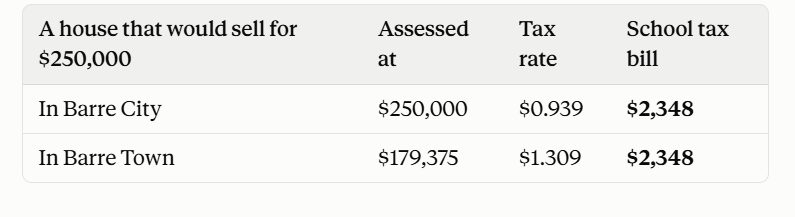
Barre Town’s rate is 39 percent higher. Barre Town’s assessments are 28 percent lower. The two cancel out. Property owners in both towns pay 0.939 percent of what their property is actually worth, and neither town is carrying the other.
That is not a coincidence. It is the machinery working as designed, and it has a name.
What the CLA Does
The Common Level of Appraisal, or CLA, is the ratio between what a town says its properties are worth and what those properties actually sell for. Towns bill taxes on their own assessed values, and assessed values go stale between reappraisals while the market keeps moving. So the state divides each town’s education tax rate by its CLA. A town whose assessments have fallen behind the market gets its rate scaled up to compensate, so it still pays its fair share. The town does not pay more real money. The rate number just gets bigger.
Barre City finished a full reappraisal this year, its first since 2006. Under a change the Legislature made this year, a town’s CLA is set at 100 percent in the year it completes a reappraisal, so Barre City’s assessments now match the market and its rate gets no adjustment at all. Barre Town’s assessments date to 2021 and its CLA has slid to 71.75 percent, so its rate is scaled up by that much.
Here are the two rates the district projected, per $100 of assessed value:
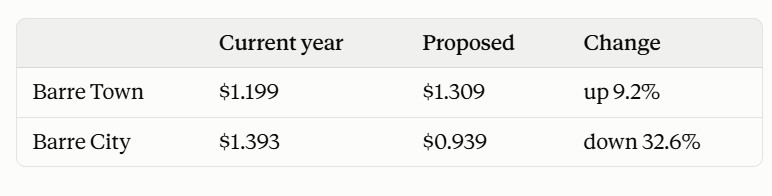
Because Barre City’s CLA is 100 percent, its 93.9-cent rate is the district’s underlying rate with nothing added to it. Divide 93.9 cents by Barre Town’s 71.75 percent and you get $1.309 — exactly what the district projects for Barre Town. The entire gap between the two rates is that one division.
Your Own Bill, Compared With Last Year
A separate question, and the one that catches people: what happened to your bill?
In Barre Town, nothing was reassessed, so the 9.2 percent rate increase is a 9.2 percent bill increase. A property assessed at $200,000 goes from $2,398 to $2,618.
In Barre City, the rate fell by a third but assessments rose about 68 percent on average, so bills went up. The district’s own example: a property assessed at $100,000 last year is assessed at roughly $168,000 now, and its bill goes from $1,393 to $1,578 — up about 13 percent. Individual properties moved by very different amounts in the reappraisal, so that 13 percent describes the average, not any particular house.
So the average Barre City owner’s bill rose more than the average Barre Town owner’s, while their rate was falling. That is what a reappraisal does. It does not mean Barre City is subsidizing Barre Town — the table above still holds. It means Barre City had been paying on out-of-date numbers and is now paying on current ones.
Both towns are above the statewide average. The Legislature applied a $100 million one-time buy-down to hold Vermont’s average education tax increase this year to about 3.5 percent.
The Part That Is About Money
There is one way Barre Town property owners genuinely pay more, and it has nothing to do with the rate: their houses are worth more.
Barre Town’s median home value is $281,400 against Barre City’s $210,400, per Census estimates. At the same 0.939 percent, that is about $2,640 a year in Barre Town and about $1,980 in Barre City — a difference of roughly $670, driven entirely by property values.
Barre Town’s median household income is $93,210 against the city’s $65,625. Barre Town is 88.4 percent owner-occupied; Barre City is 50.4 percent, meaning about half of Barre City households never receive a school property tax bill at all. Poverty runs 2.5 percent in Barre Town and 17.3 percent in Barre City, and roughly half the district’s students live at or below the poverty line — most of them in the city.
The district is also not a big spender. Barre proposed $12,648 per pupil against a statewide range from $10,698 to $24,106, and it spends less per student than Montpelier or Paine Mountain. The budget on the ballot was a 2.11 percent increase. Board chair Garrett Grant has made that point repeatedly: “The budget’s a 2.1% increase. Inflation for the last 12 months is about 3.5%, so well below inflation.”
Barre Town voters were not inventing a grievance. Their bills did go up 9.2 percent, they lost a merger incentive the state had offered them to join a district they voted against joining in 2018, and the district’s own budget FAQ was still posting a Barre Town rate of $1.428 this week — a February figure attached to a bigger budget voters had already rejected, 12 cents above the number actually on Tuesday’s ballot.
What Happens Now
With no approved budget after June 30, 16 V.S.A. § 566 lets the school board borrow against up to 87 percent of the last approved budget — roughly $48.6 million, against the $55.9 million the district spent last year. Barre is operating on a bank line of credit and expects to pay up to $22,000 a month in interest, about $700 a day, to keep the schools open. The authorized amount, the interest rate and the lender appear in no public district record.
The same statute says that if the board borrows, “it shall determine how all funds shall be expended.” That is why the cuts now under discussion do not go back to voters. Winter sports, transportation and extracurricular activities are on the table, with about $350,000 still to find and staff contracts and health insurance already locked in. Grant has said the board hopes to meet the week of September 22 to decide when to try a fourth time.
Nothing in Vermont law sets a deadline for that fourth vote, installs a fallback budget, or brings the state in. Barre can keep voting, and keep paying $700 a day, for as long as it takes.
What a Barre property owner should check
Your assessment. Barre City reset every assessment this year — look up your new value and the grievance process at barrecity.org/assessment.html. Barre Town assessments are unchanged from 2021; the Assessor’s Office takes valuation questions at barretown.org.
Whether you pay on income instead. If your household income is modest, your school tax may be figured on your income rather than your property value. Check eligibility for the property tax credit at tax.vermont.gov.
Not your neighbor’s rate. A higher rate in Barre Town does not mean a higher bill. If you’re comparing with someone in the other town, compare what the two houses would sell for.