



For years, the gold standard for internet in the Green Mountain State has been “fiber or bust.” But a new bipartisan push in Washington is shining a light on a growing debate: should Vermont continue to wait for a universal fiber-optic network, or is it time to embrace the satellites already circling overhead?
A Bipartisan Push for the Stars
In January 2026, an unlikely duo—Vermont’s Democratic Senator Peter Welch and Texas Republican Senator Ted Cruz—teamed up to reintroduce The Satellite and Telecommunications Streamlining (SAT) Act. The bill aims to overhaul how the Federal Communications Commission (FCC) licenses satellite constellations.
The primary goal is to cut through regulatory “red tape” to speed up high-speed internet deployment in rural areas. By imposing a one-year “shot clock” on FCC license reviews, the bill seeks to move at the same speed as modern aerospace companies like SpaceX and Amazon’s Project Kuiper.
The Great Debate: Claims vs. Reality
At the heart of the tension is a fundamental disagreement between the Vermont Community Broadband Board (VCBB) and federal proponents of satellite technology. While the VCBB maintains that fiber is the only viable long-term solution, the SAT Act suggests that modern satellite performance and market dynamics have changed the equation.
The following table contrasts the specific assertions made by Vermont officials against the technical and economic rebuttals emerging in 2026:
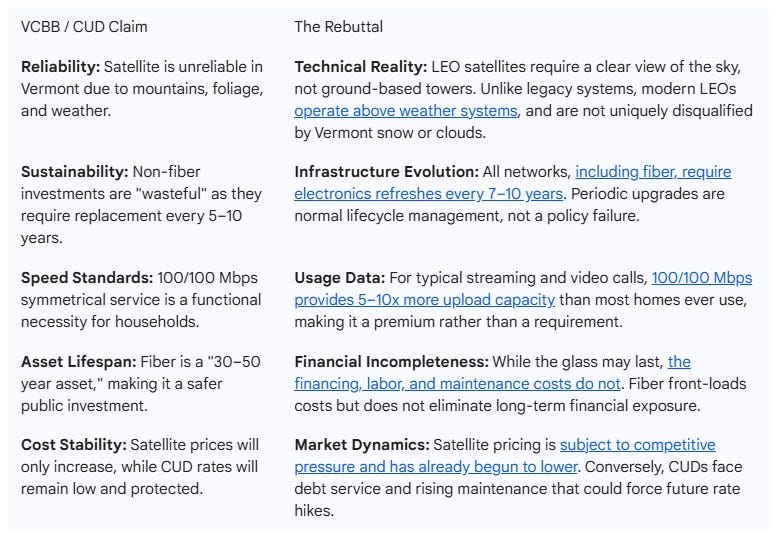
The “Fiber First” Doctrine and its Risks
The move by Senator Welch marks a noticeable shift from the policy of the VCBB. Since its inception, the Board and local Communications Union Districts (CUDs) have followed a “Fiber First” doctrine. In this framework, satellite internet has been labeled a “last resort” for only the most expensive, off-grid locations.
Critics argue that by rejecting hybrid models, Vermont is concentrating risk. A fiber-only strategy relies on massive, irreversible upfront spending. In contrast, hybrid models distribute risk across different technologies and timelines, ensuring that residents are not left waiting years for service while public funds are locked into “gold-plated” infrastructure in low-density areas.
Senator Welch’s “Plan B”
Why would Senator Welch support a bill that seems to bypass Vermont’s local fiber districts? Analysts suggest a “Plan B” strategy. With the current administration freezing federal Broadband Equity, Access, and Deployment (BEAD) funds, the dream of universal fiber may be facing a significant funding gap.
By streamlining satellite licensing, Welch ensures that if the CUDs cannot finish their builds due to financial or geographical hurdles, rural residents will at least have a robust, private-sector alternative. However, this creates a conflict: if the FCC designates satellite-covered areas as “served,” those areas may become ineligible for future fiber grants. This policy “triage” protects public funds from extreme marginal costs but may leave some residents with private subscription models rather than municipal ones.
What Happens Next
The SAT Act of 2026 is currently moving through the Senate Commerce Committee with broad industry support from the Satellite Industry Association.
In Vermont, the VCBB is facing increasing pressure to justify its “fiber-only” stance as federal priorities shift toward technology neutrality. As the “shot clock” in Washington begins to tick, the state must decide if it will continue to hold out for the “30-year asset” or pivot to a strategy that acknowledges the rapid evolution of satellite technology to get Vermonters online today.
If any prt of the pro satellite argument includes SpaceX or Starlink, no thank you. I'll wait for something I can trust.
From what little I know, the main flaw with satellite is upload speed and capacity. Down link is Ok but uplink is nowhere near as good. Can’t imagine it working well for online gaming or other interactive applications where speed is critical both directions.