


ANALYSIS
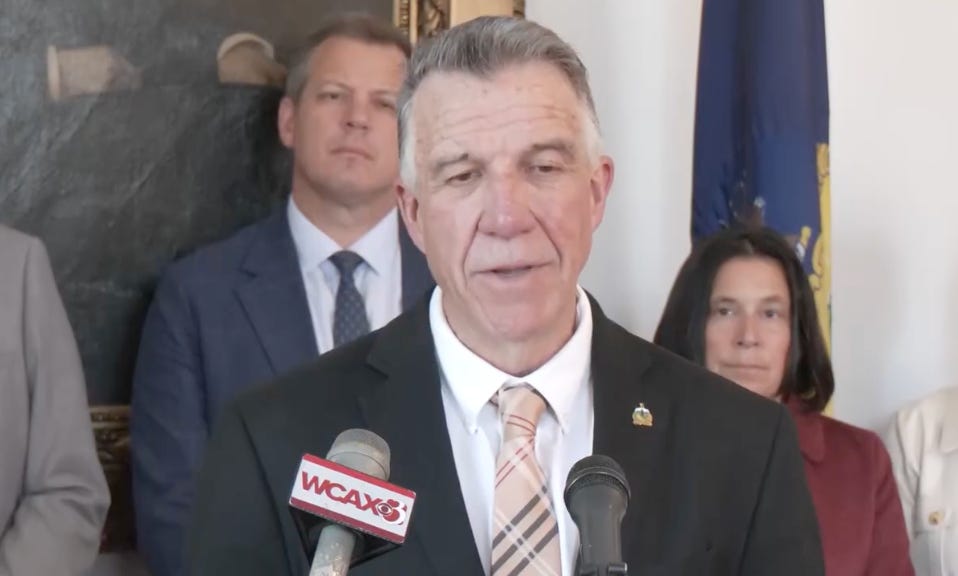
Gov. Phil Scott opened his post-session news conference Wednesday not with a signature accomplishment but with an argument about how the building works.
The session’s results, he said, were possible because no single party held a supermajority. “I don’t believe any of this would have happened without our balance in the legislature,” Scott told reporters, “which is important regardless of which priority is in the majority.” It was a deliberately party-neutral framing: the problem he described was the supermajority itself, not the Democrats who held it.
That thesis is about to be tested in real time. As Scott reminded the room, a bill passed by both chambers does not land on his desk immediately — it moves through legislative legal review first, and once delivered, the governor has five days, excluding Sundays, to sign it, veto it, or let it become law without his signature. Over the coming weeks, some of the session’s most consequential bills will reach him one at a time. Compass will report each action as it happens. This piece is the lens we’ll be watching through — and a look at whether the record supports the frame the governor handed us.
What “balance” actually means
Stripped of politics, Scott’s claim is a statement about arithmetic.
To override a gubernatorial veto, the Vermont Legislature needs two-thirds of the members present and voting — in a full chamber, 100 of 150 in the House and 20 of 30 in the Senate. The current House holds 87 Democrats, three Progressives, four independents and 56 Republicans. The Senate holds 16 Democrats, one Progressive and 13 Republicans.
The math: Democrats, Progressives and independents together fall short of an override in either chamber on their own. In the Senate, those 17 members sit three votes short of 20; in the House, the 94 of them sit six short of 100. Republicans, by contrast, now hold enough seats in each chamber — 13 and 56 — to sustain a veto if they stay united. That is the party-line baseline; in practice, override coalitions form bill by bill, and many measures pass with enough crossover that the math never comes into play.
That is new. The 2024 election, in which Scott campaigned hard for down-ballot Republicans, produced a net Republican gain of six Senate seats — taking the GOP from seven to 13 — and erased the Democratic supermajorities in both chambers. Before that, the majority could enact bills over Scott’s objection without a single Republican vote — and did.
The clearest illustration is now headed to his desk. Act 181, the 2024 land-use law, became law only because the previous Legislature overrode Scott’s veto. This session, the same institution voted to roll back the law’s most contested pieces — the “road rule” and the Tier 3 conservation provisions — passing the partial repeal (S.325) on a near-unanimous 28-2 final Senate vote. A law enacted over his veto in 2024 is being unwound today, this time with broad bipartisan support. Whether that vindicates the theory that balance produces better policy, or simply shows a law was rushed and is now being corrected, is a judgment readers can make. The facts of the sequence are not in dispute. (Compass has covered the Act 181 rollback in detail separately; this is the structural through-line, not a re-litigation of the land-use fight.)
H.955, the education bill, shows the same mechanism working on a live bill rather than an old one. An earlier House version passed 79-62 in April — 15 votes short of what an override would have required, as Compass reported at the time — and Scott had vowed to veto any bill that abandoned his push for forced school-district mergers. Rather than test that veto, legislative leaders went back to negotiate. The rewritten bill, built around voluntary consolidation backed by financial incentives, then cleared both chambers by wide bipartisan margins. Whether that sequence proves Scott’s point — that without the votes to override him, the Legislature had to come to the table — or simply shows a workable compromise was available all along, is again the reader’s call. Either way, the arithmetic he described is visible in the outcome.
The record the governor is pointing to
Scott named five results as the case for the session: property-tax relief, a structural fix to the Transportation Fund, the partial rollback of Act 181, long-stalled progress on a forensic facility, and the education reform bill, H.955.
Two caveats matter before any of this is called settled. First, several of these bills have not yet been signed — or even formally delivered. The Act 181 rollback (S.325) has cleared the Legislature and is headed to his desk; Scott long opposed the conservation provisions it targets, but rather than celebrate the repeal, his office faulted lawmakers for spending the session undoing Act 181 instead of advancing housing — and he has not said whether he’ll sign. On H.955, he was explicit that he would not commit until he reads the final text: “I want to make sure it’s a very technical bill... I’m not going to commit to doing anything,” while adding he believed he “would find my way to signing it if everything’s the way I’d left it.” Compass will hold the version-lock line — we report on the bill that becomes law, not the bill as described from the podium.
Second, much of the detail came not from Scott but from his cabinet, and attribution matters. The description of the Transportation Fund fix — money the state had been routing from the fund into education, now partly stabilized, with more to follow next year — came from Transportation Secretary Joe Flynn, not the governor. The education mechanics — the move from forced mergers to a voluntary process, the regional service areas, and the accelerated transition to a foundation funding formula — came from Education Secretary Zoie Saunders and legislative negotiators. We note who said what because “the governor said” is a claim Compass does not make loosely.
The counter-reading, in his own words
The strongest argument against treating the session as a success comes from Scott himself.
He described the year as one spent largely undoing: lawmakers had, in his telling, “spent an entire session undoing harmful policies passed by the previous super majority rather than making meaningful progress.” A sitting governor characterizing his own session as mostly subtractive is itself newsworthy, and it cuts two ways. To his supporters, it reads as disciplined restraint — divided government correcting overreach. To critics, it reads as a year of stalemate, with little built and much unwound, framed as a virtue.
There is also a competing explanation for the session’s biggest reversal that has nothing to do with Scott’s theory. The Democratic leadership’s pivot on Act 181 came as the 2026 election season approached, after a grassroots rural backlash — the Rural Vermont Rising movement, which Scott himself noted at the news conference had drawn some 15,000 followers in two months — mobilized against the law. Even Sen. Russ Ingalls, a Republican who helped organize a March protest, cast the movement as energized for the campaign ahead, saying rural Vermont was “ready to engage” from August through November. Whether the rollback reflects the machinery of balance or the politics of an election year is, again, a question the record raises rather than resolves.
The kind of Republican making the argument
Scott’s “balance” brand is his own, and he was careful at the podium to keep it distinct from his party’s apparatus.
Asked how closely he is working with Vermont GOP chair Paul Dame, Scott declined to claim alignment: the two are “in contact,” he said, but “I wouldn’t say we’re working hand in hand... We see we’re doing okay on our own, and they seem to be doing okay on their own.” Dame leads the state party; Scott, a Republican governor in a state Kamala Harris carried by double digits, has long kept visible public distance from the national party. His arm’s-length answer does the work here, and readers can weigh what that distance signals about whose brand of Republican politics the “balance” pitch represents.
What we’re watching
The governor has, in effect, given Vermonters a scorecard and told them how to read it. The next few weeks supply the test: which bills he signs, which he returns, and which he lets become law without his signature — and whether the legislature has the votes to answer back.
Compass will track each consequential bill as it reaches the desk, recording what it does, when it was delivered, and what the governor decided. We bring the data. You form the opinions.
In my view,the last 10yrs in Vermont is nothing but Astounding!!! Proportions [income] are all out of wack! Cost of living is through the Roof! Taxes,fees,regulations constant increase! Cost of goods and services constantly going up! A local landfill just went up again,another 25%! Last year in went 30%! Total-55% in one year! WTF. Begs the question, how much is enough??? It's no wonder people are leaving this state. And it can all be traced back to Montpelier's doing. All the Legislators and the Governor are to blame. And It's not a Dem. or Rep. issue, as some people would claim, It's a "People" issue!!! You either give a Dam or you don't!! Values, Morals, they all add up! And some are out the window!! The "Middle Class" is being eaten alive. And for the History buff's, I see many parallels with the French Revolution. Is that next??? I wonder how many people who came here under the program the state did with the 10k giveaway. Remember that??? Are they still here??? There's a story for you Compass. Ok, rant over. Mr.Scott needs to go, and so does many of the Legislator's. We need change, more than ever....