


As candidates for the Vermont Legislature begin filing on Monday, April 27, 2026, lawmakers pave the way for them to skip the financial disclosures.
On Friday, the House Committee on Government Operations and Military Affairs voted 10-0, with one member absent, to advance the bill that does it.
The disclosures are still required. Candidates for State office, county office, State Senator, and State Representative are directed by law to file a financial disclosure form with the State Ethics Commission — listing income sources, investments, loans, and other financial interests — at the same moment they file their petitions to appear on the ballot.
But under the bill the committee advanced Friday, a candidate who skips that disclosure can still run. Still win. Still serve. And face no penalty for leaving voters in the dark about who, or what, might be paying their bills.
Draft 5.1 of S.298 — originally the Senate-passed Vermont Voting Rights Act, now renamed the “Voter Protections Act of 2026” — would suspend enforcement of Vermont’s candidate financial disclosure penalty through May 30, 2027. That covers the entire 2026 election cycle: primary, general election, and transition into the 2027 legislative session.
The penalty is Vermont’s first, and only, mechanism to make candidate financial disclosure an actual requirement rather than an aspiration. The Legislature itself created it in 2024. The 2026 cycle was to be the first in which it applied.
Both agencies the bill names as administrators — the Secretary of State’s office and the State Ethics Commission — filed written testimony with the committee opposing the suspension. The committee advanced it anyway.
What the Amendment Does
The candidate financial disclosure requirement itself has been Vermont law since 2017, enacted as part of the legislation that created the State Ethics Commission. Under 17 V.S.A. §2414, every candidate for state or legislative office must submit a disclosure form identifying each source of personal income over $5,000, business investments, real estate, municipal and state bond holdings, certain loans, and — for statewide candidates — a redacted copy of their most recent federal tax return.
Beginning January 1, 2026, the disclosure requirements expanded substantially. Filers must now disclose individual stock holdings valued at $25,000 or more, interests in virtual currencies or trusts valued at $25,000 or more, Vermont state or municipal bonds valued at $25,000 or more, non-commercially reasonable loans, and ownership interests in companies with business before state or municipal government. County candidates were added to the disclosure regime.
For seven years, the disclosure requirement existed without teeth. There was no penalty for late filing, incomplete filing, or failure to file at all. In 2024, the Legislature closed that gap. Act 171 (H.875), signed into law without Governor Phil Scott’s signature on June 10, 2024, added a new section — 17 V.S.A. §2415 — creating the state’s first candidate financial disclosure enforcement mechanism: $10 per day, up to a maximum of $1,000, beginning on the sixth working day after the Ethics Commission issues a delinquency notice. Candidates have five working days to cure after receiving notice.
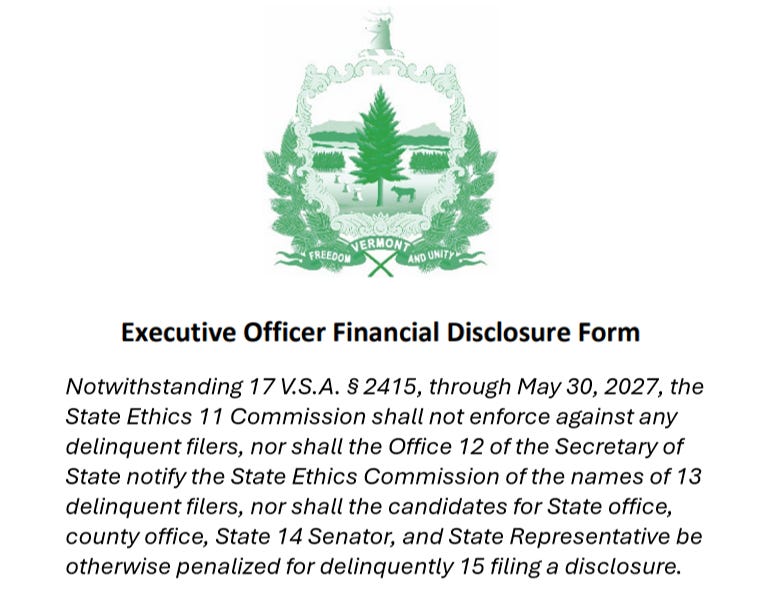
Draft 5.1 suspends that enforcement. Section 5 of the amendment reads, in full: “Notwithstanding 17 V.S.A. § 2415, through May 30, 2027, the State Ethics Commission shall not enforce against any delinquent filers, nor shall the Office of the Secretary of State notify the State Ethics Commission of the names of delinquent filers, nor shall the candidates for State office, county office, State Senator, and State Representative be otherwise penalized for delinquently filing a disclosure.”
In practical terms: a candidate who skips the disclosure form when filing petitions Monday does not face a $10 daily penalty. The Secretary of State’s office is prohibited from telling the Ethics Commission which candidates skipped. And the Commission is prohibited from enforcing. The requirement remains on paper. The consequence disappears for thirteen months.
The amendment does one other notable thing with candidate disclosures. Section 4 adds a new subsection to §2414 requiring the Ethics Commission to “provide informational resources to candidates and answer candidates’ questions” about the disclosure form — what Erlbaum, in his written testimony, called a new duty never previously assigned to the Commission. Draft 5.1 also requires the Commission to post the form on its website, publish responses to frequently asked questions, post “any informational resources and materials that it deems necessary,” and respond to candidate inquiries “by email or by phone, whichever the candidate may prefer.”
Both Agencies Filed Written Objections
On Wednesday, April 22, Deputy Secretary of State Lauren Hibbert and Director of Elections and Campaign Finance Sean Sheehan submitted joint written testimony to the committee on Secretary of State letterhead. On the suspension, their position is unambiguous: “Our preference would be to strike Section 5 altogether.”
They gave the committee three specific reasons. First, the draft language purports to suspend enforcement authority the Secretary of State’s office does not have — §2415 places enforcement authority with the Ethics Commission alone. Second, if the committee proceeded with a suspension, Hibbert and Sheehan asked that the original June 1, 2026 start date be removed, because it fell after the May 28 major-party filing deadline — meaning the suspension would protect only late-filers who missed the deadline, not candidates seeking guidance while completing the form. Third, the office proposed a non-legislative alternative: the Secretary of State’s office would post the Ethics Commission’s form on its own website, with a clear header attributing it to the Commission and a link to the Commission’s contact information.
That offer would have solved the immediate practical problem candidates face Monday morning. The committee did not take it.
The same day, Paul Erlbaum — Chair of the State Ethics Commission since 2021 and a commissioner since 2019 — filed his own written testimony. Erlbaum told the committee that Section 4 would create “an altogether new duty for the Commission,” one candidate-advising has never been assigned to.
More significantly, Erlbaum reported that the disclosure form already exists. The Commission created a revised form months ago and provided it to the Secretary of State’s Elections Division for inclusion in the candidate package, as has been standard practice for years, he wrote. "Erlbaum's testimony adds detail to the story of the form's status. Seven Days reported Thursday that 'this year's financial disclosure form has yet to be released, in large part because of the standoff between the commission and the secretary of state's office' — and that remains accurate. What Erlbaum's testimony establishes is that the form itself exists. The Commission created a revised version months ago and delivered it to the Elections Division, as has been standard annual practice. What remains unresolved is which agency's header appears on it, and which agency fields candidate questions."*
Erlbaum also told the committee what it would cost to make the Commission capable of performing the duty the amendment assigns it. With current staffing — one part-time Executive Director and one part-time administrative assistant — the Commission cannot respond to candidates’ questions, he wrote. Performing existing obligations would require at least two new staff positions. Taking on the Section 4 candidate-advising duty would require three new positions, including at least two attorneys.
The committee’s response to Erlbaum’s testimony was to expand Section 4, not contract it. Between Wednesday’s hearing and Friday’s Draft 5.1, the committee added requirements that the Commission post the form online, publish frequently asked questions, and staff both email and phone responses for candidates — while keeping the Section 5 suspension in place.
The 2024 Backstory: A Penalty Added Without Funding, Now Suspended Before First Use
Draft 5.1 suspends a penalty that is not yet two years old.
Act 171 of 2024 — the law that created §2415 — was the product of years of advocacy by the Ethics Commission. Executive Director Christina Sivret had told lawmakers that of the 48 states requiring candidate financial disclosure, Vermont was the only one without any statutory mechanism to enforce the requirement. The Commission had proposed modest penalties — ten dollars a day, capped at one thousand dollars — as a first step. A 2023 attempt to include the penalty in a miscellaneous elections bill failed. Act 171, in 2024, finally enacted them.
Act 171 did more than create the penalty. It substantially expanded the Commission’s portfolio: establishing a statewide Municipal Code of Ethics, requiring the Commission to train and advise municipal officers, empowering the Commission for the first time to investigate complaints and hold hearings on alleged unethical conduct in state government, and expanding candidate disclosure requirements. Act 171 assigned the Commission new duties. Governor Scott’s objection at the time, and Commission testimony over the following twenty-two months, documented that those duties were not accompanied by the additional staffing the Commission said it needed.
Governor Scott allowed Act 171 to become law without his signature. As Vermont Public reported in January, Scott’s stated reason was that while he welcomed expanded oversight, he objected to creating new administrative burdens without additional funding.
The Legislature did not add funding. The Commission entered 2026 with a budget of roughly $250,000, its two part-time staff positions, and an accumulated backlog of new duties. By mid-2025, the Commission was forced to post a public notice on its website suspending advisory and complaint services to municipalities entirely.
In January 2026, Ethics Commissioner Paul Erlbaum told the Senate Government Operations Committee that the Commission’s continued existence was precarious without additional funding. Scott’s proposed FY27 budget, delivered to lawmakers that same month, contained no additional Commission funding. The House budget bill, H.951, now in committee, includes one new attorney position for the Commission — described by Erlbaum in his written testimony as a step in the right direction but insufficient to fulfill the duties already assigned.
The penalty mechanism Draft 5.1 suspends would have been enforced for the first time in the 2026 cycle. For every candidate filing between April 27 and May 28.
Five Drafts, Four Days, One Unanimous Vote
The committee produced Draft 2.1 on Monday, April 21, at 4:00 PM. It heard testimony from Hibbert, Sheehan, Erlbaum, and others on Wednesday, April 22. It produced Draft 3.1 on Thursday, April 23, at 7:00 AM. It heard additional testimony Thursday and Friday. It produced Draft 5.1 on Friday, April 24, at 11:30 AM. As of publication, an intervening Draft 4 did not appear on the committee’s public document page.
The committee voted Friday to report the amendment favorably to the House floor — less than three hours after Draft 5.1 was finalized at 11:30 AM. The vote was 10-0, with one member absent. Democrats, Republicans, and the committee’s lone Independent all voted yes.
Across the four days of testimony and drafting, the committee accepted several narrow amendments from witnesses. It added “disability” to the definition of protected class under the voting rights provisions, responding to testimony from Vermont Progressive Party Executive Director Heather Thomas and disability-rights advocate Alicia Weiss of Plainfield. It added a voter checklist amendment to §2154 — verbatim from Hibbert’s written testimony. It removed the original June 1, 2026 start date on the suspension, as Hibbert had requested as a fallback position. It cleaned up drafting errors that had included the Secretary of State’s office in enforcement authority it does not have.
The committee did not strike Section 5. It did not take Hibbert’s offer to host the form. It did not reduce Section 4 in response to Erlbaum’s testimony that the Commission cannot perform it — it expanded Section 4. It did not restore the private right of action the Senate-passed S.298 had contained. And it did not restore the original bill’s title — “Vermont Voting Rights Act” — renaming the bill “Voter Protections Act of 2026” and relocating the civil rights provisions from their own stand-alone chapter into a subchapter of the existing chapter on “Offenses Against the Purity of Elections.”
The committee heard, responded, and advanced.
What the Suspension’s Sponsor Says It’s For
Seven Days reported Thursday that Rep. Chea Waters Evans (D-Chittenden-5), Ranking Member of the committee, said the proposed suspension was intended to avoid penalizing candidates who might lack clear guidance while the Ethics Commission and Secretary of State’s office resolved which agency would oversee the form. She told the paper: “We can’t hold people to something if we’re not giving them the tools they need to get it done correctly.” She said the committee could reinstate the penalties once jurisdiction was resolved.
Two facts in the primary-source record cut against that rationale.
First, the Ethics Commission already has discretion to waive penalties. Under 17 V.S.A. §2415(a)(4) — part of the law Draft 5.1 would suspend — the Commission may reduce or waive a penalty if a candidate demonstrates good cause, “as determined by Ethics Commission, at sole discretion of Ethics Commission.” A candidate who filed late because guidance was unavailable could have their penalty waived under existing law. The blanket thirteen-month suspension is substantially broader than what the statute’s existing flexibility already allows.
Second, the Secretary of State’s office has offered to provide candidate-facing guidance itself. Hibbert’s written testimony states the office is prepared to fulfill all of its duties and does not ask for them to be suspended, and offered to host the Ethics Commission’s form on the SoS website with candidate instructions. That would resolve the practical problem candidates face Monday morning without any legislation at all.
The result of advancing Section 5 as drafted: during the first election cycle in which Vermont’s candidate financial disclosure enforcement mechanism was to apply, it will not apply. A candidate can file for the ballot, win, and serve without submitting a disclosure — without paying a single dollar of penalty for the omission.
Where This Fits
Compass Vermont has been documenting a pattern across the 2026 session in which Vermont’s structural ethics framework is expanded in statute and contracted in practice. The Sheldon investigation traced how Vermont’s structural disclosure gap allows self-employed legislators with regulatory-consulting practices to avoid identifying their clients. One of the expanded disclosure requirements that took effect in January 2026 addressed that gap — a new requirement that filers identify business ownership interests in companies with business before state or municipal government. The current bill represents the same pattern at a different layer: a penalty mechanism enacted to close a structural gap, suspended before it can be used.
What Happens Next
With the committee’s Friday vote, the bill now goes to the House floor. If the House passes it, the bill returns to the Senate for consideration as a House proposal of amendment — because S.298 originated in the Senate. If the Senate accepts the House’s changes, the bill goes to the Governor. If the Senate rejects them, the bill proceeds to a committee of conference.
The filing window for major-party candidates closes May 28. The Legislature is currently in session. After a bill is presented to the governor, the governor may sign it, veto it, or allow it to become law without signature, as Scott did with Act 171 in 2024.
Until then, the candidate financial disclosure requirement remains in place, on paper, in statute. The Ethics Commission’s form exists, not yet posted for public candidate use in its 2026 form. Hibbert’s offer to post it on the Secretary of State’s website, for candidates filing Monday, remains available.
Editor's note (April 24, 2026): This piece was updated after publication to clarify the relationship between Compass Vermont's primary-source reporting and Seven Days' April 23 reporting on the disclosure form. The original version characterized the two accounts as contradictory; the more accurate framing is that they describe different aspects of the same situation. Seven Days' reporting that the form has not been publicly released is accurate. Erlbaum's written testimony establishes that the form exists internally and was delivered to the Elections Division.
This story was built from primary-source documents available on the Vermont Legislature’s public document portal, including committee drafts, witness testimony, and the official Record of Action, as well as from prior reporting by Vermont Public and Seven Days. Additional source links will be added as verified. Readers can access committee materials on the S.298 page at the Vermont General Assembly’s website.
Compass Vermont will continue reporting on S.298 as it progresses. Compass Vermont is an independent, reader-funded Vermont news outlet with no ads, sponsors, or corporate ownership. To support this reporting, consider a paid subscription.