


Compass Vermont gives you the facts and links to the sources so you can make up your own mind. If you value that kind of reporting, please consider a paid subscription.
If you drive or ride in a car, this has happened to you.
Downtown is packed. You’ve circled the block twice. Then you see someone walk to a parked car with their keys out. You leave them room to back out and put your blinker on. You’ve found a spot.
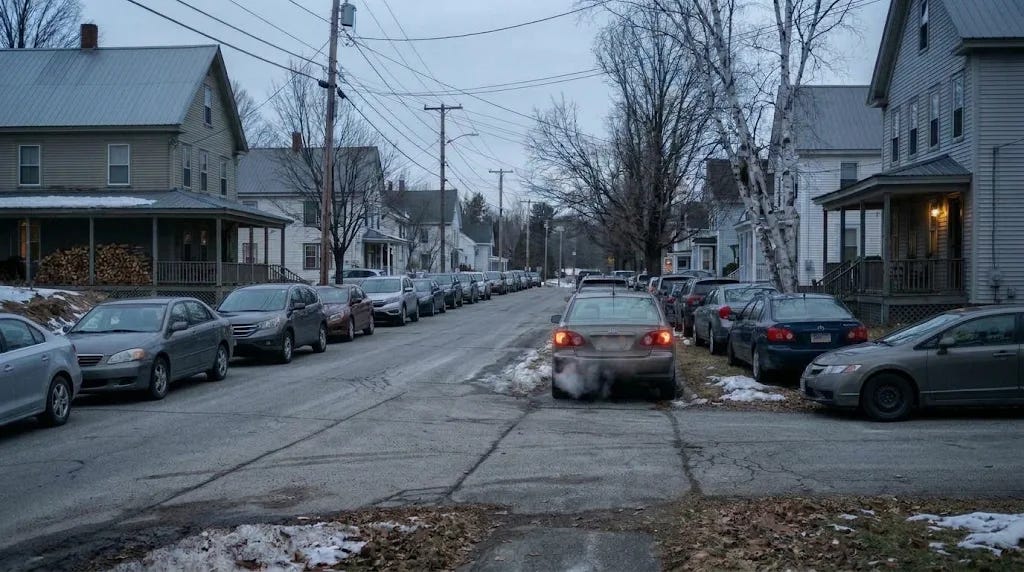
The engine starts and exhaust comes out of the tailpipe. Two white reverse lights come on. Then the brake lights stay lit and the car doesn’t move an inch.
You wait, but you know what’s going on. They’re on their phone, texting, scrolling, or watching a video somebody just sent them.
It’s annoying when you’re looking for a place to park, and it doesn’t help the air. What a lot of Vermonters don’t know is that after five minutes, it can also be against the law.
The Vermont Department of Environmental Conservation reminded drivers of that Wednesday in its “Be Idle Free” push ahead of colder weather.
You’re Not Imagining It
Researchers have actually timed this. In a study published in 1997, Barry Ruback and Daniel Juieng watched 200 drivers pull out of spaces at an Atlanta-area mall. With nobody waiting, drivers took about 32 seconds to leave. With somebody waiting, they took about 39 seconds. When the waiting driver honked, they took even longer.
So sitting there tapping the steering wheel doesn’t help, and leaning on the horn makes it worse. The law might help, depending on where you are.
At the Curb, Five Minutes. At the Supermarket, No State Limit.
Vermont’s idling law took effect in May 2014. In plain English, you can’t keep the engine of a stopped vehicle running for more than five minutes in any hour. That’s five minutes total in an hour, not five minutes at a stretch.
Say the driver spends six minutes finishing that video in an on-street space or a town-owned lot. That’s a violation, unless one of the exceptions below applies.
Now put the same two cars in a privately owned supermarket lot. The state law exempts ordinary passenger vehicles, meaning anything rated at 10,000 pounds or less fully loaded, when they idle in a driveway or parking lot on private property. That’s true even in a lot where anyone can shop. The driver there can finish the video, and the next one.
The law also allows idling in these cases, among others:
In traffic, at a light, or when a police officer tells you to wait
When the health or safety of someone in the vehicle requires it
To run the defroster or other safety equipment when there’s a real safety need, like an iced-over windshield
For police, fire, ambulance, military and other emergency vehicles on the job
For trucks running equipment like refrigeration, and for older trucks heating or cooling a sleeper cab while the driver rests
During repairs, maintenance and inspections
Warming up the car for 10 minutes on a cold morning in a town lot, just for comfort, isn’t on that list.
The fine is up to $10 for a first offense, up to $50 for a second and up to $100 after that. The first-offense fine is exempt from the state surcharges that usually get added to a traffic ticket, so $10 means $10.
In Burlington, Three Minutes
Cities and towns can set tighter rules, and Burlington does. The city’s ordinance limits idling to three minutes in any area of the city, and it doesn’t carve out private lots the way state law does. Among its exceptions is when a driver’s or passenger’s health or safety requires it, including running the defroster. The fine is $12.
Why the State Cares
DEC says motor vehicles are the largest source of greenhouse gases in Vermont. The person walking past the tailpipe gets a share of the exhaust. DEC Commissioner Misty Sinsigalli said idling exhaust hurts everyone’s air quality but is hardest on children, older adults, and “people with heart or lung disease.”
An idling car gets zero miles per gallon. DEC calculates that if every gas and diesel car and truck in Vermont cut just one minute of unnecessary idling a day, Vermonters would burn more than a million fewer gallons of fuel a year and put out more than 10,000 fewer metric tons of carbon dioxide.
DEC’s advice goes further than the law:
Turn off the engine if you’ll be stopped for 10 seconds or more, unless you’re in traffic.
Warm up by driving gently. If you need to idle, keep it to 30 seconds, even in cold weather, and make sure the windshield is defrosted before you go.
Wait inside a building instead of in a running car.
That part is advice, not law. Nobody gets a ticket at 11 seconds.
So Can You Call the Police?
Technically, yes, if it’s a public street, the car has been running more than five minutes, and none of the exceptions apply. In practice, by the time anyone shows up to write a $10 ticket, you’ll have found another space or given up and gone home.
And the driver ahead of you could always turn off the engine and settle in for the rest of the video. Vermont gets cleaner air, even if you are still looking for a place to park.