


Vermont households are absorbing inflation above the national average, according to state-level calculations by the Democratic members of the Joint Economic Committee, while the farms that supply local and organic food are facing sharp increases in fertilizer and diesel costs, according to an April survey by the American Farm Bureau Federation.
The two pressures are converging on anyone trying to eat well and eat locally in Vermont.
What Vermont households are paying
According to state-level calculations released in April by the Democratic members of the Joint Economic Committee, the average Vermont household has paid $2,500 more for goods and services since January 2025. That figure — based on Bureau of Economic Analysis household spending data and Consumer Price Index data through March 2026 — places Vermont above the national average of $2,357.
Vermont’s above-average number is driven primarily by housing. The state’s average housing cost increase since the current administration took office is $659, compared to $477 nationally, reflecting Vermont’s already-constrained rental and homeownership market. Transportation adds $351 per Vermont household — slightly below the national average of $368. Because Vermont’s transportation increase falls below the national figure, the JEC data suggests housing is the main category pushing Vermont’s total above the national average. The two categories combined still account for more than $1,000 of the total increase before accounting for food, clothing, health care, and other essentials.
On groceries specifically, a JEC Democratic Minority report from January 2026 found the typical American family paid $310 more for groceries in 2025 compared to 2024. That is a national figure; Vermont-level grocery cost data broken out separately is not yet published for the current period. The Bureau of Labor Statistics reported that the Consumer Price Index rose 3.3% over the 12 months ending in March 2026, up from 3.0% in January 2025, with gasoline prices rising 21.2% over the month of March. BLS also reported that food prices were unchanged month-over-month in March, with grocery prices down 0.2%. The grocery squeeze is largely cumulative from 2025 price increases rather than a sudden spring spike. The American Farm Bureau Federation notes that higher farm input costs are expected to put upward pressure on food prices in coming months, though timing and magnitude remain uncertain.
What Vermont farmers are paying
On the supply side, Vermont’s 690 USDA-certified organic farms — about one in ten of the state’s 6,537 total farms, according to the 2022 USDA Census of Agriculture — are entering the growing season with input costs the American Farm Bureau Federation describes as the most volatile since Russia’s invasion of Ukraine. A survey of more than 5,700 farmers conducted by the AFBF between April 3 and April 11 found that nitrogen fertilizer prices have risen more than 30% since late February, with urea prices specifically up roughly 47%. Farm diesel has risen 46% over the same period.
The price spikes are tied to supply chain disruptions following the closure of the Strait of Hormuz. According to the AFBF and the Fertilizer Institute, countries in and around the Persian Gulf account for approximately 49% of global urea exports and 30% of global ammonia exports. Rystad Energy places those figures lower, at roughly 21% and 15% respectively, reflecting different methodologies for measuring seaborne versus total global trade. Higher energy prices have compounded the cost pressure regardless, since nitrogen fertilizer production relies heavily on natural gas as a feedstock.
The AFBF survey found that around 70% of farmers nationally said they could not afford all the fertilizer they needed for the 2026 growing season. In the Northeast — Vermont’s USDA region — the figure is 69%. Smaller operations are the most exposed: in the Northeast, only 24% of the smallest farm operations had pre-booked fertilizer ahead of the season, compared to 35% of mid-sized farms and 67% of the largest. Because smaller farms are less likely to lock in prices in advance, they face full exposure to in-season cost spikes with less margin to absorb them.
Vermont’s certified organic sector maps closely to that most-exposed profile. According to the 2022 USDA Census of Agriculture, more than three-quarters of Vermont’s farms are family-owned operations, and the state’s 690 certified organic farms are concentrated among smaller producers selling directly to consumers through farmers markets, co-ops, CSAs, and farm stands — channels that require the farm to absorb cost increases before, or instead of, passing them along. Farmers who set their 2026 CSA share prices before the late-February input cost spike may have limited ability to raise prices during the season, making it difficult to pass along new costs until the next pricing cycle.
The convergence
That is the structural squeeze: Vermont households with less budget flexibility than the national picture suggests, buying from farms whose operating costs have risen sharply in the span of ten weeks. Certified organic production does not use most synthetic nitrogen fertilizers, but diesel remains unavoidable — it powers field equipment, transport, and refrigeration across every type of operation. The AFBF estimates combined fuel and fertilizer expenses are running 20% to 40% higher this spring depending on the specific farm.
Those cost increases have not yet fully worked their way to retail prices. The USDA’s 2025 Organic Survey — which will provide updated Vermont-specific farm input and expense data — is expected to be published October 30, 2026.
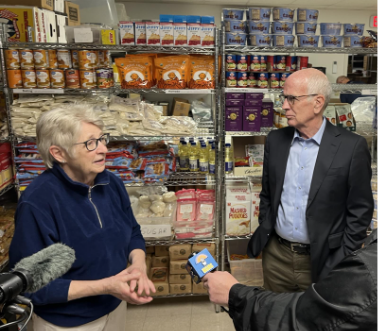
U.S. Senator Peter Welch visited a Middlebury food shelf and a Charlotte grain operation this week to hear from Vermonters about food costs. The underlying data, from federal statistical agencies and the nation’s largest agricultural organization, frames what he heard.
........."Vermont Senator Peter Welch visits farms and businesses in Addison County to discuss affordability."........Of ALL the issues/problems facing Vermont right now, what has he done for us the last few years??? Sorry, but he's part of the problem!....