


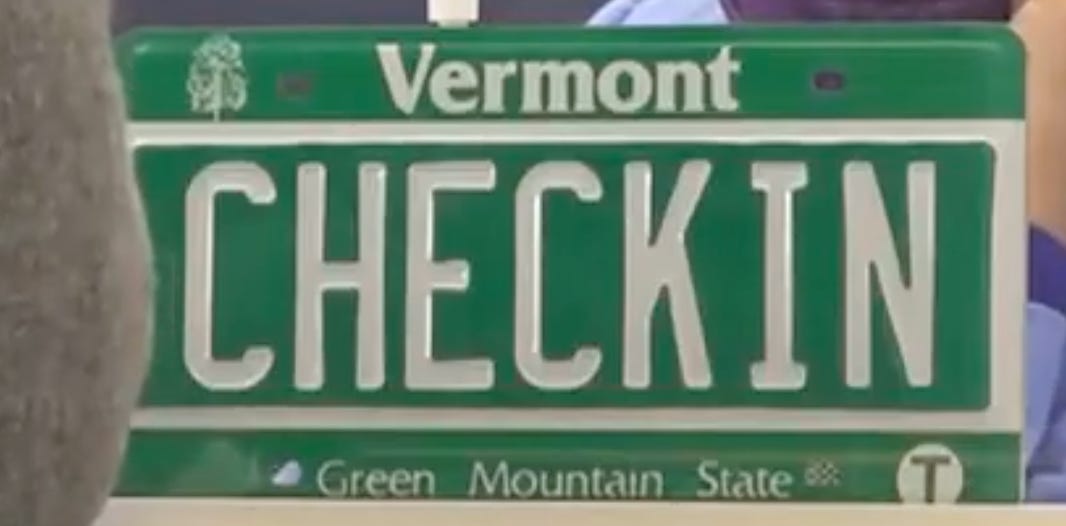
When Vermont lawmakers raised nearly every fee at the Department of Motor Vehicles by 19.8% in 2023, the reasoning was straightforward. DMV fees hadn’t been adjusted since 2016.
Over the same period, the Personal Consumption Expenditures Index — a standard measure of inflation — had risen by exactly 19.8%. Index the fees to inflation, catch the Transportation Fund up to where it should have been, and generate an estimated $20.5 million a year in additional revenue for paving, bridges, and the state’s share of federal highway dollars.
The math was clean. The Joint Fiscal Office signed off on the numbers. House Ways and Means voted the fees through. Governor Phil Scott objected, called the increases regressive, and let the transportation bill become law without his signature on January 1, 2024.
Two years in, the theory has run into a problem the math didn’t anticipate.
A December 2025 Joint Fiscal Office briefing prepared for the Senate Transportation Committee lays it out. DMV fee revenue came in at $100.3 million in fiscal year 2025 — $3.25 million below what the state had forecast. Through the first five months of fiscal year 2026, motor vehicle fee revenue is running 4.3% lower than the same period last year. The hike delivered real dollars; it did not deliver the dollars projected, and the trajectory is now pointing the wrong way.
The Transportation Fund as a whole closed FY25 at $313.6 million — $7.4 million short of target. JFO attributed the shortfall to underperformance in DMV fees and the Motor Vehicle Purchase & Use tax, the two non-fuel revenue sources the state leans on hardest.
What the theory assumed
Act 62 (H.479) set the fee increase at 19.8% — the exact growth in the Personal Consumption Expenditures Index from July 2016 to December 2022, the period since the last broad DMV fee adjustment. A one-year pleasure car registration went from $76 to $91. A four-year driver’s license went from $32 to $38. Across roughly 200 fee categories — plates, permits, titles — every transaction at the DMV got more expensive by the same percentage.
JFO Senior Fiscal Analyst Chris Rupe told lawmakers the adjustment would generate $20.5 million in new Transportation Fund revenue annually, plus another $1.16 million from a higher Purchase & Use tax cap on heavy vehicles. The logic was clean on paper: fees hadn’t kept up with inflation, so raise them by inflation.
What the theory assumed was that the number of people walking into the DMV would stay roughly the same.
JFO’s December briefing identifies the structural forces working against that assumption. Better fuel economy and more electric vehicles on Vermont roads are gradually cutting gas-tax revenue. And — in the line that matters most for the fee hike — JFO writes that “demographic constraints limit growth in vehicle purchases and registrations, leading to flat fee revenues.”
Translated: a 19.8% price increase only produces 19.8% more revenue if the same number of people show up to pay. Vermont’s population isn’t growing. Vermonters are holding onto their vehicles longer. Fewer transactions at a higher price doesn’t always add up to more money — and in FY26, it’s adding up to less.
Where your extra $15 went
The extra dollars from the fee hike didn’t go nowhere. They landed in the Transportation Fund and flowed out again — to paving contracts, bridge work, state match for federal grants. The problem is what they landed on top of.
Highway construction costs have been rising at roughly 10% a year since 2020, according to the National Highway Construction Cost Index cited in the JFO briefing — a cumulative increase of approximately 62% over five years. The same paving job that cost $1 million in 2020 now costs $1.62 million. Transportation Fund revenue, meanwhile, is projected to grow at just 1.33% a year through 2030. Road costs are rising nearly eight times as fast as revenue. The extra $15 on your registration hits a budget that is losing ground every year against the actual price of asphalt.
Here’s where it shows up. Vermont gets about 83 cents of every transportation dollar from the federal government — every state dollar unlocks roughly five federal ones. JFO projects the state will be $33.4 million short of what it needs to match those federal dollars in FY27. That puts $163 million in federal road and bridge money at risk of walking away. In FY28, the deficit grows to $35 million, endangering $170.8 million.
AOT budgeted $103 million for paving in FY26. At that level, AOT estimates 60% of Vermont’s pavement will be in poor or very poor condition by 2030 — more than half the roads Vermonters drive on, including the ones in front of their own houses.
Town highway aid — the money the state sends directly to municipalities to fix local roads — is scheduled to drop 7.3% between FY26 and FY27, from $96.6 million to $89.6 million, according to JFO projections cited by the Vermont League of Cities and Towns. That’s $7 million taken out of town road budgets at a time when asphalt costs are still climbing.
AOT adopted a rescission plan in September 2025 to absorb the forecast downgrade, eliminating 31 positions. Secretary Joe Flynn has told lawmakers the agency plans to cut another 31 positions in FY27 — plow drivers, maintenance crews, project managers — for a total reduction of 62 budgeted positions. The Legislature also eliminated the $20.25 million annual Transportation Fund appropriation to Vermont State Police in FY26 to free that money up for roads.
Every one of those moves is an admission: the original math isn’t working.
The question lawmakers now face
The governor’s FY27 budget address put a number on how big a problem this has become. Scott proposed redirecting $10 million a year of Purchase & Use tax receipts from the Education Fund back to the Transportation Fund, phased over five years — an unwinding of what is now a $50 million-a-year transfer. Roughly $52 million of Purchase & Use tax currently flows from motor vehicle transactions to the Education Fund under a formula that has been in place for more than a decade.
The proposal is a tacit concession of what JFO’s December briefing says more technically: raising DMV fees again will not fix this. The fee base is flat. The fuel-tax base is shrinking. The construction-cost base is rising. The state cannot charge its way out of this problem.
But the governor’s fix takes money from a fund that is itself in crisis. The Education Fund is facing a projected operating deficit of roughly $90 million in FY26 and $131 million in FY27. Every $10 million redirected to fix roads is $10 million pulled from a school budget already looking at deep shortfalls, and the most likely backfill is higher property taxes.
The other options are narrow and slow. Act 62 directed AOT to design a mileage-based user fee; the agency is using a federal grant to do the design work, but no such fee is collecting revenue yet. A small registration fee increase for plug-in hybrid vehicles took effect July 1, 2025. Gas tax indexation has not advanced.
The Vermonter who paid $15 more at the DMV in 2024 is, by FY27, looking at worse roads in front of their house, fewer state troopers on the highway, the real possibility of higher property taxes to keep their school open, and a state government that is closer to losing federal road money than to fixing the problem.
Two years after the fee hike, the numbers point to the same conclusion two different ways. Vermonters paid more. The assumption underneath the increase — that the people paying it would keep showing up in the same numbers — was the one that didn’t hold.