


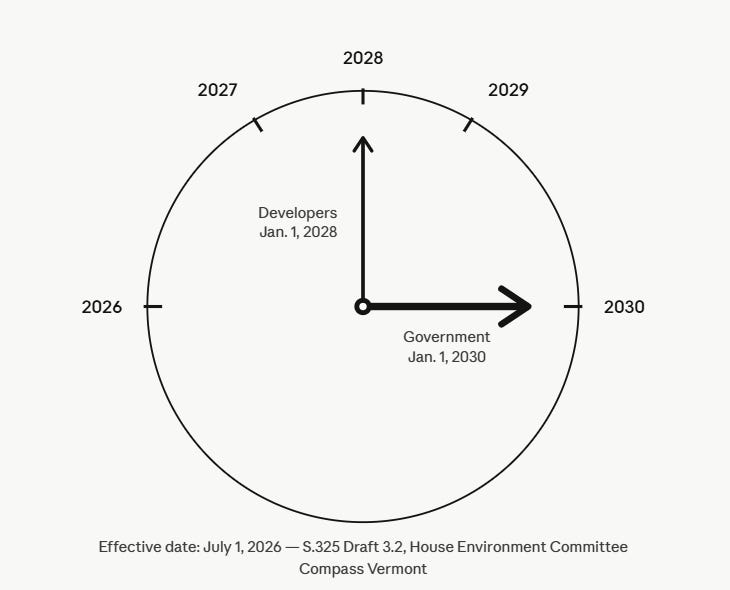
The House Environment Committee’s latest draft of S.325 is dated April 28, 2026, and remains subject to further revision. This analysis is based on Draft No. 3.2 and the Senate-passed version of S.325, both available on the Vermont Legislature’s website.
The Vermont House Environment Committee’s current draft of S.325 repeals the road rule. It repeals Tier 3. It creates an oversight committee, funds a public engagement study, and extends the regional planning process. Those are the provisions drawing attention as the bill moves through committee.
What is drawing less attention is the math embedded in the effective dates — and what that math reveals about how Vermont’s legislature calibrates timelines for itself versus the private sector it is asking to solve the state’s housing crisis.
What the Senate Passed
When the Vermont Senate passed S.325 in March, the bill took a different approach to the road rule and a different approach to housing exemptions.
On the road rule — the Act 181 provision that brought roads and driveways over a certain length under Act 250 jurisdiction — the Senate did not repeal it. The Senate delayed it. Under the Senate version, the road rule implementation date was pushed to January 1, 2030, giving Vermont roughly three and a half additional years to decide what to do with one of the most contested provisions in the 2024 land use overhaul.
On housing, the Senate version set the Act 250 interim housing exemptions — the provisions that remove the Act 250 land-use permit requirement for qualifying housing construction in designated new town centers, growth centers, neighborhood development areas, village centers, and downtown development districts — to January 1, 2030. The dates aligned, though the legal mechanics differed: the road rule was delayed before becoming operative, while the housing exemptions were a temporary window before sunsetting. That gave the private development sector roughly the same planning horizon the Senate was extending to its own policy process on the road rule.
The Senate version also included a fourth housing exemption, under subsection (dd)(4), covering up to 50 units of housing — with at least 20 percent of those units qualifying as mixed-income — in designated village centers within one quarter mile of the center boundary. That exemption was also set to January 1, 2030. The Senate version additionally extended a separate priority housing project exemption, covering projects in designated downtown development districts, neighborhood development areas, and growth centers, to January 1, 2028.
What House Draft 3.2 Would Do
House Draft 3.2, released April 28, made several significant changes to the Senate version.
On the road rule, the House went further than the Senate — it repealed the provision outright rather than delaying it. Act 181 Section 19 is simply deleted. That is the more decisive outcome.
On housing exemptions, the House moved in the opposite direction.
The 2030 deadline for interim housing exemptions — the window during which qualifying projects can rely on the Act 250 exemption in designated areas — was shortened to January 1, 2028 across every applicable provision. Under a bill that takes effect July 1, 2026, that leaves an 18-month window during which developers can rely on the exemption before its scheduled sunset.
The mixed-income housing exemption — subsection (dd)(4) of the Senate version — does not appear in House Draft 3.2 at all. The House did not shorten it. It eliminated it entirely.
The Asymmetry
The same draft that shortened the housing exemption window contains the following government process timelines:
The Land Use Review Board must contract a nongovernmental organization to develop a public engagement plan by January 15, 2027 — six and a half months after the bill takes effect. That organization will study risks to agricultural soils, forest blocks, and habitat connectors, and propose tools to protect them. A report goes to the legislature by March 15, 2027. No legislative action is required from that report.
By January 15, 2027, the LURB must also report to the legislature on whether to repeal the existing formal review and appeal process for regional plans, and what should replace it. The Senate version had simply repealed that mechanism outright. The House replaced a clean repeal with a study of whether to repeal.
Regional and municipal plans expiring in 2026 or 2027 are automatically extended to December 31, 2027. Municipalities receive that protection automatically, with no action required. Developers face the same 18-month window — but must use it to finance, design, permit, and build.
The new Joint Legislative Environmental Oversight Committee, created to supervise the LURB, Act 181 implementation, Act 250 permitting, and the Agency of Natural Resources, runs until July 1, 2029.
The Senate’s road rule delay — before the House replaced it with an outright repeal — was set to January 1, 2030, the same date the Senate gave housing developers.
The pattern is consistent: Vermont’s government processes receive timelines measured in years. The housing exemption window, under the House draft, is measured in months.
The Production Gap
Vermont is not facing a modest housing shortfall. The Agency of Commerce and Community Development, working with regional planning commissions and the Vermont Housing Finance Agency, published a housing needs assessment identifying a range of 27,867 to 41,185 additional homes needed by 2030 — with state communications using the upper figure of 41,000, or approximately 8,200 units per year. Vermont issued building permits for 2,456 homes statewide in 2023, per ACCD. The gap between what the state needs and what it is currently producing is not marginal.
Among the mechanisms aimed at accelerating housing production, the Act 250 interim housing exemptions are among the few capable of directly reducing regulatory barriers for private developers in the near term. Removing the Act 250 permit requirement in designated growth areas eliminates one documented source of cost and delay.
But the exemption tool has a practical constraint. Many multi-unit projects are unlikely to move from concept to completion within 18 months, especially when pre-development, financing, local permitting, and construction are factored in. The projects covered by these exemptions — up to 75 units in growth centers, up to 50 in village centers, with no stated unit cap for downtown development districts — are precisely the scale most affected by that constraint. National Association of Home Builders data shows buildings with 20 or more units took an average of 22.1 months for construction alone after permit authorization in 2024, with the Northeast posting the longest regional average at 23.4 months. Local permitting in Vermont can add six to twelve months on top of that, before a shovel enters the ground. Saving the Act 250 layer matters — but only if the exemption window extends long enough for the rest of the process to run its course.
Under House Draft 3.2, a developer who begins the process when the bill takes effect on July 1, 2026, has until January 1, 2028, to rely on the Act 250 exemption. That is 18 months.
The Senate’s 2030 deadline was at minimum logically consistent with the problem. It gave the private sector roughly the same planning horizon the legislature was extending to its own processes. Whether 2030 was the right number is a policy question. Whether 18 months is sufficient to meaningfully accelerate multi-unit housing production is an arithmetic one.
What the Bill Does Not Say
The draft text itself does not explain why the committee reduced the exemption window from the Senate’s 2030 to 2028, or why the mixed-income housing exemption was eliminated entirely.
The appropriation line for the public engagement contractor — one of the bill’s centerpiece process provisions — reads “$X0,000.00” in the current draft. The dollar amount is a placeholder. The Senate version, by contrast, included specific appropriations: $200,000 to the Agency of Commerce and Community Development for 802 Homes model plans, and $100,000 to the LURB for public engagement on Tier 3. The House is moving forward with an unspecified appropriation while the exemption window for housing closes.
The committee vote line at the end of the 24-page document is blank.
The bill takes effect July 1, 2026.
Compass Vermont reviewed the full text of S.325 Draft No. 3.2, dated April 28, 2026, and the Senate-passed version of S.325, both available through the Vermont Legislature’s website. Act 181, the 2024 land use law S.325 seeks to modify, passed over a gubernatorial veto. State housing production and target data from the Vermont Agency of Commerce and Community Development and the Vermont Housing Finance Agency; 2023 permit figure per ACCD at 2,456 units; a separate state housing investment report cites 2,403 for the same year. Development timeline data from the National Association of Home Builders 2024 Survey of Construction.