


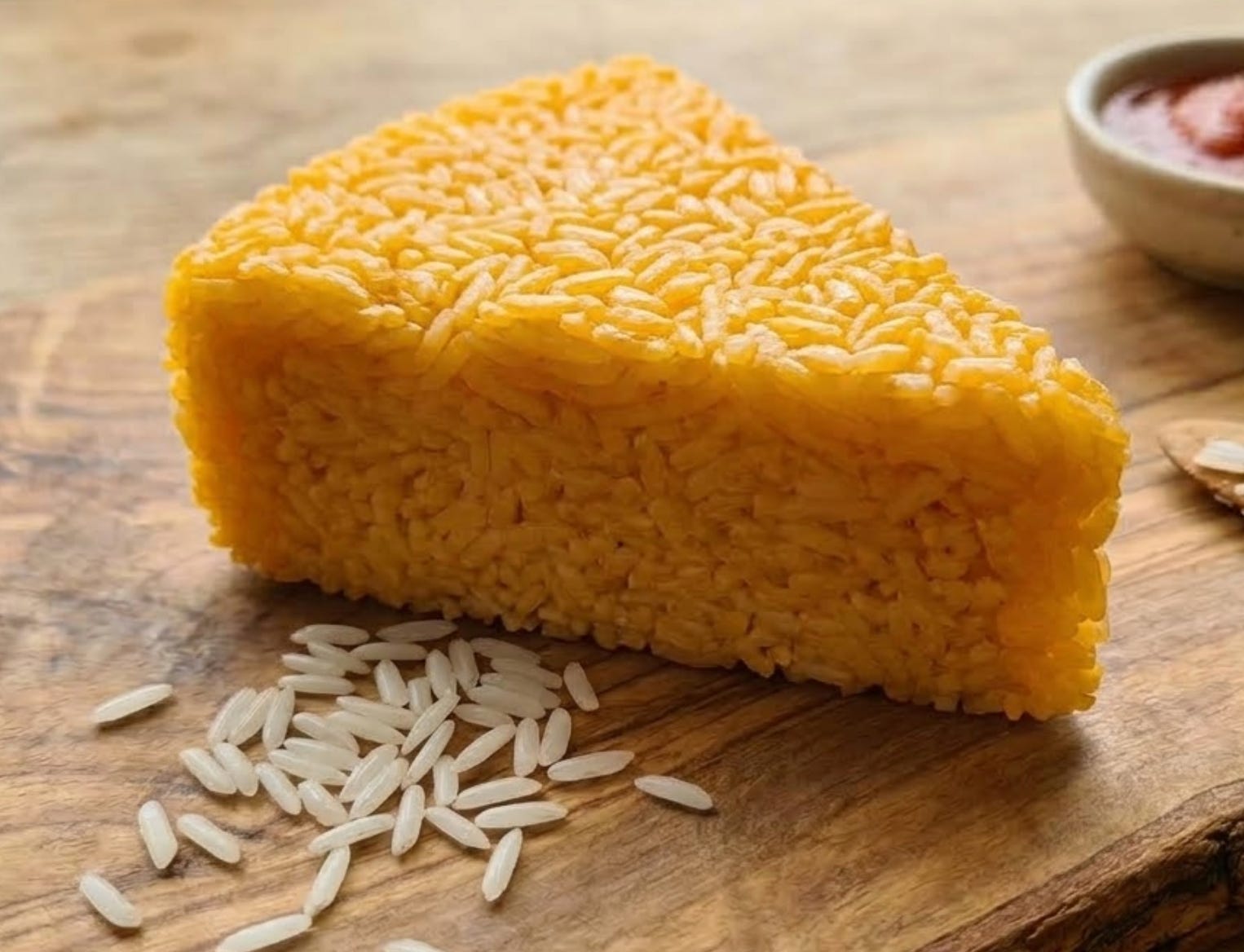
A food scientist at the University of Arkansas has figured out how to make cheese from rice — and while it won’t be displacing Cabot cheddar anytime soon, the research is further along than you might expect.
Mahfuzur Rahman, an assistant professor of food science with the Arkansas Agricultural Experiment Station, recently published a study in the journal Future Foods examining whether proteins extracted from a single rice grain could perform the functional duties of dairy in cheesemaking. The answer, at least in the lab, is yes — with some nuance.
Rice isn’t a single protein source. A grain contains three distinct protein types depending on where you look: brown rice, rice bran, and broken kernels. Rahman’s team extracted protein from each, then made three separate plant-based cheeses using a standard recipe with organic coconut oil and corn starch. Each cheese behaved differently. Bran protein produced firmer texture with better water retention. Brown rice protein scored highest on amino acid content and emulsifying stability. Broken kernel protein melted better but separated more oil. In other words, different rice proteins for different cheese applications — the same logic that gives dairy its range from mozzarella to parmesan.
One finding worth noting: the rice-based cheeses contained about 12 percent protein. Most plant-based cheeses on the market contain little to none.
The Economics
The economic framing here is as interesting as the food science. Arkansas is the nation’s leading rice producer, accounting for nearly half of U.S. rice output — a record 1.43 million acres harvested in 2024. But the proteins used in this research come from byproducts of white rice milling: bran and broken kernels, materials currently used in pet food and beer brewing, or simply discarded. The U.S. generates an estimated 14.3 million tons of rice bran and 24.8 million tons of broken kernels annually. Rahman calculates that represents a potential yield of around 3.3 million tons of protein — and right now, companies are importing rice protein to meet domestic demand rather than extracting it here.
The Caveats
The protein was extracted using hexane, an industrial chemical solvent, which creates obvious obstacles for a consumer food product. Rahman is working on an ultrasound-based extraction method that avoids chemicals entirely. The cheeses also haven’t been tested for sensory qualities, shelf stability, or consumer acceptance — steps Rahman acknowledges are the next frontier before anything moves from laboratory to grocery aisle. This is foundational research, not a product launch.
What It Means for Vermont
Vermont’s more than 100,000 dairy cows — part of an industry with a $5.4 billion annual economic impact and 2.48 billion pounds of milk produced in 2024 — can stand down for now. But the broader trend this research sits within is worth watching.
The plant-based cheese market has grown steadily, driven by vegans, people with dairy allergies, and nut and gluten sensitivities — groups for whom a hypoallergenic, rice-based option would be genuinely useful. Where Vermont’s dairy sector may feel this least, however, is in its artisan cheese culture — and that’s worth understanding.
Vermont has roughly 50 artisan and farmstead cheesemakers, a density extraordinary for a state of 650,000 people. Operations like Jasper Hill Farm in Greensboro, Shelburne Farms, Vermont Creamery, and Consider Bardwell Farm have built national reputations on the specific character of Vermont milk — its fat content, its terroir, the distinctiveness that comes from small herds on pasture. That is not a product profile a rice byproduct can replicate. The artisan segment competes on provenance, craft, and taste complexity in ways that place it largely outside the competitive pressure of commodity plant-based alternatives.
The commodity end of the dairy market is a different story. That’s where margin pressure from plant-based products — whether made from oats, nuts, soy, or eventually rice — continues to build. Vermont’s remaining commodity producers have already lived through decades of that squeeze. Rice-based cheese, if it ever reaches scale, would be one more entrant in a competitive landscape they know well.
The full study is available in Future Foods.