


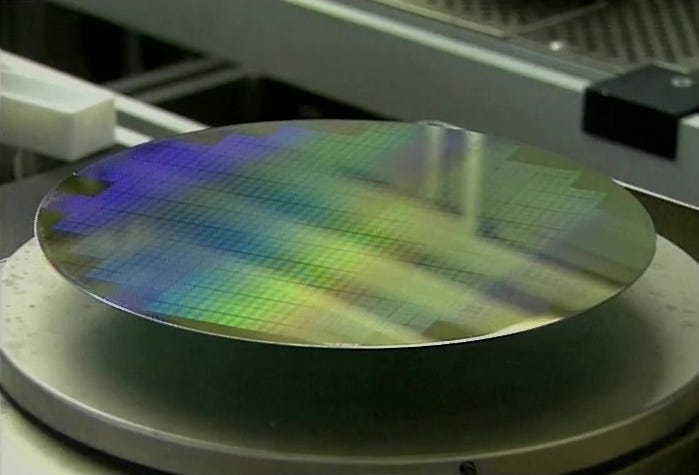
GlobalFoundries and Marvell Technology announced Thursday morning an expanded multi-year agreement that increases manufacturing capacity at GlobalFoundries’ Essex Junction plant — Vermont’s largest, for-profit. private employer — for a chip technology the artificial intelligence buildout has made suddenly scarce.
The chips are made from silicon germanium, silicon with germanium mixed in, a combination that handles extremely high-frequency signals while burning less power than ordinary silicon. That makes silicon germanium the workhorse material inside optical transceivers: the components that convert electrical signals into pulses of light, send them down a fiber, and convert them back at the other end.
Inside an AI data center, that conversion is the choke point. Thousands of processors have to talk to each other fast enough to work as one machine, and copper wire can no longer carry the volume over the distances involved without overheating. Light can. GlobalFoundries says its current silicon germanium supports 200 gigabits per lane — a lane being a single optical channel, with modern links bundling several together.
Robb Johnson, Marvell’s vice president of foundry technology, said connectivity is becoming increasingly critical as data center architecture reorganizes around AI, and that the company is investing aggressively to lead the shift toward higher-bandwidth optical designs. Shankaran Janardhanan, who runs GlobalFoundries’ photonics and radio-frequency business, framed the agreement as confirmation that silicon germanium sits at the center of high-speed optical networking for AI infrastructure. Neither company put a dollar figure, a production volume or a completion date on the expansion.
A month of agreements, one of them Vermont’s
Thursday’s announcement is GlobalFoundries’ third in nine days.
On Sept. 8, the company finalized a $375 million research award with the U.S. Department of Commerce for quantum work. On Sept. 9, it and Monolithic Power Systems announced a long-term manufacturing agreement putting new power-chip production at the company’s 300-millimeter fab in Singapore, with volume production starting in early 2027. Then Marvell, in Essex Junction.
That sequence is the thing to notice. GlobalFoundries runs plants on three continents and routes new business among them. The work announced this month could have gone to New York or to Singapore. The Singapore agreement did. This one came to Vermont.
Why this lands in Vermont
The Essex Junction plant, which GlobalFoundries calls its Burlington facility — a name inherited from IBM, which built the site in the late 1950s and ran it until the 2015 sale — is the largest private employer in the state.
How large is harder to pin down. Published accounts differ, and no current figure has been released:
About 2,300 employees at the campus, in 2019 reporting by Seven Days
Around 2,000 workers, in 2024 reporting by WCAX citing the Greater Burlington Industrial Corporation
An estimated 1,800, in Seven Days reporting on the federal CHIPS award
GlobalFoundries does not break out site-level headcount in its financial reports.
The plant’s weight in the state economy is easier to see. Frank Cioffi of the Greater Burlington Industrial Corporation told WCAX in 2024 that GlobalFoundries accounts for around 40% of Vermont’s exports and draws workers from 10 of the state’s 14 counties. The campus consumes more electricity than the entire city of Burlington, enough that the company won state approval in 2022 to form its own utility and buy power wholesale.
Vermont taxpayers have money in the building. The 2024 CHIPS package directed $125 million in federal funding to modernize the Essex Junction fab, with $4.5 million in state money on top — just under $130 million combined. The bulk of GlobalFoundries’ $1.5 billion federal award went to Malta, New York.
The federal money and the customer
GlobalFoundries is a foundry — it manufactures chips that other companies design — and a foundry’s health is measured in how much of its plant is running and who has committed to buy the output. Marvell has been buying from Essex Junction for years: a wafer supply agreement between the two companies took effect in 2019, and GlobalFoundries describes the relationship as running more than a decade. Thursday’s announcement enlarges it.
The added capacity will go toward three product categories: pluggable optical transceivers, near-packaged optics and co-packaged optics. The last two are the industry’s answer to the same bottleneck — instead of running signals across a circuit board to a separate optical module, the light-conversion hardware gets moved right up against the processor, or into the same package with it.
Those categories are why Thursday’s announcement connects to something Vermont already had a stake in.
On July 29, GlobalFoundries signed a letter of intent with the U.S. Department of Commerce — a signed statement of what both sides expect to do, short of a binding contract — for a $300 million CHIPS research award covering optical materials, wafer technologies and advanced packaging. The company said the work would run through its facilities in Malta, New York and Burlington, Vermont, and would target near-packaged optics and co-packaged optics — the same two categories in the Marvell agreement, at the same plant. GlobalFoundries makes the link itself in the new release, saying it combines silicon germanium, silicon photonics and advanced packaging for exactly those architectures.
Marvell was one of the companies that publicly backed the July announcement, alongside AMD, Broadcom, Cisco, Corning, Lumentum, Meta, Microsoft, NVIDIA and Qualcomm. Seven weeks later it signed a capacity expansion at one of the two named sites.
That photonics award is still a letter of intent and has not been finalized, unlike the quantum award that closed on Sept. 8. And under a separate agreement tied to it, the Department of Commerce took equity amounting to roughly one percent of GlobalFoundries. The federal government is now a small shareholder in the company that owns Vermont’s largest private plant.
Who runs the machines
A chip fab runs on technicians, not engineers. Someone has to load and unload the machines, run the preventive maintenance, catch a tool drifting out of spec at two in the morning, and move wafers between process steps. Those are the jobs the plant has the most of, they run on 12-hour shifts around the clock, and the entry-level versions ask for a high school diploma and the ability to stand for a shift.
The state has put money into the on-ramp. GlobalFoundries and Vermont State University jointly run a paid technician apprenticeship — the first of its kind in the U.S. semiconductor industry — that hires high school graduates, pays a full-time salary from day one, and covers coursework toward an associate degree. The federal Employment and Training Administration put $850,000 behind expanding it. Separately, the UVM-led V-GaN Tech Hub, a consortium of UVM, GlobalFoundries and the state, received $23.7 million with a target of training more than 500 new semiconductor workers over five years.
Openings are posted at gf.com/careers and on Vermont JobLink, the state Department of Labor’s job board. They’re worth a look.
Whether Thursday’s agreement adds to that list is the part nobody has answered. Expanding capacity at a chip plant can mean installing new tools, which takes crews and operators, or it can mean giving one customer more of a cleanroom already built and already running. Compass ran into the same question last November on the gallium nitride licensing arrangement at this plant, where the “thousands of jobs” figure turned out to describe a projected regional supply chain rather than hiring inside Fab 9.
What to watch
GlobalFoundries reports third-quarter results this fall, and agreements of this size tend to surface there — capital spending, utilization rates, or the business-highlights section where the company has disclosed similar deals before. Any Vermont construction work would need local permits, which are public. The job board is the other place it would show, and that one anybody can check.