


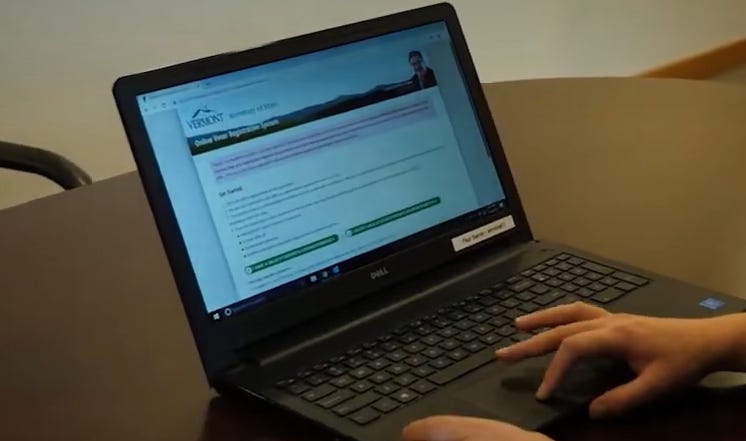
Vermont took fewer than 900 people off its voter checklist on Aug. 24, all of them registered by mistake through the Department of Motor Vehicles. Gov. Phil Scott, Secretary of State Sarah Copeland Hanzas and DMV Commissioner Andrew Collier announced the removals at a press conference the following morning, a week before the state pulls the mailing list for November’s ballots.
That is the number that will travel. The larger one came out later, when a reporter asked how many records had been sent to the Secretary of State’s office in error overall — not how many were removed, but how many were wrong.
Copeland Hanzas put the answer at roughly 20,000.
She gave it as an estimate, not a count — in the range of tens of thousands, she said, around 20,000 people over the years covered by the audit who had told the DMV not to register them and were sent over anyway. The state has not published an exact figure, and nobody at the press conference offered one.
Want to know where you stand? Look it up yourself.
Go to vote.vermont.gov/public/dashboard. You’ll need your name, your date of birth, and either your driver’s license number or the last four digits of your Social Security number.
If your name is there, you’re registered and a ballot is coming in November. If it isn’t and you want it to be, you can register on the same site in a few minutes. Either way, do it before Sept. 1 — that’s when the state pulls the list of who gets a ballot in the mail.
How 20,000 Became 900
The audit did not find 900 mistakes. It found something closer to 20,000 records where a person checked “no” at the DMV and was transmitted to the voter rolls regardless. The 900 is what survived a filter.
The audit took the full set of “no” records and set aside anyone who showed some other sign of wanting to be registered:
A visit to a town or city clerk’s office, before or after the DMV transaction
Contact with a voter registration drive
An earlier “yes” on a prior DMV transaction
What remained — under 900 people — had checked “no,” had never voted, and had never touched the election system any other way. Those are the records the state deleted.
That filter resolves every ambiguous case in favor of staying registered, and there is a sound reason for it. Vermont’s system registers you unless you opt out, so a “no” at the counter often means “no, I’m already on the list.” Copeland Hanzas offered herself as the example: she hasn’t moved in 20 years, so she checks “no” at every license renewal. The same 20,000 could include people who avoid registering because they don’t want to be called for jury duty, and people who simply aren’t interested in voting.
The trade-off is that roughly 19,000 records where a stated “no” was overridden were left in place — not because anyone confirmed those Vermonters wanted to be registered, but because they had touched the system somewhere else. About one in 22 of the flagged records ended in a removal.
You Won’t Be Told Either Way
If you were one of the 900, no letter is coming. Copeland Hanzas said the reasoning is that these people never asked to be registered, so taking them off restores the choice they already made.
If you were one of the roughly 19,000 whose “no” was overridden but who stayed on the list, no letter is coming either.
The fix is silent in both directions. A Vermonter who opted out at the DMV in 2017 has no way of knowing, from anything the state will send them, whether they spent the last decade on the voter checklist, whether they were taken off this week, or whether they’re still on it today.
Here is what that means depending on which group you’re in:
You told the DMV not to register you, and you’re still on the list. You are a registered voter, and a ballot is coming in November whether you wanted one or not. Getting off the checklist takes a call to your town or city clerk.
You told the DMV not to register you and were removed this week. Your name is gone from the checklist. If you’ve changed your mind since, registering again takes a few minutes and a photo of your driver’s license.
You never opted out and assume you’re fine. You probably are. But an out-of-date mailing address means your ballot goes to the wrong house, and that’s fixed in the same place.
The deadline underneath all of it is Sept. 1. Vermont mails a ballot to every active registered voter for a general election, and the list of who gets one is pulled at the beginning of September. That is the practical reason the state moved this week instead of after the election.
Where the Error Came From
The audit started small. A single Vermonter contacted the Secretary of State’s office over the winter to say they had been registered against their wishes, and the review widened after New Jersey disclosed in July that a software error at its Motor Vehicle Commission had registered roughly 6,600 people who had identified themselves as noncitizens during license transactions between June 2023 and June 2024. New Jersey has since removed about 5,100 of those registrations, blocked another 1,450 pending county review, and found that 340 of the affected people had already cast a ballot.
Copeland Hanzas was direct that Vermont is not looking at the same case, and the comparison bears her out in an uncomfortable way. Vermont’s number is the bigger one. Vermont’s problem is the smaller one. The records here belong to people who declined to register, not to people who had disclosed they were not citizens, and none of them voted.
Collier traced most of it to two events.
The first was the law itself. Vermont passed automatic voter registration in 2015, effective in 2016. Before that, registering at the DMV was something you opted into; after, it became something you opt out of. The data field carrying that answer appears to have failed around the transition. The bulk of the affected records date to 2016, 2017 and 2019, meaning many of these registrations sat on the checklist for roughly a decade.
The second was a migration. When the DMV moved off its legacy system onto VT TRIPS, its current records platform, staff cleaned up and transferred data by hand, and some of those entries were entered wrong.
The announced fixes are new training materials and a video for frontline DMV staff, added quality checks, and clearer communication between the DMV and the Secretary of State’s office.
The Eligibility Question
Reporters pressed repeatedly on whether any of the 900 were not citizens. The answer was that the state does not know and its audit could not find out.
The DMV verifies citizenship only for enhanced licenses and Real IDs, where an applicant’s documents get checked against federal databases. Standard licenses carry no citizenship check, and neither do driver privilege cards — the credential Vermont issues to people who can’t document legal presence in the country. That is by design: the DMV’s job is deciding who can operate a vehicle, not who can vote. Copeland Hanzas said it is reasonable to expect a small number of people on the removal list were not eligible, and that all of them are now off the rolls.
What the state can say is narrower and firmer: none of the 900 ever cast a ballot in a Vermont election. The removal heads off a future ballot, not a past vote.
What Isn’t Changing
Both the Governor and the Secretary of State said automatic registration at the DMV stays, and Copeland Hanzas made an argument for it that cuts against the intuition of the story: the DMV link is what keeps the rolls clean. When someone moves from Morrisville to Stowe and renews a license, the Morrisville clerk gets a notice. Cut that connection and the rolls get less accurate as people move, not more.
The rest of the maintenance is done by hand — Vermont’s 247 town and city clerks, working with local boards of civil authority, the town-level panels that review the checklist and can challenge a voter who has died or moved away. Statute requires them to take that up in every odd-numbered year.
The number to hold onto is the one that took a follow-up question to surface. Something like 20,000 times, a Vermonter told the DMV not to register them to vote and the state did it anyway. Fewer than 900 of those were undone this week. The rest are still on the list, and the only person who can check is you.
Please tell us WHO conducted the audit and WHY. What access where they provided to conduct this audit?
Register at birth.