


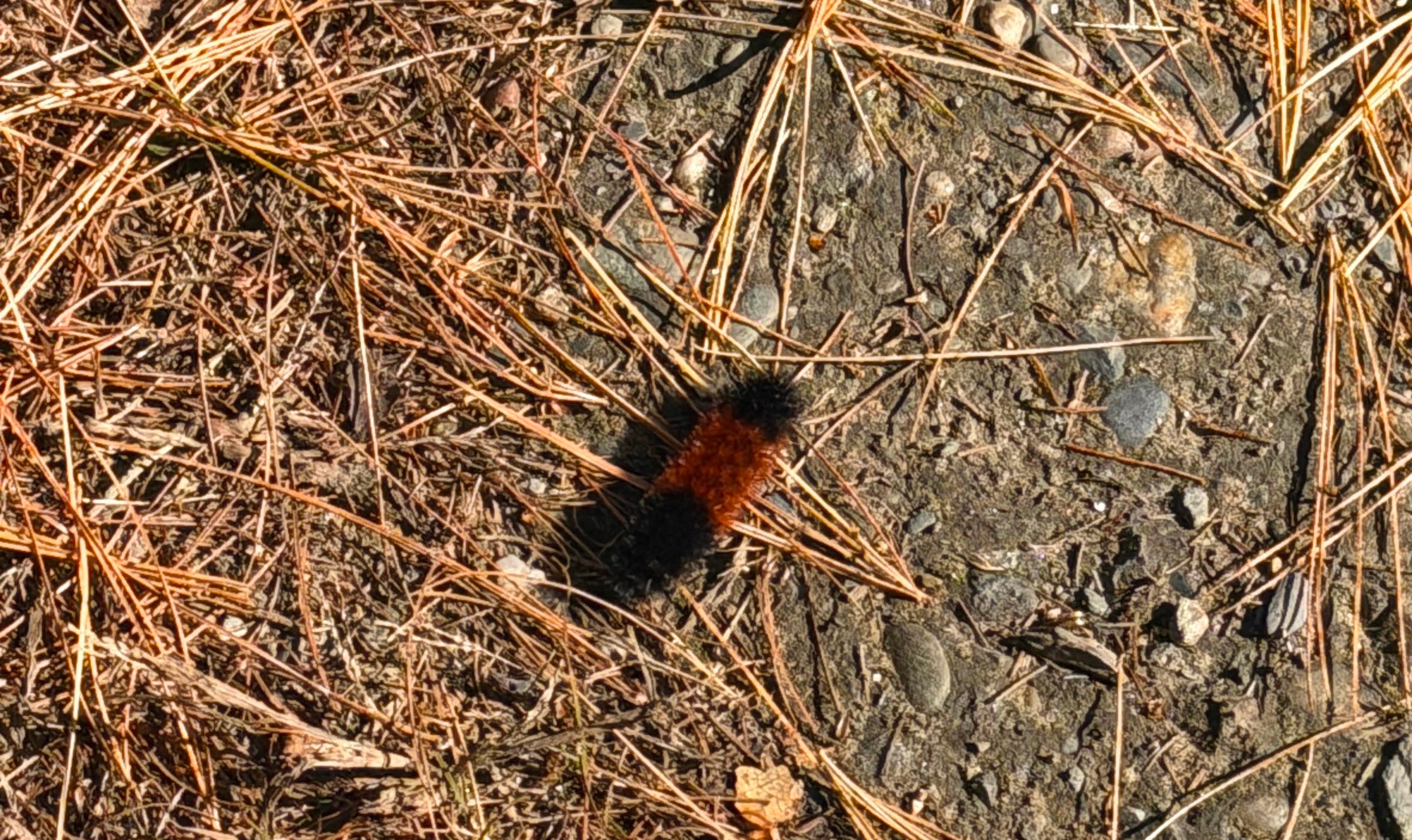
The federal government released its official winter forecast on Thursday. Compass Vermont got a second opinion from a caterpillar.
We found him crossing a patch of pine needles on a Vermont access road this week. He’s a woolly bear, black at both ends with a wide rust-colored band in the middle. If you grew up in Vermont, you may well know what that means.
What the woolly bear says
The folklore goes like this: the wider the brown band, the milder the winter, and black on the ends means cold weather at the start and end of the season. The Old Farmer’s Almanac has kept the legend going for generations. Some readers even count the caterpillar’s 13 segments as the 13 weeks of winter.
Here’s our woolly bear’s forecast:
Wide brown middle: a mild heart of winter.
Black at both ends: cold at the start, cold at the finish.
Which end is worse: We can’t say. We didn’t get a good look at which end was his head, and he wasn’t taking questions. Either December or March gets the rough edge. Your guess is as good as ours.
What the federal government says
NOAA’s winter outlook, released Oct. 15, favors warmer-than-average temperatures across much of the East from December through February. It also expects wetter-than-average conditions along the East Coast.
The reason is El Niño, a warming of the Pacific Ocean near the equator that shifts where storms travel. Forecasters expect this year’s El Niño to be a strong one.
NOAA doesn’t predict how much snow you’ll get, because its forecasters say snowfall can’t be predicted more than about a week ahead. The woolly bear doesn’t let that stop him.
What the almanacs say
There are two almanacs, and they are not the same publication.
The Old Farmer’s Almanac, published since 1792, calls for a mostly mild winter nationally, but colder and snowier than normal in central New England. Check its regional map to see where your town lands.
The Farmers’ Almanac, published since 1818, promises the Northeast “snow, sleet, and surprises,” with rounds of heavy, wet snow inland in January and February. It says its regional forecasts are right 80 to 85 percent of the time.
Both almanacs use secret formulas they don’t share. So does the woolly bear.
What the scientists say about the woolly bear
The scientists have bad news for the caterpillar’s forecasting career. They say the brown band tells you about his past, not the coming winter. A woolly bear turns less black and more orange each time it molts, or sheds its skin. A wide brown band mostly means an older caterpillar.
What he was actually doing on that trail was looking for a place to spend the winter, such as under leaves, a log or a rock. Woolly bears freeze solid over the winter and thaw out in spring. Then they spin a cocoon and come out as Isabella tiger moths, which are orange-tan with small black dots.
The scorecard
Woolly bear: Mild, with cold at both ends. Method: fuzz. Salary: none.
NOAA: Warmer and wetter than average. Method: ocean temperatures and computer models.
Old Farmer’s Almanac: Mostly mild, but cold and snowy in central New England. Method: secret.
Farmers’ Almanac: A messy mix of snow, sleet and rain. Method: also secret.
The caterpillar and the federal government agree on mild, and the almanacs aren’t so sure. After last winter, the Northeast’s coldest since 2014-15 according to NOAA, nobody will complain if the woolly bear turns out to be right.
Keep the shovel by the door anyway. We’ll check his work in March, though by then he’ll have moved on to a career as a moth.