


A national health story lands differently when the contaminated water is the water your town drinks. Our researchers are pulling microplastics from the lake, the sand and the fish — and, unlike the rest of the country, we have some idea what to do about it.
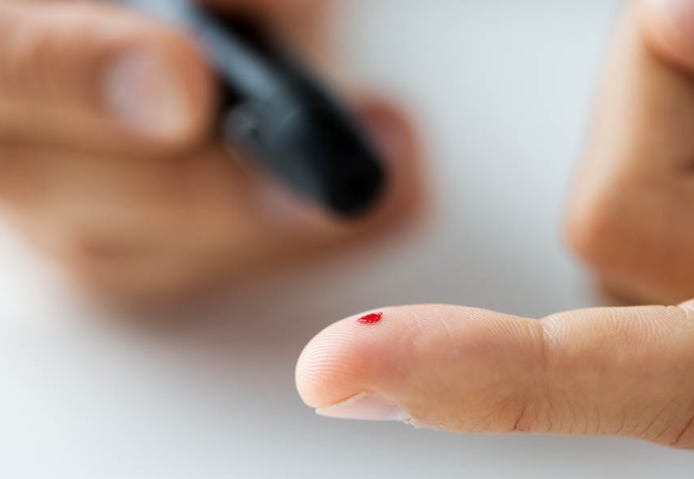
A story made the rounds this week that’s easy to file under someone-else’s-problem: a Wall Street Journal health reporter, Sumathi Reddy, pricked her finger at her kitchen table, mailed the blood off to a lab, and a month later learned she had 13 tiny particles of plastic circulating in her body.
She’d bought an at-home microplastics test — one of a new crop of them, priced around $135 — mostly out of curiosity. The number that came back put her right about average. Then came the twist that makes the piece worth reading: average of what, exactly, nobody could tell her. Not where the plastic came from, not where it had settled, not whether it was doing her any harm.
It’s a tidy little parable about the limits of measuring something we don’t yet understand. But for anyone who lives on this side of Lake Champlain, it isn’t really a story about one reporter’s fingertip. It’s about the lake outside the window — because the plastic she paid a lab to count in her blood is the same plastic our own scientists have been pulling out of the water, the beaches and the fish for years now.
What the lake already knows
You don’t need a $135 kit to find microplastics in Vermont. You need a net and a boat.
In the summer of 2024, a coalition of Vermont and New York researchers — the Lake Champlain Basin Marine Debris Coalition, led by the University of Vermont and SUNY Plattsburgh — ran the first comprehensive microplastics survey of the basin, sampling more than a dozen rivers and beaches on both shores. The headline finding is the kind that stays with you: they found microplastics in every single waterway they tested flowing into the lake. Not most. Every one.
“They found microplastics in every single waterway they tested flowing into the lake. Not most. Every one.”
Anne Jefferson, who directs Lake Champlain Sea Grant and leads much of this work out of UVM’s Rubenstein School, has been documenting the particles all along our shoreline — foam sloughing off aging dock flotation, raw manufacturing pellets, and the crumbled confetti of larger plastic litter. And she draws the line the WSJ story only gestures at: we eat the fish that carry these particles, and the towns that draw their drinking water from the lake are pulling from the same source. Plastic fibers have already turned up in Champlain’s fish, its sand, and its tap water.
The sobering part is what comes next. “There is no technology that can remove microplastics at scale from the environment,” Jefferson has said. Once it’s in the lake — and in the fish, and in us — it stays. Reddy’s test measured a number she could theoretically watch go up or down. The lake offers no such reset button.
What scientists are, and aren’t, sure of
It’s worth being honest about the science, because the hype tends to outrun it. Microplastics are any plastic fragment smaller than about five millimeters — roughly a sesame seed — and researchers have now found them in essentially every human organ they’ve examined, from lungs and liver to the brain. That much is settled. What isn’t settled is the part everyone actually wants to know: how much of this is harming us, and how badly.
The clearest signal so far points at the heart, where both human and animal studies have linked higher microplastic levels to more cardiovascular disease. Beyond that, most of the evidence for cancer, inflammation and other harms still lives in cell cultures and lab mice — suggestive, not conclusive. One rule of thumb does seem to hold: the smaller the particle, the deeper it travels into the body and the more toxic it appears to be. Which is exactly why the at-home tests, for all their novelty, leave their customers where they left Reddy — holding a number, short on answers.
The part Vermont gets right
Here’s where the local story turns, and where it parts ways with the national one. The WSJ piece ends on a shrug: control what you can, plug the air purifier back in. Fair enough for an individual. But Vermont has spent years demonstrating something more useful — that the collective lever actually works.
When the state banned single-use plastic bags in 2020, it wasn’t just a feel-good gesture. Researchers working the lake say they can see the difference in their samples; the coalition has pointed to bag litter as a case where, in their words, legislative action produced “real, quantifiable change.” The stubborn problem now is foamed plastic — the polystyrene that shreds off docks and takeout containers and never fully goes away — which is precisely the kind of target the next round of policy can aim at.
And Vermont has kept aiming. The state’s single-use products law and its expanding restrictions on PFAS “forever chemicals” in food packaging put it near the front of the national pack, and the Department of Environmental Conservation has commissioned its own studies on PFAS and microplastics in the state’s food-packaging and composting streams. None of this scrubs the lake clean. But it means the question hanging over the microplastics conversation everywhere else — what can one person possibly do? — has a partial answer here that most places don’t have: pass the ban, and the water notices.
So what do you actually do?
By all means, take one of the tests if you’re curious — just treat the result as a baseline to watch, not a diagnosis. The more productive moves are the ordinary ones, and they happen to line up with how a lot of Vermonters already live: eat less processed and packaged food, and lean on the farmers’ market while it’s in season. Store food in glass, steel or foil rather than plastic, and never heat anything in it. Carry a steel water bottle. Choose natural fibers where you can — synthetic clothing sheds plastic fibers straight into the wash water and, eventually, the watershed. Run an air purifier in the bedroom, since we breathe these particles as much as we swallow them.
Notice that nearly every one of those habits is also good for the lake. That’s not a coincidence; it’s the whole point. We all carry microplastics now — 13 particles or 30, above average or below. Knowing your own number changes almost nothing. What changes something is the habitat we protect, the packaging we ban, and the bag we wave off at the register. Staying good at that is a very Vermont thing to do — and Lake Champlain is worth staying good at it for.
Reporting on Lake Champlain draws on the work of the University of Vermont’s Gund Institute, Lake Champlain Sea Grant, the Lake Champlain Basin Marine Debris Coalition, and the Vermont Department of Environmental Conservation. The at-home blood test described at the top was chronicled by Sumathi Reddy in The Wall Street Journal (”I Tested My Blood for Microplastics. I Got a Number, but Few Answers,” July 16, 2026).