


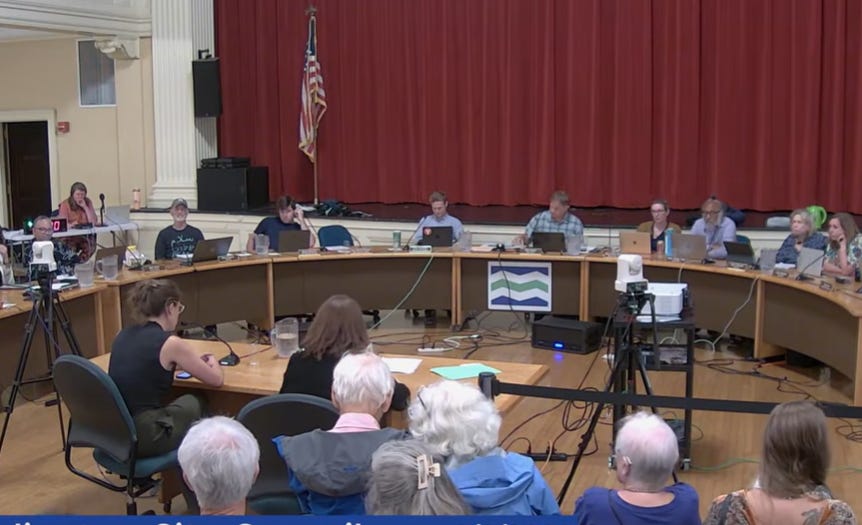
They came because of a new plan called Burlington Forward.
On July 24, the Democratic caucus of the Burlington City Council held a press conference to introduce it — twenty-one pages proposing a harder line on public drug use, encampments, and what the document calls unpermitted social services in city parks. On July 30, Compass Vermont published an overview of an Atlantic cover story on harm reduction that used Burlington as its cautionary example, a city that had said yes to drugs and gotten the predictable bill. In between, the mayor sent a series of citywide emails opposing the resolution and asked the council to table it. The council president declined.
By the time the gavel came down on August 3, the meeting had become the place where all of it would land at once.
It landed for six hours. More than a hundred people signed up to speak. Public forum ran past three hours against a rule that allots ninety minutes. The council suspended its own rules twice to get through the rest of its business and adjourned at 12:08 a.m.
Compass pulled the full transcript and counted it.
One word stuck out, and it was said seventy-one times — roughly once every five minutes, for six straight hours. The word was compassion.
It is not the word that was spoken most. It is the word that meant the most different things.
What beat it
Plenty of words beat it. People was said 403 times. Council, 306. City, 300. The words for housing and homelessness together, 220. Safe, safety and unsafe, 166. The vocabulary of drugs and addiction, 161. Community, 160. Police and cops, 143.
Those are the furniture of the meeting. They are what the meeting was about. Nobody walked to the microphone to contest what city means.
The comparison that matters is narrower. Set compassion beside the other words people use when they are making a claim about what is right, and it is not merely first. It is most of the field.
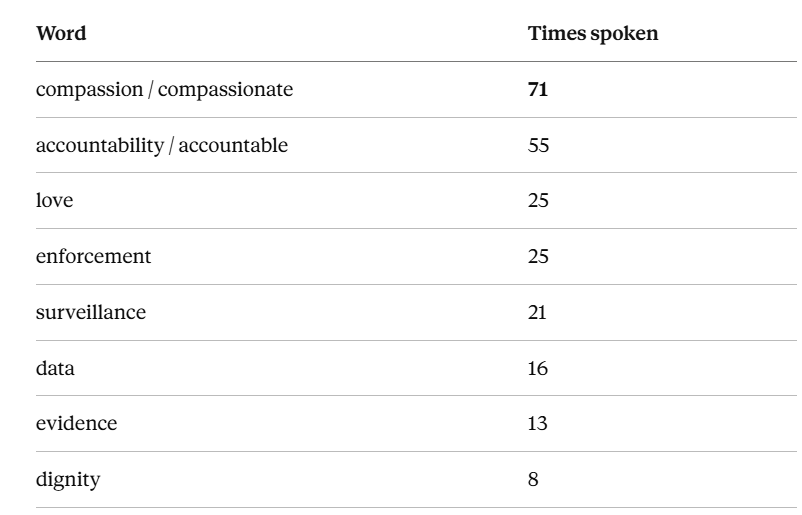
Compassion was spoken more often than evidence and data put together. Over six hours, the room reached for virtue more than twice as often as it reached for proof.
One speaker named that while it was happening. Selena Colburn, a former city councilor and state representative, told the council she had changed her remarks and decided to talk about what she found in shortest supply in the resolution itself — evidence and science.
Half the uses were an argument over who gets to claim it
Compass read all seventy-one uses in context. Roughly half of them are not a person claiming compassion. They are a person denying that someone else’s version qualifies.
The denials came from every direction:
From a resolution supporter, on open drug use: it is not compassionate to leave people suffering from addiction on our sidewalks.
From an opponent, on the city’s record: compassion hasn’t even gotten started here.
From a supporter who read the city’s economic data aloud: anyone who looks out that window and sees success, compassion, or any sort of accountability is lying to themselves.
From an economist and doctoral candidate opposing the resolution: the same old ideas had surfaced cloaked in a veneer of compassion and accountability.
From a downtown property owner, turning it back on the administration: the mayor speaks of compassion, but she has compassion for everyone except the law-abiding residents and businesses of Burlington.
From a volunteer inviting councilors to a downtown cleanup crew: maybe that’s too compassionate for some of you.
And one speaker refused the word altogether, telling the council she did not want compassion from the people at the table. She wanted liberation.
Two councilors, from opposite caucuses, went further than contesting a definition. Each accused the other side’s compassion of being cover.
Gene Bergman, opposing the resolution, said the framework is heavy on enforcement, couched in the technocratic word accountability, and covered in the calming word compassion — an iron fist in a velvet glove.
Buddy Singh, supporting it, described people left in the park to be preyed upon by dealers and taken advantage of, and said it was all happening in the name of compassion.
More than half the times the word compassion was spoken on Monday night, someone was wrestling it out of someone else’s hands.
That is not a shared value. It is contested ground that everyone had agreed to fight on.
Five definitions, one word
Sorted by what the speaker actually meant, the seventy-one uses of compassion fall into about five camps. Nineteen sit within a few words of safety. Nineteen sit within a few words of accountability or enforcement. Eleven attach to something material — food, syringes, naloxone, a bed. Eight extend the word outward, past the people usually meant by it.
Compassion as the thing you hand someone. The harm reduction and mutual aid position, and the most concrete: compassion is a meal in City Hall Park, a clean syringe, a dose of naloxone, a place indoors when it is cold. A nurse practitioner told the council that Burlington already has organizations showing what compassion and safety look like together, and named the daily free lunch that has run for six years on no city budget. Here, the act is the compassion. There is no further test.
Compassion as the thing you refuse to allow. The mirror image, argued just as earnestly. A speaker who has lived across from City Hall Park since 1998 said compassion cannot mean looking away. Another said boundaries are what make compassion last, and that the city had come to treat boundaries as though they were the opposite of care. Councilor Buddy Singh built his floor remarks around intervening with someone he loved, and the therapist’s line about putting on your own oxygen mask first. In this definition, letting a person remain untreated in public is the cruelty, and the intervention is the kindness.
Compassion as structural repair. A third group rejected the premise that any of this is about individual conduct. Housing, health care, and a tax on wealth are the compassionate policies; anything else manages symptoms. One speaker walked the council through a proposed transfer tax on million-dollar home sales and asked why the council could summon concern for the financial circumstances of twenty sellers a year and not for people sleeping outside.
Compassion widened. The least-noticed definition, and it did real work in that room. A downtown developer said compassion for neighbors in need matters deeply — and so does compassion for families who no longer feel safe, for employees, for businesses hanging on. The board chair of a local nonprofit asked the council to make children the north star. This is not a rejection of the word. It is an argument about the size of the circle it covers.
Compassion refused. And then the speakers who declined the frame entirely. Not only the speaker who wanted liberation, but the several who separated safety from comfort and told the council it was conflating them — that watching a person suffer is uncomfortable and should be, and that discomfort is not danger. If the word has been captured, this position holds, then arguing about it is a trap.
Both documents claim it
The clearest sign the word had stopped doing any sorting work is that both sides of the table used it to describe their own paper.
Burlington Forward is built on the pairing. Its supporters returned to it all night: the city does not have to choose between compassion and enforcement, it needs both; compassion and accountability are not opposing values; the resolution rejects a false choice.
And the mayor, opposing that resolution, said this: This has never been a choice between safety and compassion. We need both. She described her own administration’s framework as grounded in both compassion and accountability.
Two documents, opposite conclusions, identical claim. Every person in that chamber could have signed the sentence Burlington should be compassionate, and it would have settled nothing about zoning for an overdose prevention center, about license plate readers, about permits for serving lunch in a public park, or about what happens to a person who does not show up to a restorative justice appointment.
Why this matters going forward
The resolution passed, 7–5.
What passed, though, was not the twenty-one pages. It was a motion to send them to four council committees — Public Safety, Racial Equity Inclusion and Belonging, Community Development and Neighborhood Revitalization, and Parks Arts and Culture — with recommended amendments due back to the full council by September 14. The mayor’s office was asked to work with council leadership on the sections dealing with the state.
So the vote settled where the argument goes, not how it ends. Nothing in the resolution takes effect. Nobody is bound by it. It is not over. It moved.
That leaves roughly six weeks of drafting, in public, by people who spent Monday night demonstrating at length that they do not share a definition of the document’s central term.
Amendments are written in words. If compassion survives into the amended text doing the same work it did on Monday — signaling agreement while concealing its absence — then September’s version will read as warmly as this one and settle as little.
The useful questions in committee are the ones the word lets people skip. Not whether Burlington is compassionate. Whether a syringe services program may operate downtown. Whether a group may serve food in a public park without a permit. What happens when someone referred to City Circle does not appear.
Those have answers. Compassion does not, or rather it has seventy-one of them.
Compass Vermont is an independent Vermont news outlet. This piece is labeled ANALYSIS: it draws conclusions from primary source material rather than reporting news alone.
“Fat Thumbs” and during Miss Doubtfire’s tenure. Not once did I forget what generation of raising families from within ours , to the greatest of neighborhoods parents lessons, To “spare the rod is to spoil the child”. OH! But that didn’t necessarily mean what some folks might jump to in conclusion. What it does mean is if you let bad behavior’s slide you get what you dismissed tenfold. It seems everyone wants compassion to be seen as compassionate. Deliberate action in “Compassion “ also seems to want the outcome to be exactly what they get. What you might say? We parents are compassionate, but we’re not trying to make a job out of warring our compassion on our sleeves for a lively hood. There might be , in lies a problem. I can’t recall when ignoring a problem, persistent or not was ever a solution. But I was looking to exasperate the problem. Nor were my old country neighborhoods parents, who never failed in sparring the rod for comparison sake.
Raised a family on compassionate principles. Coached several grade school sports teams and played mister mom before Miss Doubtfire