


ANALYSIS
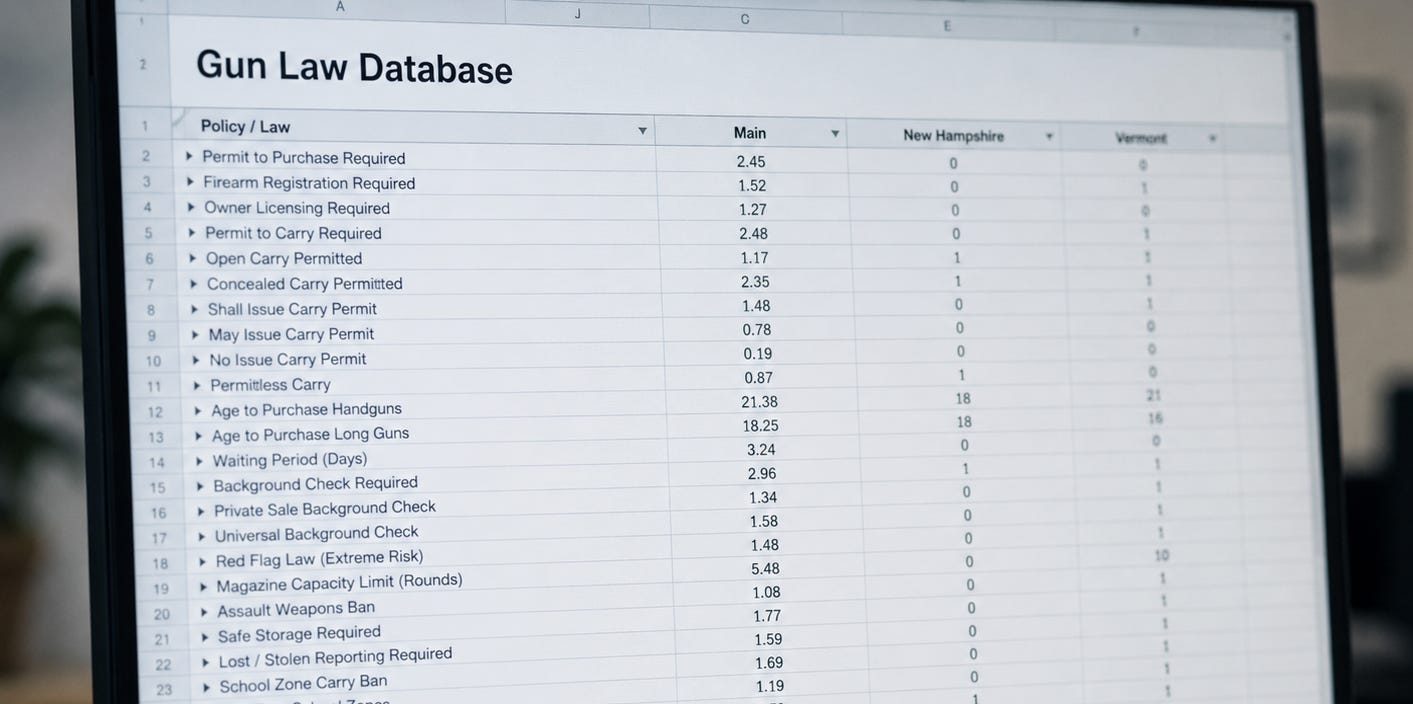
A team of legal scholars and policy researchers has just published something Vermont does not have and could use: a single searchable record of what all fifty states did about firearms over a quarter century, built so that any two states can be laid side by side.
The database covers 146 separate firearm laws in every state from 1999 through 2023. Each law gets a simple yes-or-no mark for each state in each year — did this state have this law, that year, or not. That produces 1,250 state-years of information and, more useful for a reader, the ability to ask a question Vermonters ask all the time and rarely get answered: what did we do, what did our neighbors do, and how did those choices diverge?
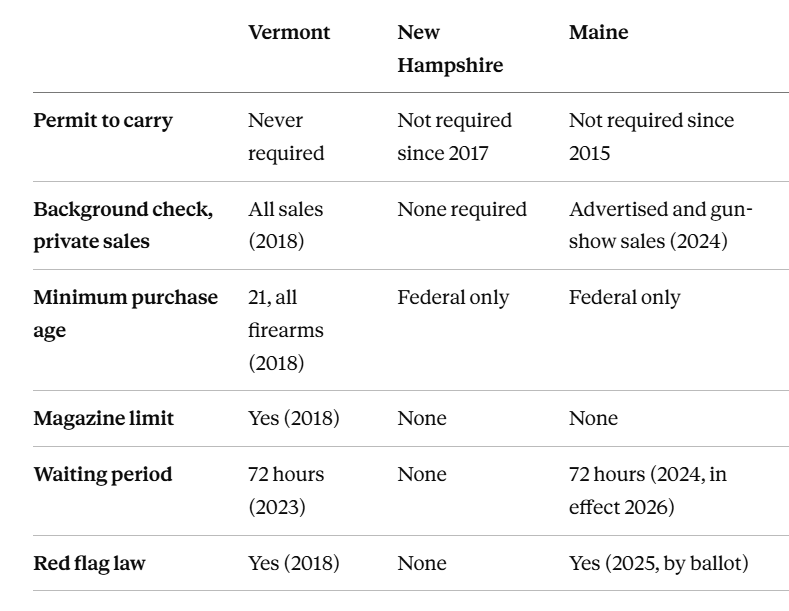
The answer for northern New England is genuinely surprising. Three states that look alike on paper — rural, heavily armed, low homicide rates, all three allowing people to carry a concealed handgun without any permit — took three completely different routes.
The database was built by Everytown for Gun Safety Support Fund, which advocates for stricter gun laws, and published in the peer-reviewed American Journal of Preventive Medicine. That combination is worth stating plainly up front. The funding and authorship are disclosed by the authors themselves, the paper is open-access, and the data is free to download.
It is also true that the framing is not neutral: the authors sort laws into “firearm-safety” and “firearm-permissive” categories, and score the permissive ones in reverse, so that not having one counts in a state’s favor. Under that scheme, Vermont’s tradition of permitless carry counts against Vermont. Readers should know whose scoreboard they are reading.
Three States, Three Routes
New Hampshire took the simplest route: it did essentially nothing. New Hampshire has no extreme risk protection order law — the court order, often called a red flag law, that temporarily bars someone judged dangerous from having guns. No waiting period, no state background check on private sales, no magazine limit, no permit to buy or carry. Its preemption statute bars towns and cities from adding rules of their own. Extreme risk bills have been introduced repeatedly and defeated, most recently in the current session.
Vermont took the legislative route, and did it fast. For most of the period this database covers, Vermont’s firearm code was thin: dangerous weapons, school grounds, courthouses, a dealer record book dating to the 1960s. Then, in April 2018, after a plot to attack Fair Haven Union High School was uncovered, Gov. Phil Scott signed two bills in a single day. Act 94 required background checks on private sales, barred sales to anyone under 21, banned bump stocks, and capped magazines at 10 rounds for long guns and 15 for handguns. Act 97 created Vermont’s extreme risk protection orders.
Five years later, Act 45 of 2023 added a 72-hour waiting period between a cleared background check and taking the gun home, and opened extreme risk petitions to family and household members. Scott let that one become law without signing it, saying he doubted the waiting period would survive a constitutional challenge.
Maine took the ballot route, after a catastrophe. Maine had a “yellow flag” law — a narrower gun-removal process only police could start, which required taking the person into custody for a mental health evaluation first. It was not used before a gunman killed 18 people in Lewiston in October 2023. In 2024 the Legislature responded with a package: background checks on advertised and gun-show private sales, a bump stock ban, a 72-hour waiting period, and changes to the yellow flag process. But it declined to create a full red flag law. Gun-safety advocates gathered signatures and went around it. In November 2025,
Maine voters approved Question 2, creating an extreme risk protection order law that family and household members can file themselves. It took effect in February 2026, leaving Maine among the very few states running two separate gun-removal systems at once.
Three states, three mechanisms: a legislature acting after a near miss, a legislature acting partway and voters finishing the job, and a legislature declining with nothing following.
That is what a comparative tool is for. None of it is hidden — but assembling it required statutes from three states, a federal appellate docket, a ballot measure record and a peer-reviewed supplement. A Vermonter who simply wants to know how their state compares to the state across the river has no place to look that up.
The Same Waiting Period Is In Two Federal Courts, With Opposite Signals
Vermont and Maine now have the same 72-hour waiting period. They sit in different federal appellate circuits, and the two courts are not obviously headed the same way.
In Maine, gun owners and dealers won an injunction in federal district court in February 2025, freezing the law. On April 3, 2026, a unanimous First Circuit panel reversed, holding the waiting period likely constitutional. Maine’s law took effect three weeks later. The case is Beckwith v. Frey.
In Vermont, the Vermont Federation of Sportsmen’s Clubs sued in December 2023, challenging both the waiting period and the magazine limit. Joining as plaintiffs were Powderhorn Outdoor Sports Center in Williston, Black Dog Guns in Rutland, Vermont Republican Party chair Paul Dame, and Marsha Thompson, a Hubbardton resident and Army veteran. Federation president Chris Bradley said in announcing the suit that the two laws “unconstitutionally infringe on Vermonters’ fundamental right to self-defense.”
Sen. Philip Baruth, who backed the waiting period, has argued the opposite — that a law explicitly designed to prevent suicide is about as strong a case for regulation as exists, given how often those deaths happen in Vermont.
Judge William K. Sessions III denied an injunction in an 88-page opinion in July 2024. The Second Circuit heard the appeal on April 28, 2026 — twenty-five days after the First Circuit ruled the other way on Maine’s law. Bloomberg Law reported that the judges questioned whether Vermont’s waiting period is a blanket burden on buyers. No decision had issued as of publication.
Elsewhere, the Tenth Circuit struck down New Mexico’s seven-day waiting period in August 2025.
For Vermont gun owners, this is the live question in the whole file. There is no Vermont-specific place to track that either.
What The Database Can’t See
Every measurement tool has edges, and the honest ones say where theirs are. This one does: the authors note it omits some laws, that reading legal text involves judgment, that their codes have never been checked against the two rival databases in the field, and that their findings describe patterns rather than prove causes.
For northern New England there is a bigger structural limit, and it shapes how Vermont looks in any national ranking.
The largest category in the database is “firearms in public” — 44 of the 146 laws, nearly a third of the whole thing. Most are rules about who may carry a concealed handgun and where, which only exist in states that issue carry permits. The authors are explicit that in a state without a permit system, those variables get marked “not applicable.”
Vermont has never issued a carry permit. Neither, now, do New Hampshire or Maine. So roughly a third of this database cannot describe any of the three states — and a Vermont with universal background checks, an age floor, magazine limits, a waiting period and extreme risk orders can still land mid-pack in a national count, because it is scored partly on a category it structurally cannot fill.
That is not a flaw in the database. It is what happens when a national tool meets a regional exception, and it is exactly the gap a state-level tool exists to fill.
The other edge is time. The database stops in 2023 — before Maine’s 2024 package, before the ballot measure, before the First Circuit ruling, and before what Vermont did this June.
What’s Missing
A recurring note we’re starting in Compass: when a good tool comes along, what would the Vermont version look like?
Vermont has already told itself to build most of one. A 2021 amendment to the extreme risk statute requires the Court Administrator to report to the House and Senate Judiciary Committees every September 1 — how many petitions were filed, how many orders issued, which counties, whether orders were renewed, terminated or violated. The same section requires the Agency of Human Services to include an analysis of how extreme risk orders affect Vermont suicide rates.
Other states publish theirs. Michigan’s court administrator releases an annual extreme-risk report detailed enough to make news, reporting 514 petitions filed and 407 orders granted in 2025.
Compass could not locate Vermont’s reports online. They may exist and simply never have been posted; they are filed with committees, not with the public. We have asked the Court Administrator and the Agency of Human Services for them.
The point is not that anyone is at fault. The point is what those reports would let a Vermonter do. Vermont’s best available public figure on extreme risk orders comes from an outside advocacy group’s case study, in which the executive director of the Vermont Department of State’s Attorneys and Sheriffs estimated roughly 100 petitions filed statewide between 2020 and 2023 — about 25 a year. A state that publishes its own numbers doesn’t have to be described by anyone else’s.
Three things would close the gap, and none require new legislation:
The extreme risk reports Vermont already requires, posted publicly each September rather than filed and forgotten.
The suicide-impact analysis the Agency of Human Services is directed to produce, published alongside them.
A plain-language statutory tracker — what each Vermont firearm law actually requires, in the words a person would use, updated when the law changes. The Attorney General’s public gun-laws page lists selected statutes ending at § 4018; the numbering stops before the 2018 background check, age and magazine provisions and before everything added in 2023.
A state that can produce those is a state whose residents can check any claim anyone makes about Vermont gun laws — including claims made by advocacy groups on either side, and including claims made here.
The database is available free from the University of Michigan’s data repository, and Everytown maintains a free interactive version of its state gun law data online.
If you or someone you know is struggling, the 988 Suicide and Crisis Lifeline is available by call or text, 24 hours a day. Vermonters can also text VT to 741741. GunSafeVT.org lists free gun locks and temporary off-site firearm storage locations across the state.
Well written- clear and concise. I’m really impressed with the research and analysis that Compass Vermont consistently offers to its readers.
Thank you!