A Hiker Never Lost Hold of His iPhone. It Told Vermont a Plane Had Crashed
Eight agencies, drone teams and a National Guard aerial search combed Mount Pisgah for an aircraft that didn't exist. The alert came from an iPhone the hiker says never left his backpack.
It arrived at the Vermont State Police at about 1 p.m. on July 13, routed through the state’s 911 system as an automated text. It placed the crash on Mount Pisgah. It came with a phone number, which police will not release.
What it did not come with was an airplane.
Eight agencies, drones, and a search from the air
Troopers, Fish and Wildlife game wardens, Orleans County sheriff’s deputies and EMS crews went up the mountain on foot. The State Police and the Division of Fire Safety launched drones. The National Guard conducted an aerial search of the heavily wooded terrain around the mountain. Glover Ambulance, Westmore Fire, Charleston Fire and Newport Ambulance were among the agencies that mobilized. The Caledonian Record, which had a reporter at the staging area on Route 5A, put the response at roughly three dozen personnel and identified the aircraft as a Vermont Air National Guard helicopter out of Burlington.
They searched for a downed aircraft. There wasn’t one.
The owner of the phone reached the State Police about three hours after the alert and told them he had hiked the trails on Mount Pisgah that day and had not been in an aircraft crash. The search was called off. No plane. No wreckage. No injured parties.
That much has been reported. Here is what hasn’t.
The phone’s owner never lost possession of the device. According to what he told police, it was inside his backpack for the entire hike, he had no cell service, and he never used it.
And the Vermont State Police say they have not determined what triggered the alert, have not determined whether it was generated by the device or by a person, have never contacted Apple about it, and do not intend to investigate further.
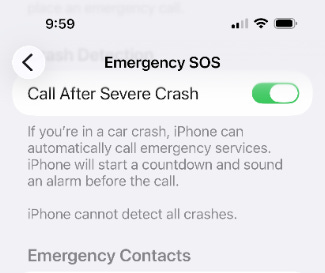
Apple’s own description of Crash Detection, in the iPhone’s setting: “If you’re in a car crash, iPhone can automatically call emergency services.
What a phone can say, and what it can’t
To understand why that alert is so strange, you have to know what an iPhone is actually able to tell the police.
There are exactly two ways an iPhone reaches emergency services from a place with no cell signal, and they work in completely different ways.
The first is Crash Detection. It’s automatic. A high-force accelerometer, a gyroscope, a barometer, GPS and the microphone work together to sense a violent impact. Apple’s own documentation is specific about what it’s looking for: severe car crashes — front-impact, side-impact, rear-end collisions and rollovers — involving sedans, minivans, SUVs, pickup trucks and other passenger cars. When it triggers, it sounds an alarm, gives you 20 seconds to cancel, then calls emergency services and plays a recorded message: you’ve been in a severe crash, here are your coordinates, here’s a search radius.
Crash Detection has no concept of an aircraft. It cannot count the people around you. It does not know what entrapment is. It reports a car crash, and nothing else.
Whatever reached the Vermont State Police on Monday, Crash Detection did not generate it.
That leaves one other path. Emergency SOS via satellite, available on iPhone 14 and later, designed for precisely the situation the hiker was in — no cellular, no Wi-Fi, nobody to call. And unlike Crash Detection, it does not sense anything at all.
It asks you.
The screen Apple won’t show you
Apple lets anyone rehearse the feature. Settings, Emergency SOS, Try Demo. It shuts off your cellular connection to simulate being off-grid, and it does not contact emergency services. We ran it, start to finish, more than once.
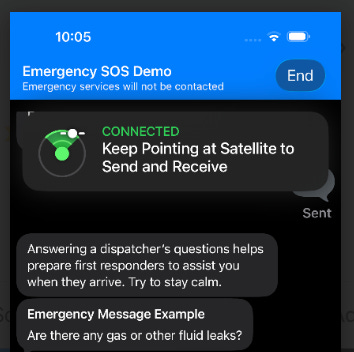
The demo previews an emergency questionnaire - a stack of choices, the first marked with a car icon. It’s the last you’ll see of them.
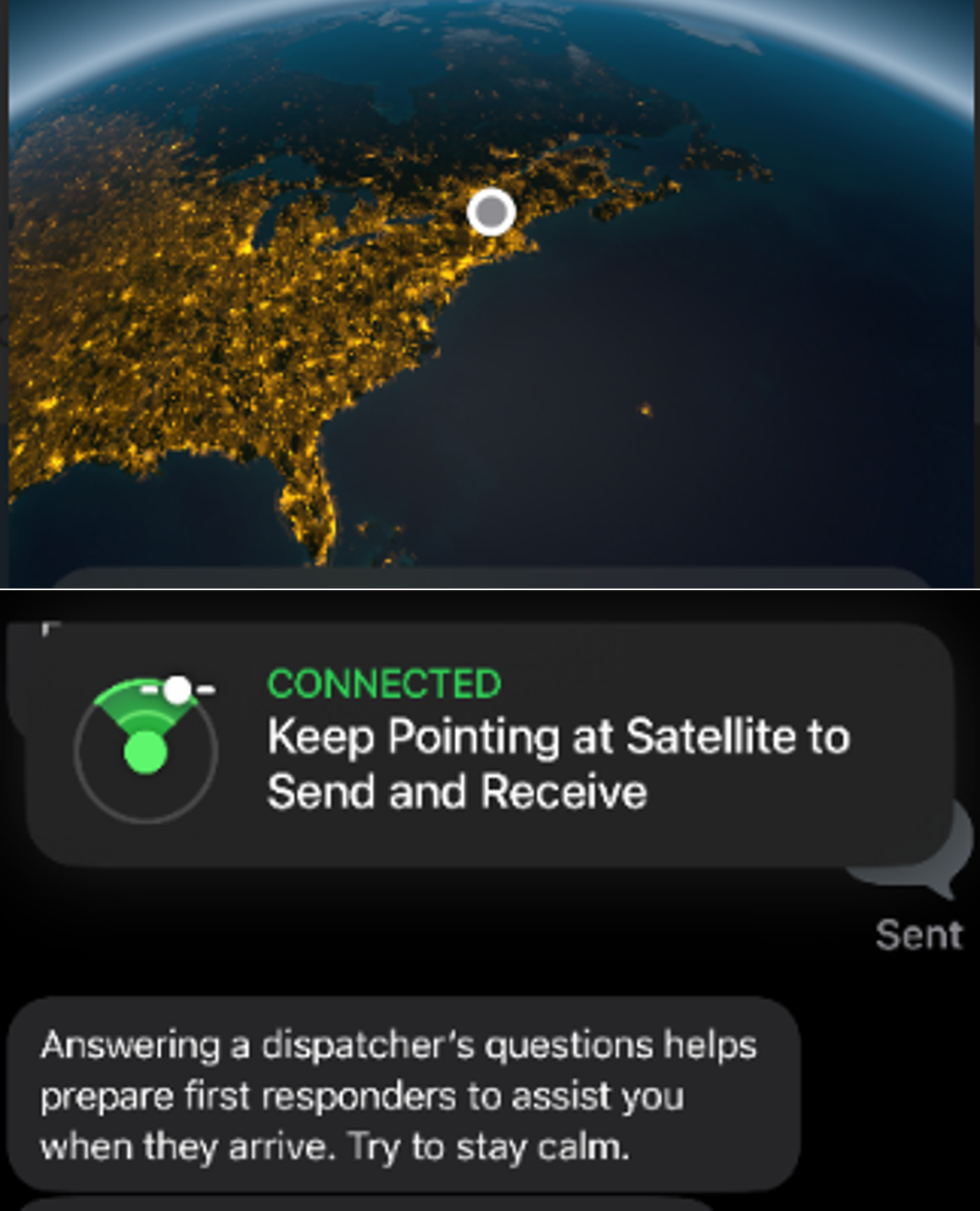
The demo takes you outside, has you point the phone at the sky, and finds a satellite. It warns that terrain, buildings and trees can block the connection — worth knowing on a mountain whose trails run under heavy canopy. It shows the link degrading mid-send, telling you to turn left to hold the signal.
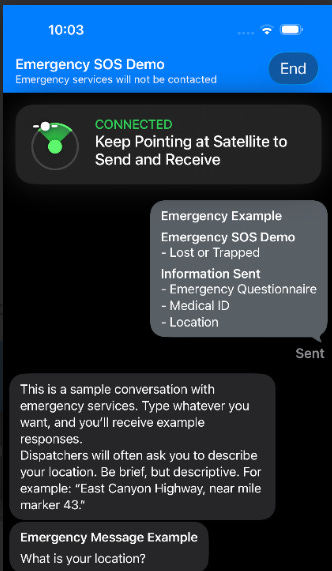
Then it transmits. And what it transmits is this:
What an iPhone sends to emergency services over satellite: a category, the emergency questionnaire answers, your Medical ID, and your location. In the demo, Apple fills in the category for you - “Lost or Trapped.”
Read that screen carefully. The phone sends your emergency questionnaire answers, your Medical ID, and your location.
The questionnaire is not something you type. It’s a series of menus you tap through — a category, follow-up questions, a description of what happened and who needs help. Those menu selections are what the police receive.
And here is what we could not learn: the demo never shows you those menus.
It fills in a category on your behalf — “Lost or Trapped” — and jumps straight to the transmission. We ran the demo to the end. We started it over. The questionnaire screens, the actual choices your phone offers when you are describing an emergency to the police, never appear.
Apple ships a rehearsal mode so Vermonters can practice the feature that might save their lives in the backcountry, and it hides the part where you say what’s wrong.
Compass Vermont wrote to Apple to ask whether the questionnaire includes an aircraft option, whether it can produce a report of multiple people and entrapment, and whether it can be completed without deliberate taps.
A member of Apple's public relations team responded and pointed to the company's published documentation, including its description of Crash Detection and its 2022 announcement of Emergency SOS via satellite. That announcement states that the feature "front-loads a few vital questions to assess the user's situation," and that the questionnaire and follow-up messages are relayed to centers staffed by Apple-trained specialists who can call for help on the user's behalf.
Apple did not answer Compass Vermont's specific questions about whether the questionnaire can generate an aircraft-emergency report, or whether it can be completed without deliberate user input.
Those are not a dispatcher’s words. They read like fields. A category — plane emergency. A count — multiple parties. A condition — entrapment.
Compare it to what Apple’s own demo transmits on your behalf: Lost or Trapped. The same vocabulary. The same structure. The same system.
The Vermont State Police told Compass Vermont they cannot say how the aircraft and occupant information in that alert was determined. They cannot say whether it came from the device or from a person.
Apple's own account of how the feature works matches what its demo transmits. In announcing Emergency SOS via satellite, the company said the iPhone "front-loads a few vital questions to assess the user's situation," and that those questionnaire answers are relayed onward to be acted on. The words the Vermont State Police received — a category, a count, a condition — are what that questionnaire produces.
And the man carrying the phone says it was zipped inside his backpack the entire time, in a place with no signal, untouched.
Those two things do not fit together. A satellite connection requires the phone to be pointed at open sky. A questionnaire requires selections. Somebody, or something, produced three fields of structured emergency information — and nobody in an official capacity can explain how.
How the professionals solved this fifty years ago
When an airplane actually goes down, it does not send a text message.
It sets off an Emergency Locator Transmitter — a beacon bolted into the aircraft, triggered by the force of impact. The beacon broadcasts on 406 MHz to an international satellite network, and encoded in that signal is a 15-character identifier that says what kind of beacon it is and, if registered, exactly which aircraft it belongs to and who owns it.
The signal reaches NOAA’s mission control center, which automatically matches that code against a federal registry and attaches the owner’s name, phone number and a description of the aircraft to the alert before passing it to the Air Force Rescue Coordination Center in Florida, which runs inland search and rescue for the lower 48 states.
And then — before anyone launches a helicopter — the rescue center calls the owner. The Federal Aviation Administration’s manual explains why in plain language: if the airplane turns out to be sitting safely in a hangar, an expensive ground or air search never happens.
That phone call is not a courtesy. It is load-bearing. In 2017, there were roughly 8,900 emergency beacon activations in that rescue center’s territory. Around 98 percent of them were false alarms. Only 122 were real. Aviation absorbs a 98 percent false-alarm rate without buckling, because every single alert arrives with a name and a number attached, and somebody picks up the phone and checks.
A cellphone alert arrives with none of that. No registry. No aircraft. No verified occupant count. Nothing to check it against.
The alert lands at dispatch, and then verification begins — by calling the phone that sent it.
On Mount Pisgah, that call could not go through. The phone was in a dead zone. Which is, of course, the only reason the satellite feature was available in the first place.
The system’s one safeguard fails in exactly the conditions the system is built for.
This has happened before, at smaller stakes
Vermont is not the first state to find out that a phone in a pocket can summon a rescue.
In January 2023, Summit County, Colorado, fielded 185 accidental Crash Detection calls in a single week, nearly all from skiers whose phones read a hard fall as a car wreck. The county’s emergency services director warned that the flood of false alarms risked desensitizing dispatchers and pulling resources away from real emergencies. Apple sent representatives to observe the dispatch center and later pushed software changes. Roller coasters have set it off too.
But those were false reports of something a phone can genuinely detect. Mount Pisgah is different. An alert saying an aircraft went down with multiple people trapped inside is a report of something a phone cannot sense, cannot verify, and — by Apple’s own documentation — has no automatic mechanism to produce.
What the State Police say now
Compass Vermont put eight written questions to the Vermont State Police about the device and the case. Did troopers examine the phone, or take the owner’s word? Did they review its emergency call log or its satellite message history? Was the owner cleared? Why was Apple never contacted, given that the Derby barracks has never before received an automated aircraft-emergency alert?
Public information officer Adam Silverman replied that he had no additional details to share, that VSP is not investigating further at this time, and that the agency would reevaluate if something arose that warranted it.
He added something else, and it deserves to be taken seriously:
It remains important that emergency personnel respond when VSP receives alerts like this from a mobile device, because there often can be a legitimate emergency that prompted the alert.
He’s right. That is the correct policy, and the response on July 13 was the correct response. When a report comes in that an aircraft is down with people trapped inside, you go. You do not sit at the barracks weighing the odds. Every agency that mobilized on Mount Pisgah did its job.
But that is exactly why the unanswered question matters. If Vermont will always launch on these alerts — and it should — then whether a consumer phone can generate a false one is not a technical curiosity. It is the whole question. And the state has decided not to ask it.
About the man with the phone
He has not been named. He has not been charged. He has not spoken publicly, and Compass Vermont has not sought him out.
The version of this story that traveled fastest — that a hiker dropped his phone off a cliff and the falling phone called in a plane crash — did not come from the Vermont State Police. It originated in a first-responder social media post and was picked up from there. The State Police account contradicts it. The man never lost possession of his phone.
He told police the device was in his backpack. Police have not said whether they verified that, and they have said they are not investigating further. That is the entire public record, and Compass Vermont is not going to embroider it.
What’s left
An iPhone told the State of Vermont that an airplane had crashed on Mount Pisgah with multiple people trapped inside. Eight agencies, three dozen responders, two drone teams and an Air National Guard helicopter answered that call. There was no airplane.
Apple’s documentation says the automatic system that could have generated it doesn’t do aircraft. The interactive system that could have generated it requires someone to tap through a menu — a menu Apple will not show you, even in the demo it built for you to practice on.
The Vermont State Police say they don’t know which happened. They have not asked the manufacturer. They are not going to look further.
Vermont has a great deal of country with no cell service, and every acre of it is a place where an emergency alert cannot be checked before the helicopters go up.
Somebody should be able to explain how a phone said “airplane.”
So far, nobody has.
Update, July 15: This story was updated after publication to reflect a response from Apple, received after it first went live. Apple pointed to its published documentation and did not address Compass Vermont's specific questions.
So here's a crazy thought (from someone who has employed some very talented and creative software developers in my dark past). It seems logical that the Apple development team would be striving for the iPhone to cover any possible scenario, including an airplane crash. The same developers who created the automobile crash capabilities may have built a prototype for the aircraft application and it somehow was left in the code that was released (not uncommon) but not turned off. One of the triggers might have been altitude (=mountain) or time at altitude, and another would have been a high g event (such as a fall or dropping the backpack on the ground for a rest break). Since the prototype software would not officially be included in the release, the product support people would not know about it and would sincerely deny its existence.
If it is something more sinister, the Norwich University Cybersecurity team might have some fun figuring it out.
This is more fun than another Wordle game. Thankfully, this was a false alarm and no responders were injured --chalk it up to a good drill.


So here's a crazy thought (from someone who has employed some very talented and creative software developers in my dark past). It seems logical that the Apple development team would be striving for the iPhone to cover any possible scenario, including an airplane crash. The same developers who created the automobile crash capabilities may have built a prototype for the aircraft application and it somehow was left in the code that was released (not uncommon) but not turned off. One of the triggers might have been altitude (=mountain) or time at altitude, and another would have been a high g event (such as a fall or dropping the backpack on the ground for a rest break). Since the prototype software would not officially be included in the release, the product support people would not know about it and would sincerely deny its existence.
If it is something more sinister, the Norwich University Cybersecurity team might have some fun figuring it out.
This is more fun than another Wordle game. Thankfully, this was a false alarm and no responders were injured --chalk it up to a good drill.
Strange days indeed.... Would love to know what Apple and Google have to say...