


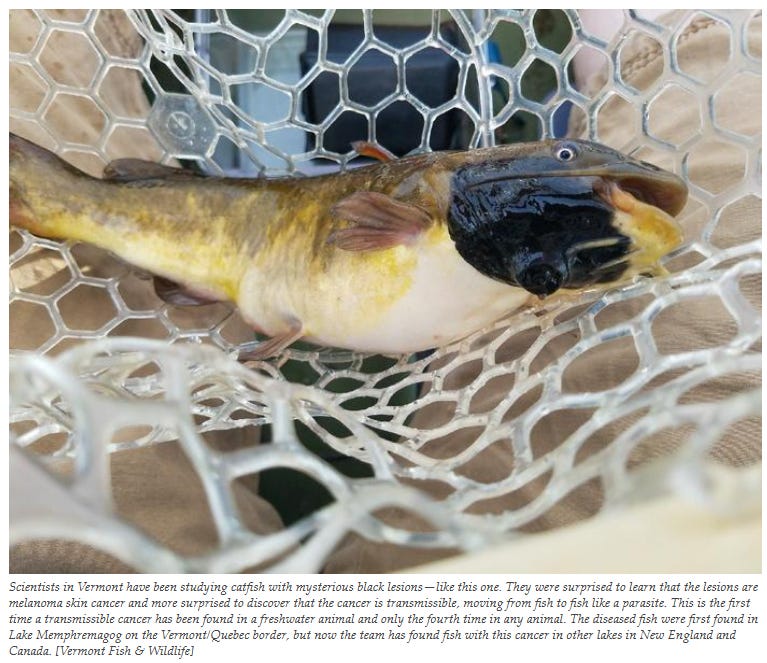
If you fish Lake Memphremagog, you have probably seen one. A brown bullhead — a catfish, what a lot of people around here still call a pout — with a raised black patch on its side, its head, its fins, sometimes in and around its mouth.
Anglers and biologists started reporting them in 2012. Depending on where in the lake you drop a line, somewhere between roughly a fifth and 40% of the adult bullhead have them.
A study published today in the journal Nature explains what they are. The answer is stranger than anyone expected, and it comes with a second finding that has gone almost unmentioned: this cancer did not start here.
First, the question you actually have
Can you eat the fish?
The researchers say the disease poses no known risk to people. In UVM’s announcement of the study, the team states that the cancer cells cannot infect or survive in another species and that the fish are safe to handle. The lake also supplies drinking water to more than 175,000 people, most of them across the border in Quebec, and the researchers say nothing about this affects that supply. The Nature paper itself is a genetics paper and does not take up human health at all.
So the scientific answer is no, you are not going to catch cancer from a catfish.
Here is the part that is harder to summarize. Vermont has no fish consumption advisory specific to Lake Memphremagog or to brown bullhead. The state’s waterbody-specific advisories cover lake trout in Lake Champlain, all fish in the Hoosic River, and several reservoirs on the Deerfield and Connecticut. Memphremagog bullhead have never been on that list. Statewide mercury guidance applies here as it does everywhere else in Vermont, but nothing addresses these fish or these tumors.
What anglers have instead is one scientist’s personal answer. In UVM’s announcement today, fish biologist Mark Henderson, one of the study’s authors, says of the affected fish: <cite index=”1-1”>”personally, I wouldn’t eat the ones with tumors.”</cite>
That is a biologist speaking for himself. No Vermont agency has told the public anything about eating these fish.
There is one concrete reason that gap matters, and it has nothing to do with the cancer being contagious to people. A separate study published in May in the Journal of Fish Diseases found that the diseased skin on these fish carries higher concentrations of seven metals than skin from healthy fish — including arsenic, a known human carcinogen, and zinc. That is a finding about lesioned skin, not about fillets. Nobody has published an assessment of what it means for a person eating the fish. That assessment is the thing that does not exist.
What is actually wrong with the fish
The black patches are melanoma — skin cancer.
That was the first surprise. Melanoma is the cancer we associate with too much sun, and the brown bullhead is a bottom-dwelling fish that spends its life away from sunlight.
The second surprise was much bigger. When the team sequenced the DNA, they expected to find each fish developing its own cancer from its own damaged cells. Instead, tumors from different fish turned out to be more closely related to each other than to the fish carrying them — in the mitochondrial DNA, in single-letter changes across the nuclear genome, and in large-scale structural rearrangements. All three lines of evidence pointed the same way.
That means the cancer is not starting over in each animal. It is one cancer, descended from a single original fish, spreading from animal to animal, with the tumor cells themselves acting as the infection. It behaves less like a tumor and more like a parasite.
The team also screened every sample for viruses and other microbes and found nothing associated with the tumors. That matters, because the obvious alternative explanation — a virus causing cancer in fish after fish — is the one they were able to rule out.
Only three others like it are known anywhere in the animal kingdom: a facial tumor in Tasmanian devils, a venereal tumor in dogs, and a leukemia-like disease in clams, mussels, and other bivalves. This is the first ever found in a fish, and the first in fresh water.
There is a historical footnote worth the space. In the early 1900s, a researcher studying black tumors on brown bullhead in a Massachusetts pond managed to produce small tumors in healthy fish by exposing them to tumor cells. He concluded something contagious was at work but could not identify what. More than a century later, this study identifies it: the cells were the contagion.
The work was led by Emily Curd and Julie Dragon of the University of Vermont, with Mark Henderson of UVM’s Rubenstein School, Matthew Bodnar, Tom Jones, and Peter Emerson of the Vermont Fish and Wildlife Department among the authors. Collections were made under the auspices of Fish and Wildlife.
It did not start here
This is the finding most likely to get lost, and it is the one with the most consequence for the Northeast Kingdom.
When the researchers compared the tumor DNA against healthy bullhead from around the region, the tumor lineage did not match Memphremagog fish. It sat closer to reference fish sampled in New Hampshire and Maine. The study’s conclusion is direct: the cancer lineage originated outside Lake Memphremagog.
It also predates 2015. Tissue collected that year, reanalyzed for this study, already carries the same clonal signature.
That reorders the local debate. For a decade, the working assumption was that something in the lake was causing the cancer. A leading hypothesis in the scientific literature was that flooding from Tropical Storm Irene in 2011 degraded water quality enough to trigger it. The genetics do not support that. The cancer was not created here by local conditions. It arrived, and then it spread fast — from not being present at any notable level before 2012 to roughly 30% of the lake’s bullhead by 2015.
The landfill question
Which brings up the question most people around Newport will ask second.
The Coventry landfill — Vermont’s only operating landfill, run by the Casella subsidiary NEWSVT — sits above South Bay, next to the Black River, which feeds the lake. It has drawn organized opposition for years from Don’t Undermine Memphremagog’s Purity on the Vermont side and Memphremagog Conservation Inc. in Quebec.
Be precise about what today’s paper does and does not say. The Nature study never mentions the landfill. It is a genetics paper, and it does not test water, sediment, or contaminants.
What it establishes is that this cancer is an inherited lineage from a founder fish somewhere outside the lake, not damage caused to Memphremagog fish by something in Memphremagog. That is a strong reason to look elsewhere for the cause, and it is stronger evidence than anything offered before.
Separately, in UVM’s announcement, the researchers say directly that they see no evidence pointing to the landfill, and give their reasons: the diseased fish are spread across the full 32 miles of the lake rather than clustering near the landfill; they appear in bullhead populations within the lake that do not breed with one another; the team’s water testing found pollutant levels comparable to other lakes in the region, including Lake Champlain, where this cancer has not been found; and as sampling expanded, the disease turned up in ponds and lakes in Vermont, New Hampshire, Maine, and New Brunswick, some of them clean water nowhere near a dump.
The distinction that is going to get lost this week
None of this concludes that the landfill is not affecting the lake. It concludes the landfill did not cause this cancer. Those are two different questions with two different bodies of evidence, and this research only answers the first.
The second question is still very much open. The landfill collects roughly a million gallons of leachate — the liquid that drains through buried garbage — every month. Since 2019, treating or disposing of that liquid anywhere in the Memphremagog watershed has been restricted under a condition attached to the Act 250 permit that approved the landfill’s 51-acre expansion, Land Use Permit series 7R0841. The leachate goes to treatment plants in Montpelier and Plattsburgh, New York, instead.
How long that restriction lasts is not clear from the public record. Memphremagog Conservation Inc. has described it as running to January 1, 2024, after which treated leachate could return to the watershed. In January, the Newport Daily Express reported that the Agency of Natural Resources had extended it indefinitely. In March, VTDigger quoted Rep. Larry Labor, R-Morgan, describing a five-year moratorium that would soon expire. The permit condition itself would settle it, and it has not been published.
The rest is firmer. Casella has run a system at the site since September 2023 to strip PFAS out of the leachate, with its formal pilot phase set for the second quarter of this year. In January, the Environmental Court ruled that making that system permanent requires an amended Act 250 permit, sending it before the District 7 Environmental Commission. A bill that would have banned landfill waste discharge into Lake Memphremagog outright, H.652, was introduced January 13 by Rep. Woodman Page, R-Newport City, referred to the House Committee on Environment, and never voted out.
Fourteen years of sampling
Most of this was built in public, a piece at a time.
YearWhat was found2012Anglers and biologists report black growths; not seen at notable levels before this2014–1723–37% of sampled bullhead affected2015Liver tumors in 8% of fish sampled; none at a comparison pond. Tissue from this year, reanalyzed later, already carries the clonal signature2020Lab work confirms malignant melanoma spreading into muscle and boneMar 2020State holds a public meeting on the lesions; cause unknownMay 2025State committee minutes record the contagious-tumor idea as under investigationMay 2026Lakewide survey finds 18–42%; the disease also turns up in Maine and New HampshireJul 2026DNA sequencing confirms one cancer spreading between fish, originating outside the lake
Worth noting: the contagious-tumor idea appears in the minutes of a Vermont Department of Health committee more than a year before it was published, raised by Matthew Bodnar, who is among the authors of today’s paper.
What nobody knows yet
How it spreads. The study lays out the candidates without settling on one. The disease has not been documented in fish younger than breeding age, which points at spawning — bullhead crowd together in shallow water to breed, and that contact could pass cells along. Bullhead are also scaleless bottom-dwellers in constant contact with sediment, which could carry cancer cells between fish the way seawater is thought to carry the bivalve version. Weakened immune systems, from pollutants or from the hormonal swings of spawning season, could make fish easier to infect. None of this is established.
Where it came from, and what else it is in. The lineage traces outside the lake, but the study cannot yet say where or when it began. Other transmissible cancers range from decades old in Tasmanian devils to thousands of years old in dogs. Black tumors on brown bullhead have been reported for over a century, and whether those were this same lineage is unknown.
What arsenic has to do with it. This is not part of today’s paper. Separately, the researchers have said the map of where this cancer appears roughly tracks the map of naturally occurring arsenic in New England soils, which runs high through the Northeast Kingdom and into Maine. Whether arsenic weakens fish enough for the cancer to take hold, or is simply along for the ride, is unresolved. It is a finding about fish. It is not a statement about arsenic in Vermont wells, which is a separate and long-documented issue.
What it does to the fish population. The other transmissible cancers run the whole range. The Tasmanian devil version has driven a 90% decline and threatens extinction. The dog version usually regresses on its own. Bivalve populations persist despite it, with some localized die-offs. Heavily diseased Memphremagog bullhead live for years. The study is explicit that the effect on bullhead numbers here is currently unclear, and calls this the time-sensitive question.
What to watch
Whether the Department of Health takes up guidance for Memphremagog bullhead now that the cause is known, and whether it treats a fish tumor with no human transmission route as an advisory trigger at all. There is no announced timeline for that decision.
Whether containment becomes a management question. The study raises the possibility that spread to new waters — naturally or with human help — may eventually need to be limited. Nothing has been proposed, but this is the finding with the most direct implications for how people move boats, bait, and fish between Vermont waterbodies.
What the 7R0841 permit condition actually says about the leachate restriction, and whether it is a fixed date, a permanent bar, or conditional on treatment. Compass will report the term once the permit language is confirmed.
The District 7 proceeding on the leachate treatment system, and whether either side puts this study into that record.
Whether a successor to H.652 is introduced next biennium.
Where else this turns up. The authors’ own read is that transmissible cancers may be considerably more common than assumed, in fish and elsewhere — we have not been looking for them.
Sources for this piece are linked in the text. Additional documents: Act 250 Land Use Permit series 7R0841; the H.652 legislative record.