


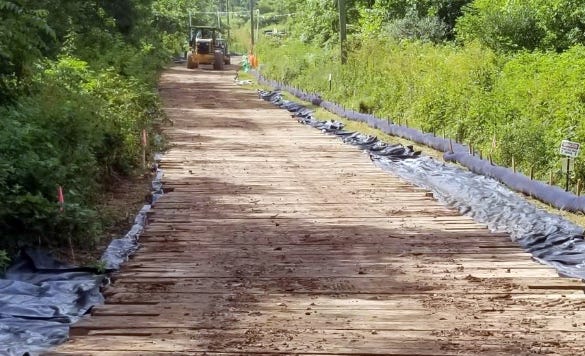
The Vermont Department of Forests, Parks and Recreation (FPR) is partnering with logging contractors to put up to 60 newly-built hardwood crane mats into each qualifying logger’s hands at $45 apiece — roughly ten percent of what a comparable mat costs on the commercial market — under a first-come, first-served cost-share program funded by a U.S. Forest Service grant.
Applications are due May 30 (the press release date; the FPR program page lists May 31). Mats are expected to be ready for pickup by July 1, 2026 at storage locations specified in the application packet.
To qualify, an applicant must earn 51 percent or more of their annual income from timber harvesting, sign a cost-share agreement with the State, and obtain a free Unique Entity Identifier through SAM.gov. Applications are available on the FPR website or by emailing Watershed Forestry Specialist Silas Rainville at silas.rainville@vermont.gov.
Each subsidized mat will measure 16 feet long, 4 feet wide, and 8 inches thick, and will be built from hardwood cants (squared-off timbers cut from logs at the sawmill).
What a crane mat is
A crane mat — also called a swamp mat, timber mat, or bridge mat — is a thick wooden platform laid across soft, wet, or sensitive ground to spread the weight of heavy equipment. The mats are bolted together with steel rod through dense hardwood timbers and are designed to be laid temporarily, picked up after the job, and moved to the next site.
Commercial crane mats of similar dimensions typically retail in the range of several hundred dollars apiece, with industry suppliers advertising standard 8-inch-thick hardwood mats and used inventory across a broad price range depending on species, grade, and location. The $45 contribution required from Vermont applicants reflects what the State describes as ten percent of total mat cost.
Why they matter on a Vermont logging job
Vermont logging operations are governed by the Acceptable Management Practices for Maintaining Water Quality on Logging Jobs in Vermont — the “AMPs” — first adopted in 1987 and most recently revised effective August 11, 2018, under authority of 10 V.S.A. § 1259(f) and Act 64 of 2015. The AMPs are designed to prevent sediment, petroleum products, and woody debris from entering Vermont’s waters.
The AMPs apply to every logging operation on every acre of public and private land in Vermont, regardless of purpose — commercial timber harvest, residential lot clearing, or utility right-of-way. A landowner or logger who chooses not to implement the AMPs and whose operation negatively affects state waters can face enforcement action and penalties under Vermont’s water pollution control statutes.
Sediment is the primary water pollutant associated with logging. Proper implementation of the AMPs helps absorb and disperse runoff, retain soil nutrients, filter sediment, and prevent fluctuations in water temperature.
Crane mats address one of the most difficult AMP scenarios: operating heavy equipment on wet, soft, or seasonally saturated ground without rutting the soil, compacting it past recovery, or creating channels that concentrate runoff into nearby streams or wetlands. Mats spread the load, reduce ground pressure, and — when used at landings, on skid trails crossing soft ground, or as decking on temporary stream crossings — keep tracked or wheeled equipment off the soil itself.
“Crane mats play a key role in minimizing impacts during timber harvests by reducing soil compaction and preventing erosion,” FPR Watershed Forester Dave Wilcox said in the announcement. “This program makes it possible for loggers to follow best practices for water quality at minimal cost.”
One piece of a broader assistance framework
The Crane Mat Cost-Share Program is one of several tools FPR’s Watershed Forestry Program offers logging contractors to meet AMP requirements without absorbing the full equipment cost themselves. The agency also administers a Skidder Bridge Cost Share Program — for both wooden and steel temporary bridges, funded through State Clean Water funds — and a temporary skidder bridge rental program, along with the SLoCAMP cost-share initiative for landowners.
Funding for the crane mat program comes from a U.S. Forest Service grant, making this a layered federal-state-industry arrangement: federal dollars subsidize the equipment, state foresters administer the program and verify eligibility, and Vermont logging contractors deploy the mats on jobs governed by state water quality rules.
The full application and storage location list are available on the FPR Crane Mat program page at fpr.vermont.gov.